Stop Fighting the Bar: Try the Landmine Hip Thrust Instead
I used to dread glute day, and it wasn't because of the burn. It was the logistics. There is nothing more frustrating than trying to roll a barbell loaded with 45-pound plates over your shins while your sweat makes the bar slip off your hip bones. I’ve spent more time adjusting foam pads and chasing rolling bars than actually training. If you are tired of the setup friction, the landmine hip thrust is the hack that finally makes heavy glute work feel like a workout rather than a construction project.
Quick Takeaways
- Eliminates the 'barbell roll-out' struggle by using a fixed pivot point.
- The arc of the bar follows the natural path of your hips better than a vertical path.
- Significantly more stable for single-leg variations.
- Requires a landmine attachment or a sturdy corner and a piece of carpet.
Why I Stopped Wrestling With the Barbell on Glute Day
The standard barbell hip thrust is a logistical nightmare in a home gym. You need a bench that doesn't slide, a bar, specific plates high enough to roll over your legs, and a thick pad to keep from bruising your pelvis. Even with a dedicated setup, the bar loves to tilt. If your left glute is 5% stronger than your right, that bar is going to dip, making the set feel clunky and uneven.
I realized I was spending five minutes setting up for a 45-second set. In a garage gym where time is limited, that friction is a motivation killer. I started looking for a way to get the same heavy loading without the balancing act. Anchoring the bar into a landmine attachment changed everything. It stays where you put it, it doesn't roll away, and the weight distribution feels locked in from the first rep to the last.
What Makes the Landmine Hip Thrust Different?
When you use a free barbell, the weight moves in a strictly vertical line. But your hips don't actually move that way—they move in a slight arc. Because the landmine is anchored at one end, the bar travels in a natural curve that matches your hip extension perfectly. This biomechanical 'cheat code' often feels much more comfortable on the lower back.
Another huge win? Padding. Since the bar is fixed on a pivot, it doesn't exert the same 'crushing' pressure directly down onto your pubic bone. I’ve found I can go heavy with just a folded towel or a thin sleeve instead of those massive, bulky foam pads that make you feel three feet tall on the bench. It’s a more intimate connection to the weight, which usually leads to a better contraction.
The Landmine Glute Bridge vs. The Full Thrust
If you're short on equipment, you can perform a landmine glute bridge directly on the floor. It’s a shorter range of motion, but it’s great for pure isolation and requires zero setup. However, to get the most out of this movement, you want to elevate your shoulders. Using a dedicated Gxmmat Hip Thrust Bench or a standard weight bench allows your hips to drop lower, giving you that deep stretch at the bottom that triggers more muscle growth.
The Ultimate Fix for Unilateral Work
Single-leg work is where the landmine really shines. If you’ve ever tried a one-legged thrust with a standard bar, you know it’s a circus act. Your Single-Leg Barbell Hip Thrust Is a Balancing Nightmare (Fixed) when you realize that the landmine provides lateral stability. You aren't fighting to keep the bar from tipping left or right; you are only fighting the weight itself.
This stability allows you to actually reach failure on the muscle rather than ending the set because you lost your balance. I’ve found that my mind-muscle connection on the 'weak side' improved drastically once I didn't have to worry about the bar sliding off my lap and onto the garage floor.
Mastering the Landmine Single Leg Hip Thrust
To perform the landmine single leg hip thrust, position yourself perpendicular to the bar. The collar of the bar should rest in the crease of your working hip. Plant your foot firmly—I prefer a slightly outward toe angle—and drive through your heel. Keep your chin tucked and your core braced to avoid over-arching your lower back at the top.
If you find that the balance is still a bit tricky, you might consider a regression. Why I Replaced Single-Leg Work With the B-Stance Hip Thrust is a great read if you want to keep the unilateral focus but need a 'kickstand' foot for a bit more grounding. It’s a middle ground that still torches the glutes without the wobbles.
Gear Check: Setting This Up in Your Garage
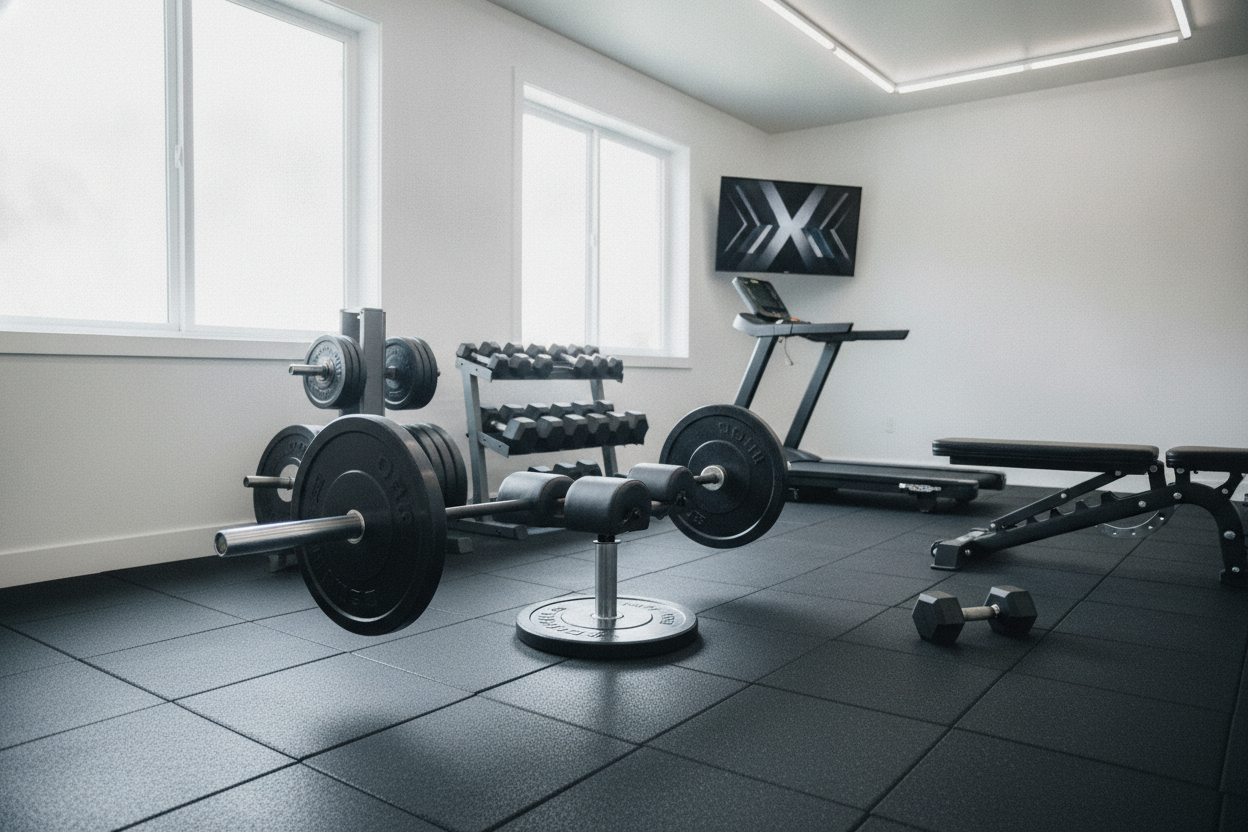
You don't need a fancy rig for this. A standard 7-foot Olympic bar and a landmine sleeve are the basics. If you don't have a landmine attachment bolted to your rack, you can shove the end of the bar into a corner—just wrap it in a heavy towel or use a tennis ball to save your drywall. For plates, I recommend bumpers. They have a wider diameter which makes the starting height more consistent, and they won't clank as much when you set the bar down between sets.
Personal Experience: My Biggest Mistake
When I first started doing these, I positioned the bar too high up on my stomach. Big mistake. The bar needs to sit right in the hip crease. I also tried to use a 35-lb bar thinking it would be easier to maneuver, but the shorter sleeve length actually made the arc feel choppy. Stick to a full-sized 45-lb bar for the best leverage and smoothness.
FAQ
Do I need a special bar for landmine hip thrusts?
No, any standard Olympic bar works. Just ensure your landmine attachment is secure. A 7-foot bar provides a better arc than a shorter 5-foot bar.
Is this better for high reps or heavy weight?
It works for both, but the landmine excels at moderate to high reps (8-15) where you can really focus on the squeeze at the top without the bar shifting around.
Will this damage my barbell?
As long as you use a proper landmine sleeve or a padded corner, your bar will be fine. Just avoid metal-on-metal contact at the pivot point to prevent scratching the finish.