Stop Chasing Failure on Every Muscular Strength Exercise
I remember the night I almost wore a 315-lb barbell as a necklace. I was alone in my garage, chasing that one last, ugly rep because some influencer told me failure was the only way to grow. My back arched like a frightened cat, my heels left the floor, and the bar barely touched the pins. It was a garbage rep. Pushing every muscular strength exercise to the point of physical collapse is a fast track to a physical therapist's office, not a PR.
Quick Takeaways
- Technical failure means the set ends when your form breaks, not when your muscles die.
- Grinding out 'ugly reps' trains your brain to use bad mechanics under load.
- Leaving 1-2 reps in the tank (RPE 8-9) is the sweet spot for long-term power.
- A stable, non-slip base is the most underrated factor in force production.
The Lie of 'No Pain, No Gain' in the Home Gym
We have been conditioned to believe that if we aren't gasping for air on the floor, we didn't work hard enough. That might fly for a high-intensity interval circuit, but it is absolute poison when you want to exercise muscular strength. Strength is a skill. It is about your nervous system learning to recruit every available muscle fiber to move a heavy object from point A to point B. When you grind out a rep that looks like a seizure, you aren't building strength; you are practicing failure.
Think about the mechanics of a heavy deadlift or a 250-lb bench press. The moment your form deviates, the load shifts from your prime movers—the muscles meant to handle the weight—to your joints and connective tissue. A 'pump' feels good, but chasing it through exhaustion during a muscular exercise usually means your smaller stabilizer muscles have already clocked out, leaving your spine or shoulders to do the heavy lifting. I have seen guys brag about a 400-lb squat that had so much 'butt wink' I thought their pelvis would snap. That isn't strength. That is an ego check waiting to happen.
Technical Breakdown vs. Complete Collapse
Technical failure is the exact moment your form is no longer 'textbook.' If you are performing the best exercise for leg strength and your knees start to cave inward on the ascent, you have reached technical failure. The set is over. It does not matter if you have the 'willpower' to stand it up. The moment your hips rise faster than your chest, the quality of that muscular strength workout has plummeted.
Complete collapse, on the other hand, is what you see in those 'gym fail' compilations. It is the point where the muscle literally cannot contract another time. While bodybuilders use this for hypertrophy (muscle size), it is counterproductive for pure force. If you are training in a 3-to-5 rep range with 85% of your max, every rep needs to be a masterpiece. If the fourth rep is a struggle and the fifth is a prayer, you should have stopped at four. Your central nervous system remembers the last rep you did. Do you want it to remember a perfect, powerful movement or a shaky, desperate struggle?
The 3 Warning Signs Your Set is Over
You need to be your own coach, especially when training solo. Watch for these three cues during your next muscular strength work out:
- The Speed Shift: If the bar slows down significantly—I am talking about a noticeable 'sticking point' that lasted more than a second—your nervous system is redlining.
- The Breath Break: If you lose your 'brace' and start leaking air, or if you find yourself gasping mid-rep, your core is no longer protecting your spine.
- The Position Shift: This is common in overhead presses or rows. If you start using momentum (a little leg drive on a strict press) or if your 'stack' (shoulders over hips) breaks, rack the weight.
Using the right strength training accessories, like a 10mm lever belt or high-quality lifting straps, can help you maintain this 'stack' longer, but they aren't a license to ignore these warning signs. They are tools to keep your form locked in, not crutches to help you grind out trash reps.
Rebuilding Your Routine Without the Ego
To really get strong, you have to stop caring about how many reps you *could* do if your life depended on it. Start using the RPE (Rate of Perceived Exertion) scale. For most of your heavy work, you should stay at an RPE 8. That means you finish the set knowing you could have done two more perfect reps. This feels 'easy' to the ego, but it is where the real gains happen. It allows you to recover faster and hit the gym again in 48 hours rather than being sidelined for a week with a 'tweaked' lower back.
If you find that you are consistently hitting failure at low weights, it might be time to upgrade your strength equipment. A cheap, 1-inch standard bar with no knurling will slip in your hands, causing you to lose focus on your form. Moving to a 20kg Olympic bar with a 28mm diameter and aggressive knurling allows you to grip the bar with confidence, meaning technical failure comes from your muscles, not a slippery bar. When the equipment matches the intensity, you can actually measure your progress accurately.
Why Your Floor Space Dictates Your Power
You cannot fire a cannon from a canoe. If you are trying to generate maximum force on a floor that is slippery, uneven, or too soft (like thick carpet or cheap foam tiles), you are bleeding power. Your brain is smarter than you; if it senses an unstable base, it will literally 'throttle' your muscular output to prevent you from falling over. This is why many people find their strength plateaus in a home gym setting.
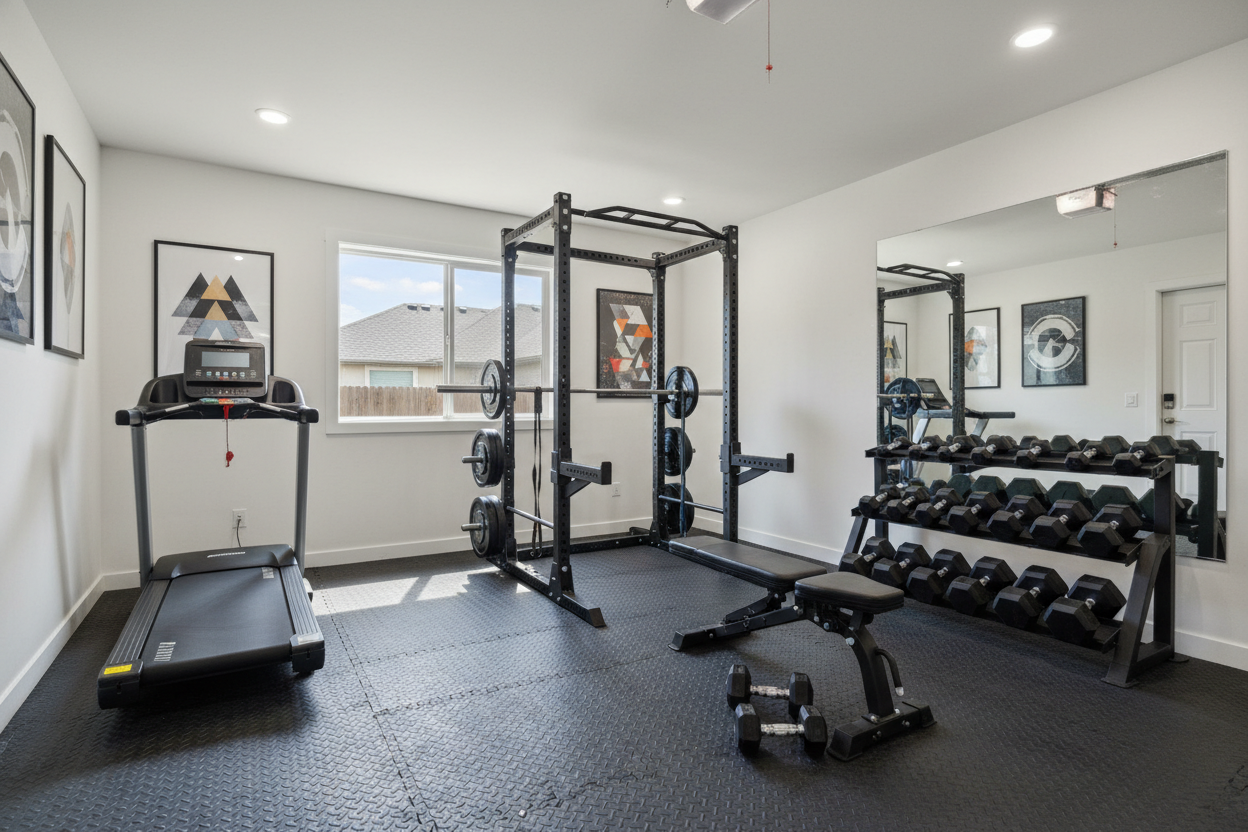
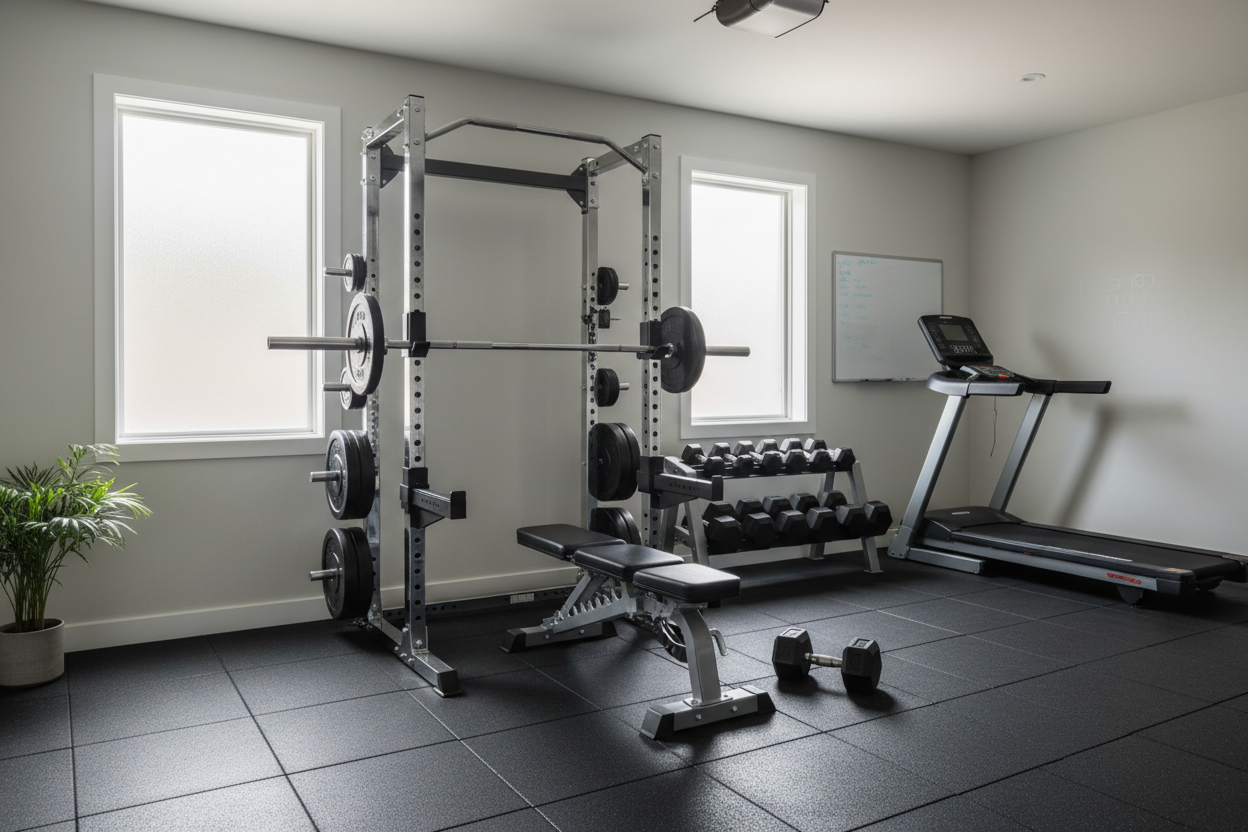
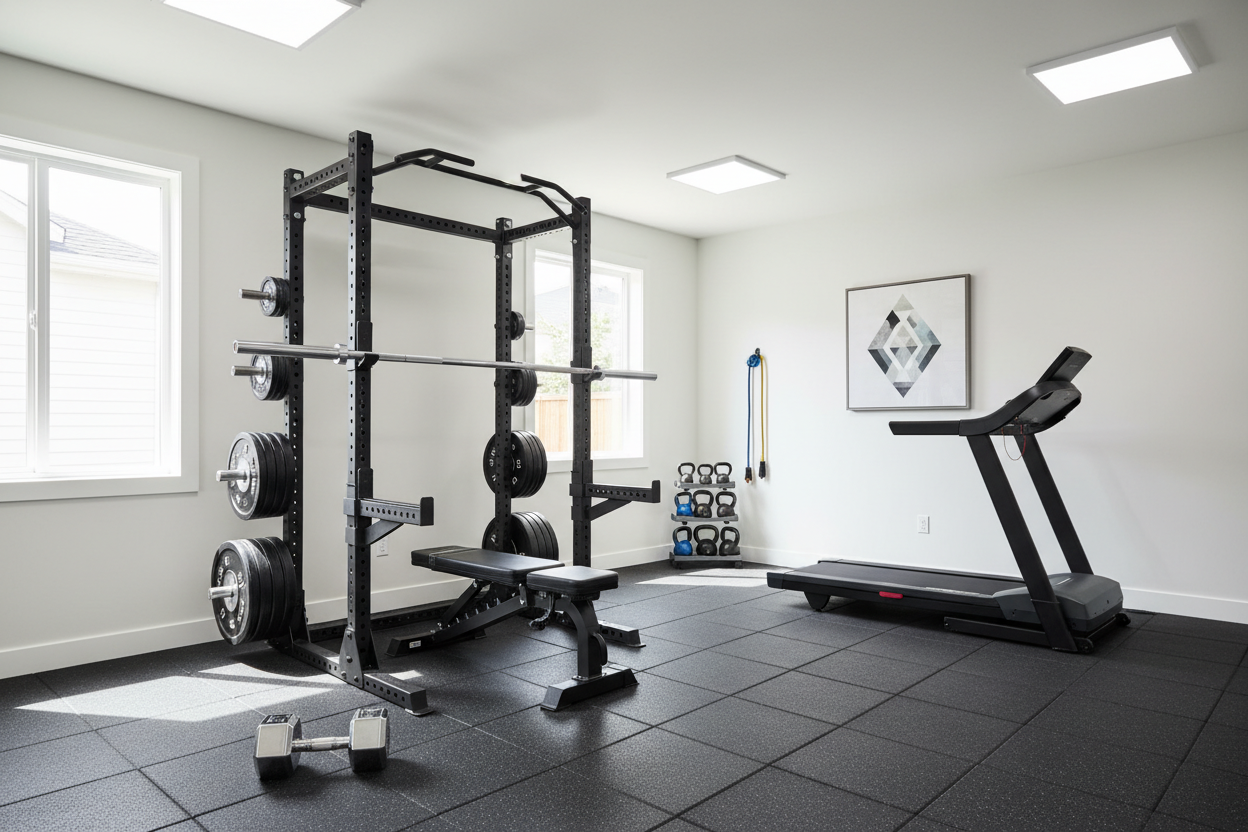
A dense, high-quality home gym flooring solution is a requirement for heavy lifting. I prefer a 6x8ft space because it fits a standard Olympic bar with room to spare. When your feet are glued to the floor, you can drive through your heels and maintain the 'joint stacking' required for a safe, heavy lift. A 7mm to 10mm rubber mat provides enough compression to protect the subfloor but enough density to keep your ankles from rolling. If your feet are sliding, your form is breaking, and your strength is stalling.
Personal Experience: The 405-lb Wake-Up Call
A few years back, I was obsessed with hitting a four-plate squat. I hit 385 for a double and it felt 'okay.' Instead of stopping there, I loaded 405. The first rep was a grind. My knees buckled, my chest dropped, but I got it up. Instead of racking it, I went for a second. I hit the hole, my form completely collapsed, and I had to dump the bar onto the safeties. I spent the next three weeks on a heating pad with a strained QL. I didn't get stronger that day; I got weaker because I couldn't train for nearly a month. Now, I stop the moment the bar speed drops. My total has gone up 50 pounds since I stopped 'testing' my max every week and started 'building' it.
FAQ
Is training to failure ever okay?
Yes, but usually on isolation moves like bicep curls or lateral raises where the risk of injury is low. For big compound lifts, avoid it.
How do I know if my form is breaking?
Record your sets. What feels like a 'slight lean' often looks like a total collapse on video. Compare your first rep to your last; they should look identical.
Does technical failure build muscle?
Absolutely. You are still putting the muscle under immense tension. You're just doing it without destroying your joints.