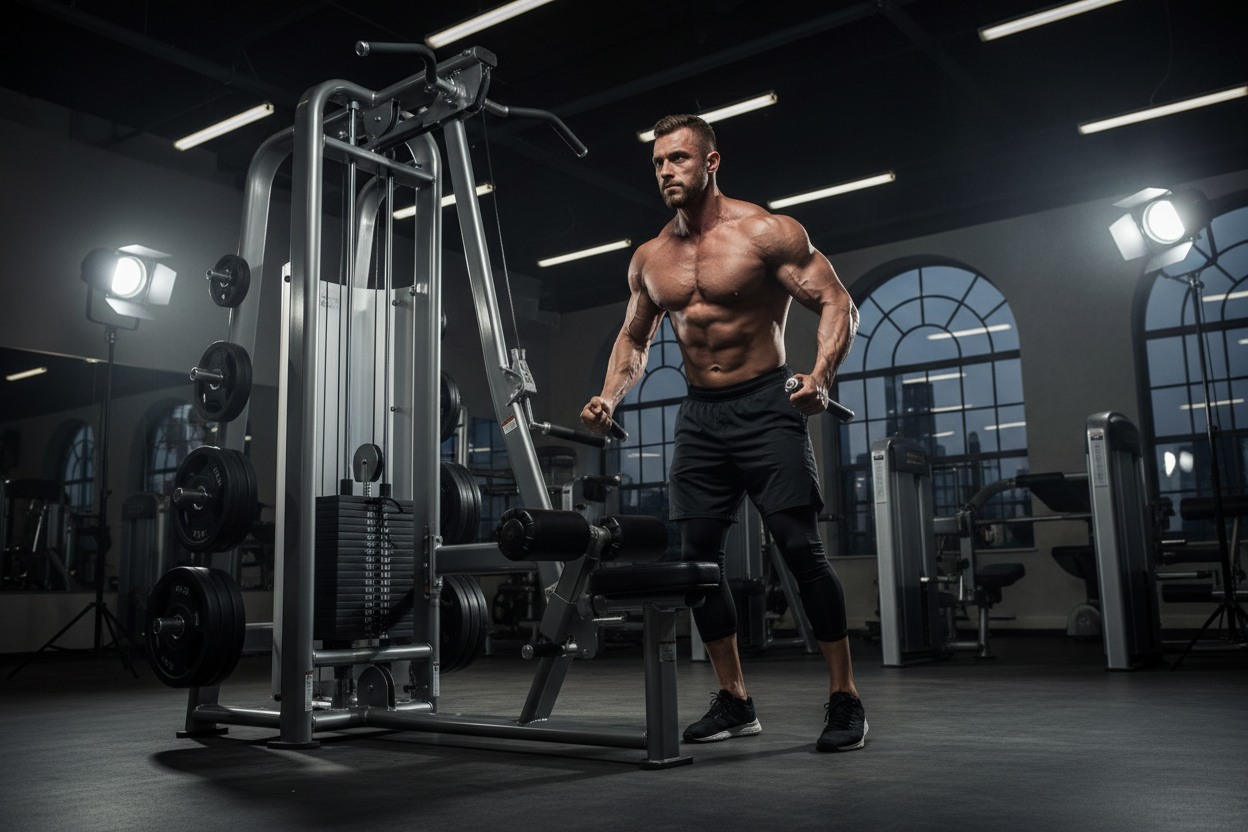
Standing Bench Press Machine: The Chest Builder You're Ignoring
Walk into any commercial gym on a Monday, and you’ll see a line forming behind the flat bench. It’s the gold standard for ego lifting, but it isn't always the best tool for hypertrophy or athletic performance. If you want to unlock functional pushing power without wrecking your rotator cuffs, you need to look at the **standing bench press machine**.
This piece of equipment removes the artificial stability of a back pad. It forces you to ground yourself, engage your core, and press with intent. It changes the geometry of the push, often saving your shoulders while torching your pecs.
Key Takeaways
- Functional Carryover: Unlike lying down, standing mimics real-world pushing mechanics used in sports and daily life.
- Core Integration: Without a seat back, your abs and obliques must work overtime to prevent you from falling backward.
- Shoulder Safety: The standing position allows for free scapular movement, reducing the risk of impingement common with flat benching.
- Versatility: It allows for unilateral (one-arm) pressing to fix muscle imbalances.
Why Get Off Your Back? The Mechanics Explained
The traditional bench press locks your scapula (shoulder blades) against a pad. While this provides a stable base for moving massive weight, it’s not how your body naturally moves. When you punch, push a car, or block an opponent, your shoulder blades glide along your ribcage.
A standing chest press machine facilitates this "scapulohumeral rhythm." By standing up, you are engaging a kinetic chain that starts at your feet, travels through your hips, stabilizes in the core, and expresses force through the hands. This is often referred to as "ground reaction force."
The "Stand Up" Factor
Many lifters refer to this as a stand up bench press machine. The name implies the benefit: you are fighting gravity and horizontal resistance simultaneously. If you don't brace your core, the weight stack will push you backward. This creates an anti-extension stimulus for your abs that a seated press simply cannot match.
Proper Form: Don't Just Push
Using this machine isn't as intuitive as sitting down and pushing handles. Your setup dictates your success.
1. The Stance
You have two options here: parallel or staggered (split stance). For heavy loads, the staggered stance is superior. Place your dominant leg back and your non-dominant leg forward. This widens your base of support and prevents the weight from knocking you off balance.
2. The Lean
Don't stand perfectly upright. Establish a slight forward lean—about 10 to 15 degrees. This engages your body weight into the press and aligns the pectorals directly against the line of force.
3. The Elbow Path
Keep your elbows tucked at roughly 45 degrees relative to your torso. Flaring them out to 90 degrees puts unnecessary stress on the shoulder capsule. Drive the handles forward and slightly inward, focusing on squeezing the chest at peak contraction.
Common Mistakes Killing Your Gains
The most frequent error I see is "hip shooting." This happens when the weight is too heavy, and the lifter jerks their hips forward to generate momentum. This kills the chest isolation and shifts the load to the lower back.
Another issue is shrugging. Keep your shoulders depressed (down away from your ears). If you shrug while you press, you are shifting the tension from the pecs to the upper traps and neck.
My Training Log: Real Talk
I want to be transparent about my first few sessions with the standing bench press machine (specifically a plate-loaded Jammer arm setup). I went in with an ego, loading it up with the same weight I used for seated presses.
Big mistake. The moment I unlocked the arms, I felt my heels lift off the ground. The machine was pushing me around, not the other way around. I had to strip two plates off immediately.
The specific thing nobody tells you is the friction—or lack thereof—on the floor. I was wearing older runners with worn-out soles, and my back foot kept sliding on the gym matting every time I hit the concentric (pushing) phase. I actually had to chalk the bottom of my shoe to get traction. Once I fixed my footing and dropped the weight, the pump in my upper pecs was unlike anything I'd felt on a flat bench. It feels less like a "lift" and more like a "fight" against the weight.
Conclusion
The standing press shouldn't replace your standard bench entirely, but it belongs in your rotation. It bridges the gap between raw strength and functional athleticism. Start light, focus on that ground connection, and respect the mechanics.
Frequently Asked Questions
Does the standing bench press machine build as much muscle as the flat bench?
It builds muscle differently. While you may not move as much absolute load due to stability demands, the standing press offers a greater range of motion and superior peak contraction, which is excellent for hypertrophy, particularly in the inner chest.
Is this machine better for people with shoulder injuries?
Generally, yes. Because your shoulder blades are free to move naturally rather than being pinned against a bench, there is less stress on the rotator cuff. The standing position also usually forces a more neutral grip, which is safer for the shoulder joint.
Can I use the standing chest press for power development?
Absolutely. This movement is ideal for explosive power. Athletes often use it to train for blocking or punching power by performing the concentric (pushing) portion of the lift as fast as possible.