Squats With Weights Exercises: The Definitive Guide for 2024
You don't need a barbell or a power rack to build impressive lower body strength. In fact, relying solely on fixed machines or heavy back squats often leads to muscle imbalances and neglected stabilizer muscles. This is where mastering squats with weights exercises becomes a game-changer for your training program.
Many lifters underestimate the humble dumbbell, assuming it can't provide enough stimulus for leg growth. They are wrong. When executed with precision, free-weight squat variations challenge your core, improve your mobility, and induce significant hypertrophy.
Key Takeaways
- Hypertrophy Potential: Yes, dumbbell squats build muscle effectively by increasing time under tension and range of motion.
- Grip Variety: Utilizing different holds (Goblet, Suitcase, Front Rack) shifts the bias between quads, glutes, and core.
- Unilateral Benefits: Squatting with weights often allows for easier transition into single-leg work, fixing strength asymmetries.
- Safety: Dumbbells are generally safer than barbells for solo training as they are easier to bail on if you hit failure.
Do Squats With Dumbbells Work?
Before we look at the mechanics, we need to address the skepticism: can dumbbell squats build muscle effectively? The answer is a definitive yes, but the mechanism is slightly different from a barbell back squat.
With a barbell, the load is axial (on the spine). With dumbbells, the load is often held in the hands or on the shoulders. This places a higher demand on the upper back and core to maintain an upright posture. While you might not move as much absolute weight, the muscular tension required to stabilize the load makes do dumbbell squats work a rhetorical question. They absolutely do, provided you push close to failure.
How to Squat Properly With Dumbbells
Learning how to squat properly with dumbbells starts with your stance and grip. Unlike a barbell squat, your center of gravity shifts depending on where you hold the weight.
The Setup and Hold
Figuring out how to hold a dumbbell when squatting is the first hurdle. For beginners, the Goblet hold is superior. Cup the top head of one dumbbell with both palms against your chest. This forces your torso upright and allows for a deeper range of motion.
For the dumbbell squat front (holding two dumbbells), clean the weights to your shoulders. One end of the dumbbell should rest on your shoulder while your elbows point forward. This is known as the front rack squat with dumbbells.
The Descent
Set your feet shoulder-width apart. Initiate the movement by breaking at the hips and knees simultaneously. Keep your chest proud. If you are doing a dumbbell parallel squat, aim to get your hip crease level with your knee. However, because dumbbells act as a counterweight, you can often squat deeper than parallel safely.
Essential Variations
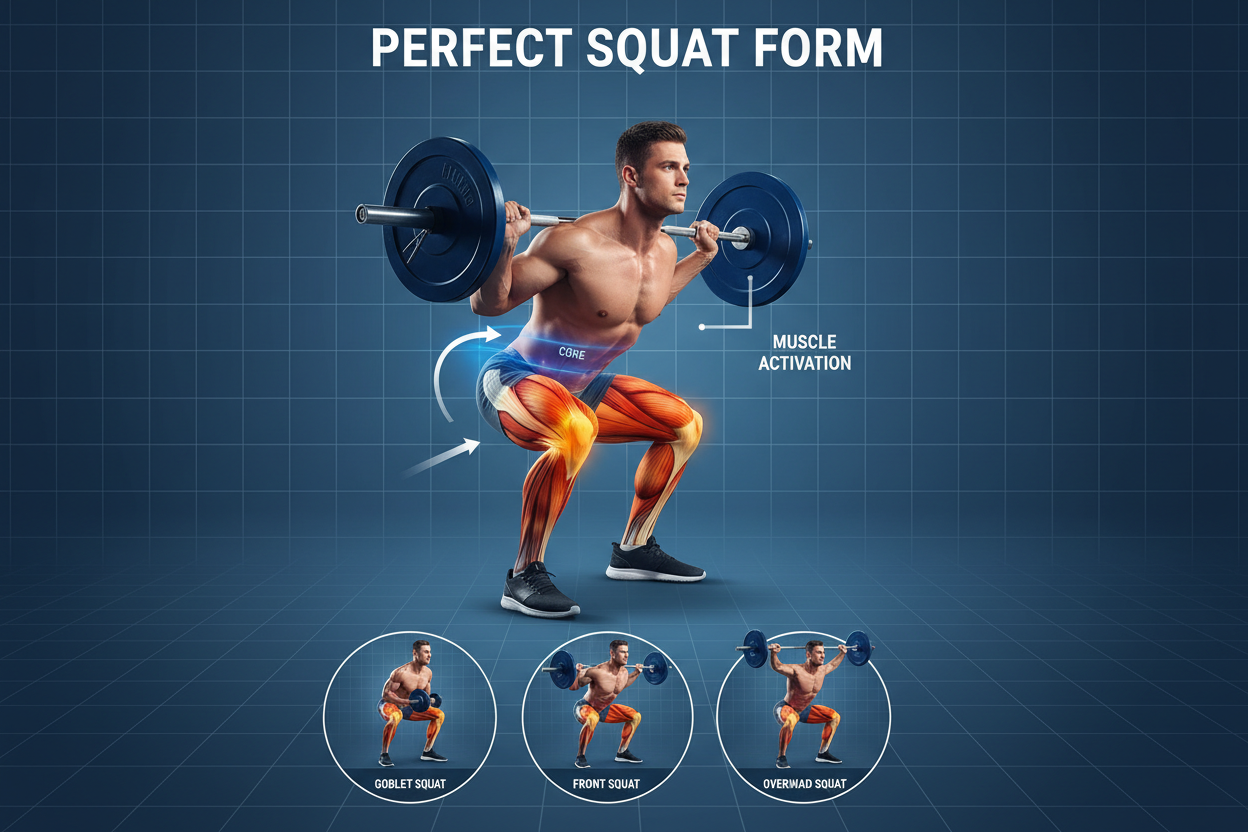
1. The Goblet Squat (Squat With 1 Dumbbell)
This is the gold standard for learning how to squat with one dumbbell. It teaches you to keep your chest up and prevents the lower back from rounding. It is excellent for high-rep metabolic conditioning.
2. The Two-Dumbbell Front Squat
When you need to load heavier, you switch to two weights. Learning how to squat with two dumbbells in the front rack position significantly challenges your thoracic extension (upper back strength). This variation mimics the barbell front squat but is more wrist-friendly.
3. Suitcase Squat vs Front Squat
The suitcase squat vs front squat debate comes down to goals. In a suitcase squat, you hold the dumbbells at your sides with arms fully extended (like carrying groceries). This reduces the load on your upper back but heavily taxes your grip strength and traps. It is essentially a deadlift-squat hybrid.
4. Single-Arm Variations
Understanding how to do squats with one dumbbell held on just one side (offset loading) is a secret weapon for core strength. The weight tries to pull you sideways; your obliques must fight to keep you upright. This is functional strength training at its finest.
Programming: Sets, Reps, and Loading
Since grip strength is often the limiting factor, your dumbbell squats sets and reps should be adjusted. Low reps (1-5) are difficult because holding heavy dumbbells is awkward.
Instead, focus on hypertrophy and endurance ranges:
- Muscle Growth: 3-4 sets of 8-12 reps.
- Endurance/Metabolic Stress: 3-4 sets of 15-20 reps.
If you are wondering how to squat heavy with dumbbells without your hands giving out, use lifting straps. This eliminates grip fatigue and lets your legs do the work.
My Training Log: Real Talk
I want to be honest about the limitations here. A few years ago, I didn't have access to a gym for three months, just a pair of adjustable dumbbells maxing out at 90lbs. I thought, "Great, I'll just do heavy dumbbell front squats."
Here is the grit no one tells you about: cleaning 90lb dumbbells up to your shoulders is a workout in itself. The first time I tried it, I exhausted my lower back just getting the weights into position. Furthermore, the knurling on the handles dug into my palms so hard that by rep 6, I wasn't stopping because my quads were tired—I stopped because my hands were numb and my rhomboids were on fire.
I learned the hard way that when you go heavy with dumbbells, you need to wear a thick shirt or hoodie to cushion the dumbbells resting on your shoulders, and you absolutely need lifting straps for the suitcase variations. The "wobble" you feel in your knees when doing these unilaterally is humbling, but that stability creates bulletproof joints.
Conclusion
Dumbbell squats are not a regression from the barbell; they are a necessary progression for athletic development. Whether you are doing a dumbbell squat hold for time or performing dynamic reps, these exercises expose weaknesses that barbells hide. Grab the weights, secure your grip, and drop deep.
Frequently Asked Questions
What are walking squats with dumbbells?
Walking squats with dumbbells (often called lunges or walking lunges, though technically different) involve stepping forward into a squatting pattern. However, a true walking squat involves performing a squat, taking a lateral step in the bottom or top position, and squatting again. This increases time under tension and lateral hip stability.
How do I squat heavy with dumbbells if I can't lift them to my shoulders?
If you cannot clean the weights for a heavy dumbbell front squat, you have two options. First, use the suitcase variation where the weights stay at your sides. Second, place the dumbbells on a raised surface (like a plyo box or bench) so you can get under them without cleaning them from the floor.
Do squats with dumbbells work the same muscles as barbell squats?
Yes, but with different emphasis. Do squats with dumbbells work the quads? Absolutely. However, because the load is often anterior (in front of you), they recruit more upper back and core stabilizers compared to a back squat, while placing slightly less compressive force on the lumbar spine.