
Sissy Squat: How to Do It Safely for Bigger Quads
Quick answer: To do a sissy squat, hold a rack upright for support, rise onto the balls of your feet, and lean back while pushing your knees forward, keeping your hips extended so your body forms a straight line from knees to shoulders. Lower until your knees are well bent, then straighten back up. Because the hips stay locked, the movement isolates the quads, especially the rectus femoris. It's demanding on the knee joint, so start with bodyweight, a partial range and support: 3 sets of 8–12 reps.
Key takeaways
- Hips locked, knees forward: the opposite of a regular squat.
- Heels lift as you lean back.
- Quad isolation with just body weight.
- Hold something for balance until you're strong and confident.
- Knee pain? Use a leg extension or other sissy squat alternatives.
Muscles worked
| Muscle | Role |
|---|---|
| Rectus femoris | Works hard because the hips stay extended |
| Vastus lateralis, vastus medialis, vastus intermedius | Straighten the knee |
| Core and hip flexors | Hold the straight body line |
| Calves | Balance on the balls of the feet |
Unlike most squats, the glutes and hamstrings do little here. That's what makes the sissy squat a quad isolation movement.
How to do a sissy squat
- Standing position: stand next to a rack upright or sturdy post, feet about hip to shoulder width, holding the support with one hand.
- Rise onto the balls of your feet.
- Lean back while driving your knees forward and down. Keep your hips extended so there's a straight line from your knees to your shoulders; don't bend at the hips.
- Lower under control as far as is comfortable, building up to your knees nearly touching the floor.
- Pause briefly.
- Return by straightening your knees and bringing your torso upright.
Common mistakes
| Mistake | Fix |
|---|---|
| Bending at the hips | Squeeze glutes; keep hips locked in a straight line |
| Going too deep too soon | Start with a partial range |
| No support | Hold a rack until you have the balance |
| Dropping fast | Lower over 2–3 seconds |
| Heels flat | Let the heels rise; stay on the balls of your feet |
Is the sissy squat bad for your knees?
It places a lot of stress on the knee joint because the knees travel far forward under load. Healthy knees can adapt with a gradual build-up, but if you have knee pain, a knee injury or recent surgery, skip it or ask a professional first. Start with a short range of motion, bodyweight only, and plenty of support.
Sissy squat progressions
| Level | Variation |
|---|---|
| 1 | Assisted partial sissy squat, both hands on the rack |
| 2 | Assisted full-range sissy squat, one hand on the rack |
| 3 | Heels elevated on a plate for extra stability |
| 4 | Unassisted sissy squat |
| 5 | Weighted: hold a plate at the chest, or wear a weighted vest |
A sissy squat machine or bench locks the feet in place for extra stability, but the bodyweight version with a rack works just as well at home.
Sissy squat alternatives
| Alternative | Why |
|---|---|
| Leg extension | Isolates the quads with adjustable load and support |
| Heels-elevated goblet squat | Quad-focused with less knee stress |
| Leg presses | Heavy quad loading with back support |
| Reverse Nordic | Kneeling quad stretch-strength move |
| Front squat | Upright torso and more quads |
| Pistol squats | Single leg strength and balance |
Guides: goblet squat, front squat, pistol squat progression and are leg extensions bad for your knees?
Sets, reps and where to use it
| Level | Sets × reps |
|---|---|
| Beginner | 2–3 × 8–10 assisted, partial range |
| Intermediate | 3 × 10–15 full range |
| Advanced | 3 × 8–12 weighted |
Place sissy squats after compound lower body exercises, as a finisher. Twice a week is plenty.
Sample quad-focused workout
| Exercise | Sets × reps |
|---|---|
| Front squat or goblet squat | 4 × 6–10 |
| Walking lunges | 3 × 10 per leg |
| Leg extension | 3 × 12–15 |
| Sissy squat | 2 × 10–12 |
Guide: walking lunges.
Sissy squats at home
- Support: hold the upright of a G5, V6 or X6 power rack.
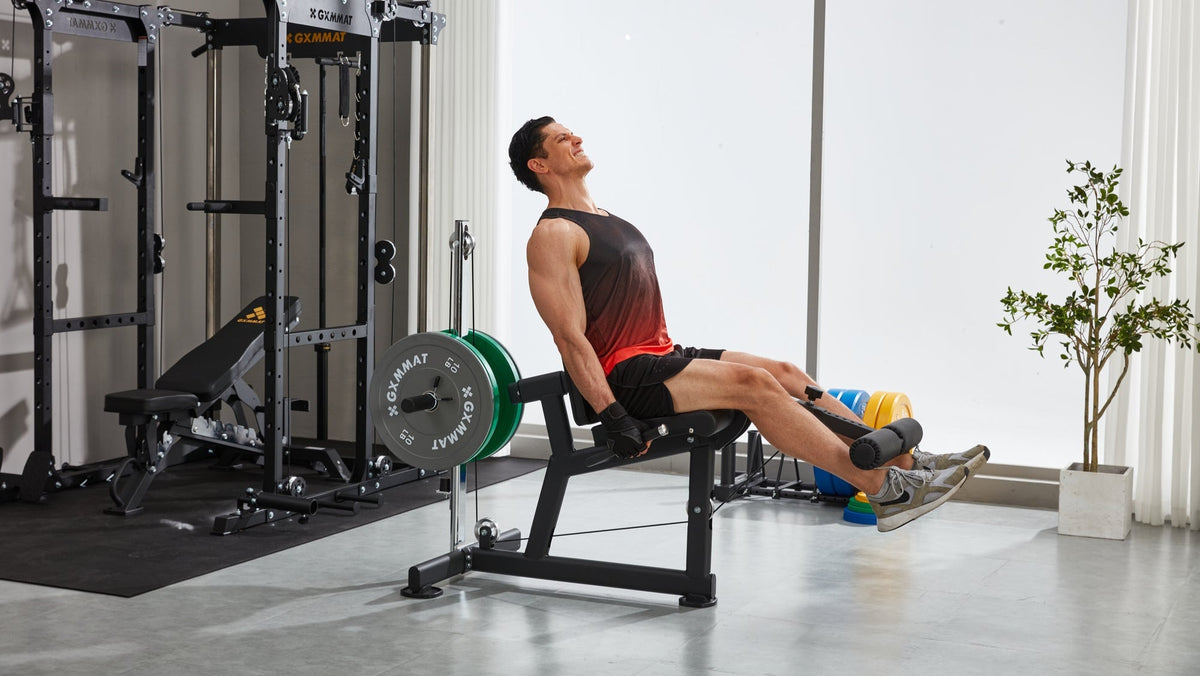
- Quad isolation with adjustable load: the GXMMAT leg extension machine, a plate-loaded station for leg extensions.
- Heel lift and load: a change plate under the heels, or a bumper plate held at the chest.
- Floor: a non-slip large exercise mat.
FAQ
What muscles do sissy squats work?
Mainly the quads, especially the rectus femoris, with the core and calves stabilizing.
Are sissy squats bad for your knees?
They're demanding on the knees. Build up gradually with support and a partial range, and avoid them if you have knee pain or injury.
Why is it called a sissy squat?
The name is usually traced to Greek mythology, not to how easy it is. It's one of the harder bodyweight leg exercises.
Can I do sissy squats without a machine?
Yes. Hold a rack or sturdy post for balance.
How many sissy squats should I do?
Start with 2–3 sets of 8–10 assisted reps and build to 3 sets of 10–15.
Written by Yuvien Royer for GXMMAT. This article is general fitness information, not medical advice.


