Signs of Gaining Muscle Female: Body Recomposition Markers, Strength Progress, and Home Workout Setup
When starting or progressing through a consistent resistance training program, identifying the physical markers of progress can sometimes feel confusing. For female lifters, tracking adaptations often involves navigating mixed signals from standard bathroom scales, shifts in clothing fit, and evolving workout capacities. Understanding the distinct signs of gaining muscle female lifters experience helps clarify whether physical changes stem from developing lean mass or fluctuations in body fat.
Understanding Body Recomposition and Female Muscle Growth
Body recomposition refers to the simultaneous process of building lean contractile tissue while reducing or managing body fat levels. Unlike simple weight loss, which focuses strictly on driving down the number on a scale, recomposition changes how mass is distributed across the frame. Because muscle tissue is structurally denser than adipose tissue, gaining lean mass reshapes the silhouette, alters physical density, and increases strength without always creating a large shift in scale weight.
For women, muscle development happens progressively through mechanical tension, adequate recovery, and consistent resistance stimulus. Recognizing how these adaptations present in day-to-day life helps maintain training momentum without over-relying on isolated metrics.
Key Signs of Gaining Muscle for Women
Muscle growth reveals itself through performance improvements, tactile changes in tissue firmness, and visible shifts in posture and frame shape. Paying attention to these diverse signals provides a clear overview of body recomposition.
Strength and Performance Increases During Workouts
One of the earliest and most reliable indicators of muscle hypertrophy is progressive strength development. When working muscles adapt to resistance, lifting familiar weights begins to feel lighter, movement paths feel more controlled, and the ability to perform additional repetitions increases. Even before noticeable visual changes emerge, experiencing smoother transitions during compound movements like squats, hinges, and presses indicates that the muscular system is adapting positively to training demands.
Changes in Clothing Fit and Body Contours
Shifts in how garments drape over the body offer a practical gauge of muscle development. Developing muscle along the back, shoulders, glutes, and quadriceps often causes tops and pants to fit more securely across structural areas while feeling looser around the natural waistline. For example, structured lower-body programming detailed in a dedicated building muscles that guide illustrates how glute and leg training reshapes lower-body contours while waistbands become roomier.
Muscular Density, Posture, and Daily Energy
Gaining muscle changes the resting firmness of tissue. Contractile muscle tissue feels solid and firm to the touch, both during exercise and at rest. Additionally, strengthening major supporting muscle groups along the posterior chain, core, and upper back naturally improves static standing and sitting posture. Everyday activities, such as lifting heavy household items or climbing stairs, require noticeably less exertion as baseline muscular efficiency increases.
How to Tell Muscle Growth from Fat Gain
Distinguishing between lean tissue gains and increases in body fat is a common question during body transformation phases. Monitoring both quantitative measurements and physical characteristics helps differentiate the two.
Scale Weight Fluctuation vs. Body Composition
A standard scale measures overall body mass, including water retention, glycogen storage, digestive content, fat mass, and muscle mass. When beginning resistance training, muscles frequently store additional glycogen and water to support repair and adaptation, which can cause temporary spikes or plateaus on the scale. A flat or slightly rising scale accompanied by a tighter waistline and enhanced muscle definition generally points toward lean muscle growth rather than body fat accumulation.
Tracking Strategies: Circumference Measurements and Progress Photos
Relying on multiple evaluation tools provides a more accurate view of progress than standard weighing alone. Useful methods include:
- Tape measurements: Tracking circumference at consistent landmarks—such as the shoulders, chest, narrowest part of the waist, hips, and mid-thigh—reveals localized composition shifts.
- Consistent progress photos: Taking photos under identical lighting, angles, and times of day highlights gradual changes in muscle outline and definition.
- Performance logs: Recording weights, sets, and repetitions across training blocks objectively confirms physical capability gains.
Supporting Muscle Adaptation Through Structured Upper and Lower Body Training
Achieving balanced muscle development requires engaging both upper and lower muscle groups with structured movement patterns. Incorporating pushing, pulling, squatting, and hinging movements ensures that muscle growth is distributed evenly across the entire frame. For lifters focusing on balanced torso development, following a structured building female muscles guide helps target upper-body strength and posture alongside lower-body routines.
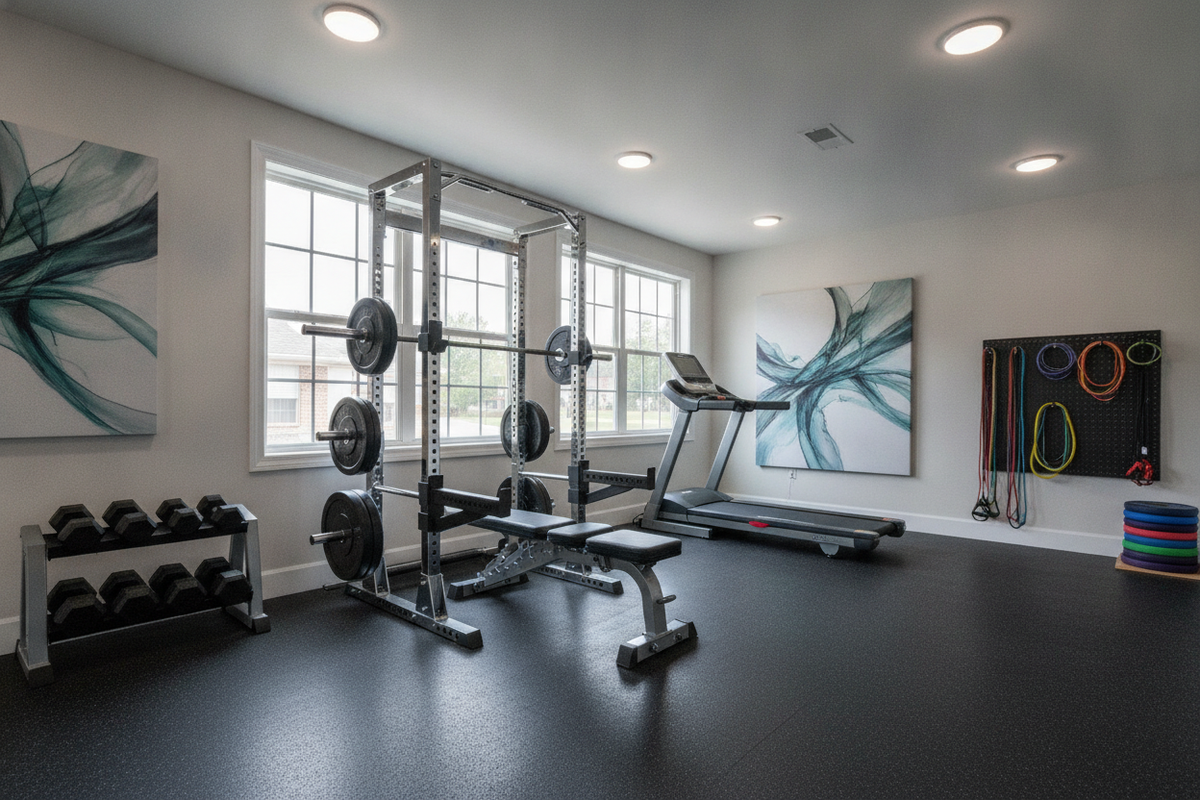
Home Training Floor Setup for Heavy Loading and Joint Stability
Developing muscle requires progressive loading, which means training spaces must accommodate heavier weights and dynamic movements safely. Setting up a dedicated workout surface with dense, non-slip gym flooring is essential for maintaining stability during heavy squats, lunges, and overhead presses.
High-density mats protect subfloors from dropped dumbbells or kettlebells while offering firm traction underfoot. Unlike soft yoga mats, dense flooring provides a firm foundation that prevents foot slippage and supports proper joint alignment under load. Pairing appropriate flooring with foundational equipment found in a comprehensive building muscle weight guide creates a safe, reliable environment for ongoing strength gains.
Common Misconceptions About Women's Muscle Growth
Several persistent myths often create hesitation around resistance training for women:
- Fear of becoming accidentally bulky: Building noticeable muscle mass requires dedicated long-term training, progressive overload, and sufficient caloric support. Muscle gain occurs gradually, allowing lifters to shape their routine to their personal goals.
- Expecting linear scale decreases: Muscle tissue adds density, meaning physical leanness can increase even if total body weight remains unchanged.
- Impatience with visual changes: Neural strength gains typically precede visible hypertrophy. Consistent training over several months is the key driver of noticeable aesthetic changes.
By monitoring performance increases, tracking non-scale markers, and maintaining a stable home training space, female lifters can confidently recognize and sustain long-term muscle growth.