
Side Glute Muscles Guide: Functional Anatomy, Movement Categories, and Home Floor Setup
Understanding the Side Glute Muscles: Functional Roles and Anatomy
The side glute muscles form the outer contour of the hip and provide essential support for lower-body biomechanics. This lateral hip group primarily consists of the gluteus medius, gluteus minimus, and the tensor fasciae latae (TFL). While the larger gluteus maximus handles powerful hip extension, these smaller muscles stabilize the pelvis whenever you stand, walk, or balance on a single leg. To see how these structures interact across full-body routines, explore our glute muscles guide.
Functionally, the lateral glute complex is responsible for hip abduction—moving the thigh outward away from the midline—as well as internal and external rotation of the hip joint. When these muscles lack adequate conditioning, the pelvis can drop or tilt excessively during dynamic movements, placing uneven stress on the knees, lower back, and ankles. Targeted training strengthens these stabilizers to build balanced hips and improve everyday movement mechanics.
Why Traditional Squats Miss the Side Butt Muscles
Many lifters rely on back squats, front squats, and lunges as their primary hip builders. While these compound exercises recruit the gluteus maximus, they operate almost entirely in the sagittal plane (forward and backward movement). As a result, the side butt muscles receive relatively low active recruitment during standard linear lifts.
The side booty muscles require frontal plane movement (side-to-side) and transverse plane control (rotational resistance) to engage fully. Relying solely on standard squats can leave the outer hip stabilizers understimulated. Incorporating dedicated lateral movements creates balanced muscle recruitment across all hip planes, rounding out your overall lower-body training.
Core Movement Categories for At-Home Lateral Glute Training
Building an effective routine for the side glute muscles does not require complicated machinery. Structuring exercises into three primary categories ensures comprehensive coverage across multiple joint angles:
- Side-Lying Abduction Drills: Movements such as side-lying leg raises, clam shells, and side-lying hip circles isolate the lateral glute without requiring balance against gravity. These drills allow you to concentrate on deliberate muscle contraction and control.
- Quadruped Rotational Lifts: Exercises performed on hands and knees, including fire hydrants and quadruped rainbow leg arcs, combine hip abduction with rotational control. These drills challenge pelvic stabilization while keeping spinal loads minimal.
- Standing Lateral Dynamic Patterns: Lateral band walks, skater taps, curtsy lunges, and single-leg hip hikes introduce weight-bearing demand. These dynamic patterns force the stabilizing hip to work against gravity while supporting full body weight.
Key Form Cues and Alignment Checkpoints for Maximum Engagement
Targeting the side butt muscles requires precision. Because the hip flexors and lower back frequently compensate for weaker lateral stabilizers, keeping strict form is critical:
- Slight Internal Rotation: During lateral leg raises, point your toes slightly downward or keep the foot parallel to the floor rather than turning the toes toward the ceiling. This rotation places mechanical focus directly on the gluteus medius rather than the anterior hip flexors.
- Maintain a Neutral Pelvis: Avoid arching the lower back or hiking the hip upward toward the ribcage during abductions. Keep the core braced and the pelvic bowl level throughout the lift.
- Controlled Eccentric Lowering: Resist the urge to let gravity drop the leg back to the starting position. Lowering the leg with deliberate control increases time under tension and reinforces joint stability.
For more insights on establishing a consistent mind-muscle connection during hip exercises, check our butt glute guide.
Structuring an At-Home Routine for Balanced Glute Development
An effective home program balances activation drills with progressive resistance. You can apply various loading strategies without heavy weights by adjusting tempos, adding isometric pauses, or utilizing resistance loop bands. For a broader look at progressive tension strategies, review our booty glute guide.
Consider organizing your training into distinct phases within a single workout session:
- Activation Phase: Begin with 1 to 2 sets of high-repetition, low-load drills (such as side-lying clams or band abductions) to prime the side booty muscles and establish neural focus.
- Dynamic Strength Phase: Progress to standing lateral movements (such as lateral lunges or resisted lateral walks) using moderate resistance and deliberate eccentric control.
- Burnout or Finisher Phase: Conclude with isometric holds or tempo-focused quadruped lifts to fully fatigue the lateral glute stabilizers.
Home Gym Floor Setup: Cushioning Pressure Points and Ensuring Lateral Grip
Floor-based exercises place direct pressure on sensitive contact points, particularly the outer hip bone (greater trochanter), elbows, and knees during side-lying and quadruped movements. Performing these exercises on hard tile or hardwood floors can cause discomfort that distracts from proper movement execution.
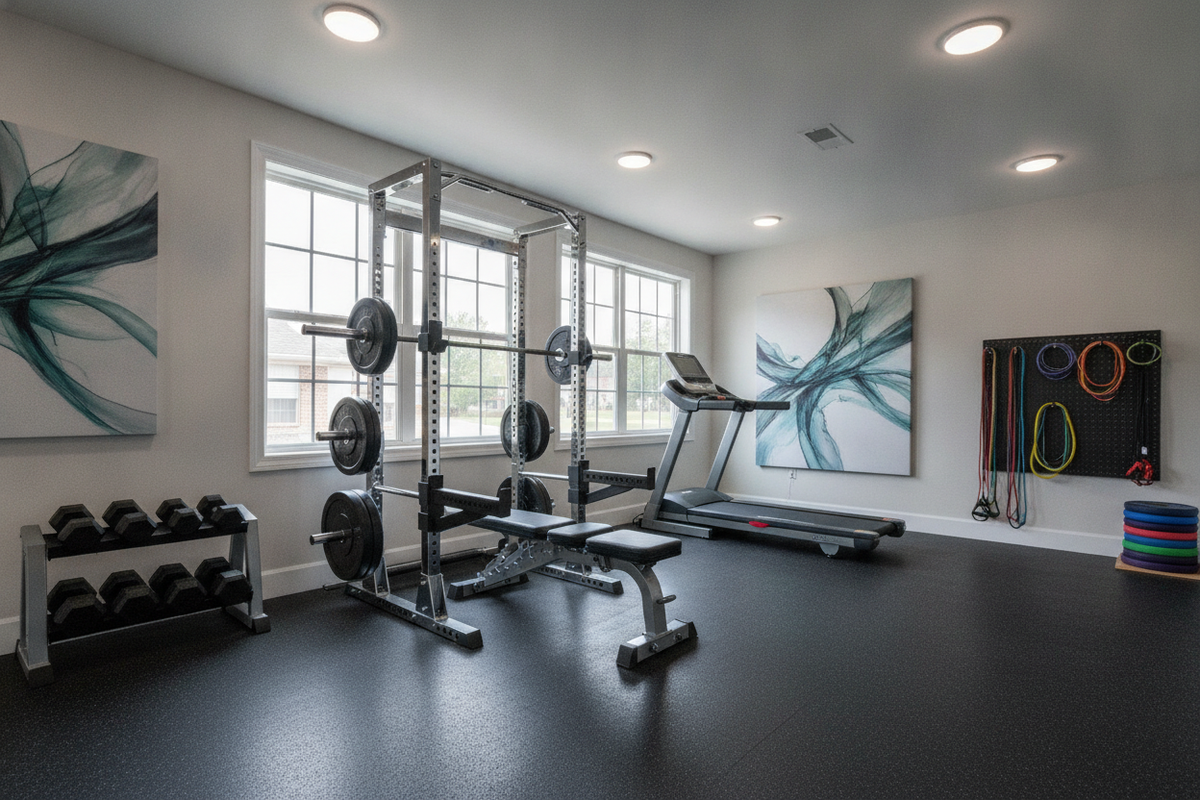
A dedicated high-density exercise mat or gym floor mat provides firm cushioning that absorbs localized pressure without allowing your body to sink excessively. Excessive sinking can compromise spinal alignment during planks and side raises. Additionally, dynamic drills such as lateral shuffles and band walks require dependable surface traction. A non-slip rubber or textured foam surface prevents foot slippage during lateral force transfer, helping you maintain stability and control while training your side glute muscles at home.


