Side Glute Training Mastery: 5 Targeted Exercises, Anatomy Breakdown, and Home Floor Staging
When trainees seek to build lower-body strength and balanced hip development, training routines frequently lean heavily on traditional sagittal-plane movements like back squats, conventional deadlifts, and standard hip thrusts. While these compound exercises are effective for developing the gluteus maximus, they often under-recruit the lateral hip muscles. Developing the side glute complex is essential not only for achieving complete lateral hip shape but also for reinforcing pelvic stability, tracking the knees properly under load, and supporting balanced movement mechanics.
Understanding how to target the lateral hip requires an examination of functional anatomy, intentional movement selection across multiple planes, and appropriate home gym staging to ensure joint comfort and traction during floor and standing work.
Understanding the Side Glute: Anatomy and Biomechanical Roles
To answer the fundamental question of what are side glutes, one must look beneath the surface of the lateral pelvis. The anatomical structure colloquially referred to as the side butt consists primarily of two key muscles: the gluteus medius and the gluteus minimus, aided by the tensor fasciae latae (TFL).
- Gluteus Medius: Originating along the outer surface of the ilium and inserting onto the greater trochanter of the femur, this broad, fan-shaped muscle acts as the primary hip abductor. Its anterior fibers assist with internal rotation and hip flexion, while its posterior fibers contribute to external rotation and extension. Crucially, during single-leg stance, the gluteus medius prevents the opposite side of the pelvis from dropping.
- Gluteus Minimus: Positioned directly beneath the gluteus medius, this smaller muscle works synergistically to abduct the leg, stabilize the femoral head in the hip socket, and assist in internal rotation.
Without targeted frontal-plane (lateral) and transverse-plane (rotational) stimulus, these muscles can remain underdeveloped relative to the gluteus maximus. While compound hip extension remains fundamental for total mass, pairing it with our structured butt glute guide ensures comprehensive development across all hip movement planes.
5 Essential Side Glute Exercises for Shape, Strength, and Stability
Targeting the side glute requires loaded movements that emphasize varying muscle lengths, from stretched positions to peak shortened contractions. If dominant quads or hamstrings tend to take over during traditional leg days, incorporating cues from a comprehensive butt glute guide alongside these five exercises will help establish deliberate lateral recruitment.
1. Standing Cable or Band Hip Abduction
Standing abduction provides direct tension throughout the frontal plane. To execute this with peak tension on the gluteus medius rather than the hip flexors, set the anchor or band around the ankle and position your torso with a slight forward lean. Hinge slightly at the hips, hold a stable post for balance, and sweep the working leg outward at roughly a thirty-degree angle backward rather than directly to the side. This slight diagonal path matches the natural orientation of the posterior gluteus medius fibers.
2. Deficit Curtsy Lunge with Pelvic Leveling
While many lateral exercises load the hip in its shortened position, the deficit curtsy lunge places the side butt under dynamic tension while lengthened. Standing on a low platform or dense mat, step the non-working leg back and across behind the lead leg while keeping the hips squared forward. Maintain a forward torso angle to emphasize hip hinge depth, decelerate under control, and drive through the lead foot to return to the top position.
3. Side-Lying Clamshell with Elevated Hip Bridge
An advanced evolution of the traditional floor clamshell, this variation combines active hip abduction and external rotation on the top leg with an isometric support bridge on the bottom hip. Lie on your side on a cushioned surface, bend knees to ninety degrees, and elevate your pelvis off the floor by pressing through the bottom knee and forearm. While holding the bridge, abduct the top knee smoothly without rotating the lumbar spine.
4. Lateral Banded Monster Walks in an Athletic Hinge
Monster walks maintain constant metabolic tension across both lateral hips simultaneously. Place a resistance band around the ankles or the balls of the feet to increase rotational demand. Lower into a moderate quarter-squat hinge, keeping the chest proud and knees tracking outward over the toes. Step laterally, maintaining tension on the band throughout every step without letting the feet snap together.
5. Elevated Side Plank with Top-Leg Abduction
This movement serves as a dual-demand exercise, challenging lateral core endurance while simultaneously loading both hips. Set up in a side plank from the elbow, ensuring the shoulder is stacked directly over the joint. Once a rigid straight line is established from head to heels, raise the top leg toward the ceiling with the heel turned slightly upward. The bottom hip stabilizes the pelvis against gravity while the top hip works through dynamic abduction.
Programming Framework: Integrating Side Butt Training into Lower-Body Splits
Programming lateral hip work requires balancing activation drills with heavier compound sessions. Because the gluteus medius acts as an essential stabilizer for heavy bilateral lifts, exhausting it prior to heavy barbell squats or deadlifts can compromise knee and pelvic stability.
A balanced training protocol typically places lighter activation drills (such as banded walks) at the tail end of a dynamic warm-up, heavy lengthened movements (like curtsy lunges or deficit split squats) early in the workout, and isolated abduction work (cables, side planks, and floor bridges) as accessory finishers. To integrate these patterns seamlessly with your broader weekly splits, reference our complete butt glute guide for structured progression models.
Home Gym Floor Staging: Joint Cushioning, Lateral Grip, and Subfloor Protection
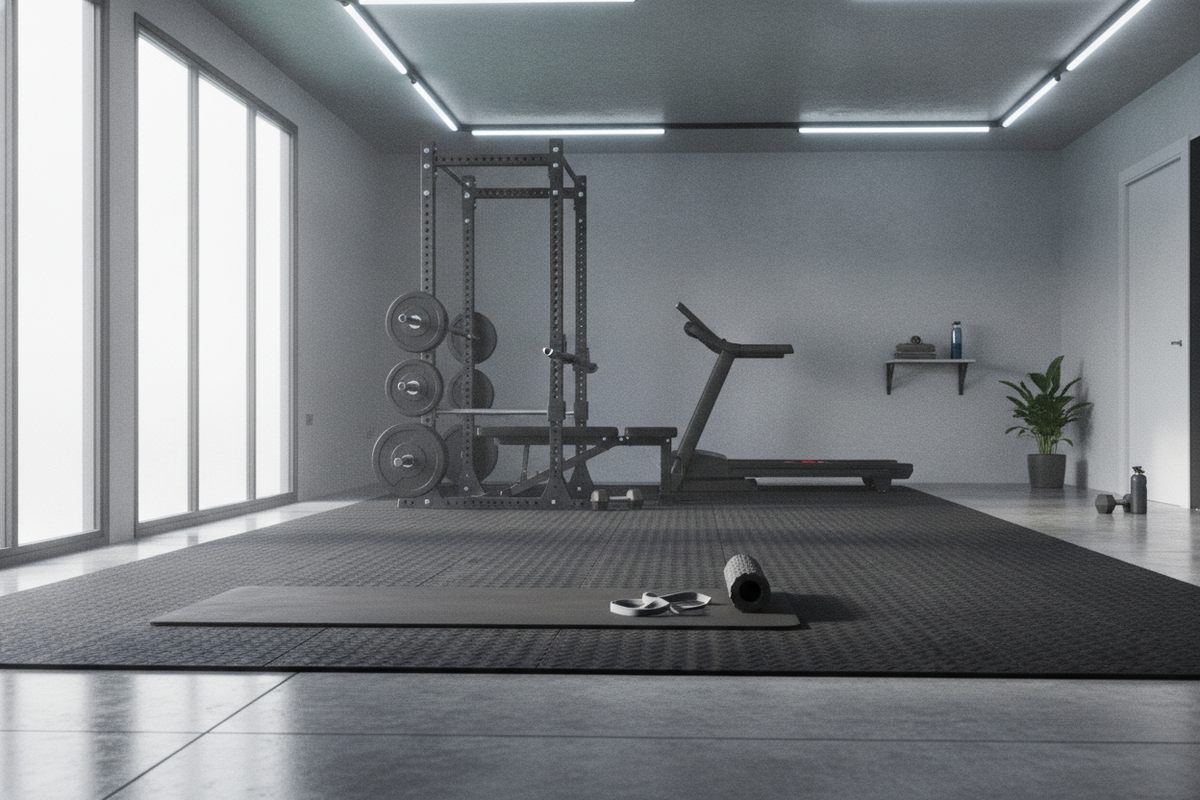
Executing lateral hip movements in a home gym presents specific environmental demands that standard residential flooring cannot adequately support. Structuring your workout space with dedicated fitness flooring is essential for both performance and joint protection.
- Contact Point Cushioning: Floor-based exercises like side-lying clamshells, kneeling fire hydrants, and side planks concentrate body weight directly onto bony prominences such as the greater trochanter, knees, and elbows. High-density, shock-absorbing mats provide the necessary depth to relieve concentrated pressure without sinking excessively or destabilizing balance.
- Lateral Traction for Dynamic Drills: Exercises such as monster walks, dynamic lunges, and standing band abductions apply shear lateral forces against the floor. Low-friction surfaces like hardwood, tile, or shifting decorative rugs can slide underfoot, disrupting hip mechanics. A textured, non-slip mat surface grips both athletic shoes and the subfloor beneath, enabling safe, full-effort lateral drives.
- Subfloor and Equipment Preservation: Using dumbbells, kettlebells, or ankle weights during lateral hip routines introduces the risk of accessory drops. Dense rubber or high-grade foam flooring shields underlying home surfaces from structural damage while dampening vibration during dynamic home workouts.
By pairing focused biomechanical execution with a stable, properly cushioned training floor, you create an environment optimized for consistent, joint-friendly side glute progression at home.