Shoulder Press Machine Weight: The Definitive Guide to Standards
You sit down, adjust the pin, and push. But does that number on the stack actually translate to real-world strength? Understanding shoulder press machine weight is tricky because no two machines are engineered exactly alike. Unlike a 45-pound barbell, which is consistent globally, a machine utilizes pulleys, levers, and friction that can drastically alter the actual resistance you feel.
If you are frustrated because you can press less on one machine than another, or you are just trying to figure out where you stand compared to the average lifter, you are in the right place. We are going to break down the mechanics, the standards, and how to stop ego-lifting and start growing.
Key Takeaways
- Mechanical Variance is Real: Due to pulley ratios (often 2:1) and friction, 100 lbs on a selectorized machine often feels lighter than 100 lbs of free weights.
- Starting Resistance Matters: The empty arms of a plate-loaded machine can weigh anywhere from 7 lbs to 25 lbs before you add a single plate.
- The "Average" Benchmark: For a novice male, pressing roughly 50-60% of body weight on a machine is a solid baseline. For females, aim for 30-40%.
- Seat Height Dictates Load: If your seat is too low, you start the movement in a mechanically disadvantaged position, forcing you to use less weight.
The Truth About Machine Shoulder Press Standards
When looking for machine shoulder press standards, you have to accept a margin of error. Since leverage varies by brand (Life Fitness vs. Hammer Strength vs. Cybex), strict numbers are harder to pin down than with barbells. However, we can look at general strength-to-weight ratios to gauge performance.
Beginner Standards
If you have been lifting for less than six months, your primary goal is motor control, not max load. A beginner male weighing 180 lbs should aim to press roughly 80-90 lbs for reps. A female beginner weighing 140 lbs should aim for roughly 40-50 lbs.
Intermediate to Advanced
Once you have a year of training under your belt, the shoulder press machine average weight shifts significantly. An intermediate lifter should be able to move approximately 75% to 85% of their body weight on the stack. Advanced lifters often press their full body weight or more for reps.
Why The Number on the Stack Lies
Have you ever felt like a superhero at one gym and weak at another? That is physics, not fatigue. Understanding the mechanics helps you stop obsessing over the number and focus on the stimulus.
The Pulley Ratio
Many selectorized (pin-loaded) machines use a pulley system to lift the weight stack. If the machine uses a 2:1 pulley ratio, lifting 100 lbs on the stack actually requires only 50 lbs of force. This is why you might max out the machine but struggle with 60 lb dumbbells.
Friction and Vector Angles
Machines guide the weight on a fixed path. This removes the need for stabilizer muscles (like the rotator cuff) to balance the load. Because you don't pay the "stability tax," you can typically handle a higher raw shoulder press machine weight than you can with free weights. However, old guide rods with grit or rust will add drag, artificially increasing the resistance during the eccentric (lowering) phase.
How to Determine Your Starting Weight
Don't just guess. If you go too heavy too fast on a fixed path, you risk shoulder impingement because your joints cannot adjust their natural tracking.
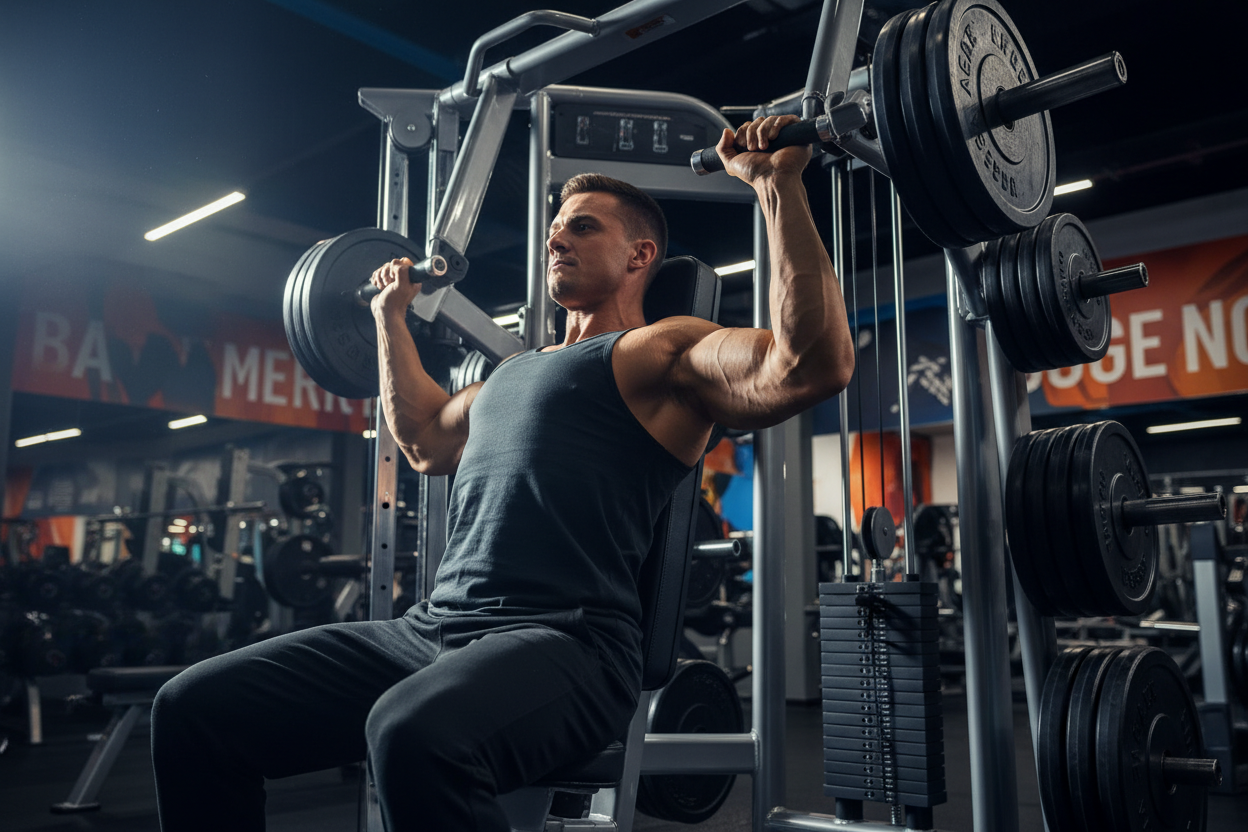
Start with a warm-up set using a weight you can easily control for 15 reps. If the machine is plate-loaded (ISO-Lateral), assume the starting weight of the arms is roughly 10-15 lbs. If it is a pin-loaded stack, start at the third or fourth plate down. Your first working set should be a weight where the last 2 reps feel difficult but your lower back stays glued to the pad. If you have to arch your spine excessively, the weight is too heavy.
My Training Log: Real Talk
I need to be honest about my relationship with the Hammer Strength ISO-Lateral Shoulder Press. For years, I tracked my progress on it religiously, thinking I was getting massive strength gains. I was slapping four plates on each side, feeling invincible.
But here is the specific detail that humbled me: I realized I was cheating the machine's mechanics. On the Hammer Strength machine, the handles have a slight inward convergence. I found that if I leaned my head forward and let my elbows flare out slightly—ignoring the intended path—I could grind out way more weight. But the moment I sat back, kept my head against the pad, and actually gripped the inner, neutral handles (the ones with that rough, aggressive knurling that tears up your palms if you forget chalk), my strength dropped by 30%.
The friction on that specific machine at my local gym was also inconsistent. The left arm had a sticky point about halfway up the guide rod. I spent months thinking my left deltoid was weaker, but it was literally just dried grease on the machine shaft. The lesson? The machine is a tool, not a scorecard. Once I dropped the weight and focused on the intended axis of rotation, my delts actually started growing again.
Conclusion
The shoulder press machine weight you move is less important than how you move it. Because mechanical advantages vary so wildly between manufacturers, comparing your numbers to an internet spreadsheet is often futile. Use the machine to safely overload the deltoids without the stability demands of dumbbells, but keep your form strict. If the weight stack is moving but your shoulders aren't burning, you're just moving metal, not building muscle.
Frequently Asked Questions
How much does the empty shoulder press machine weigh?
On plate-loaded machines (like Hammer Strength), the starting resistance of the empty arms is usually between 7 lbs and 25 lbs, depending on the leverage and counter-balances. On selectorized machines, the top plate usually starts at 10 or 15 lbs.
Is machine shoulder press easier than dumbbells?
Yes, generally speaking. The machine stabilizes the weight for you, allowing you to focus purely on pushing output. With dumbbells, you lose energy stabilizing the weight in three-dimensional space, which usually requires you to use lighter loads.
Does the seat height affect how much weight I can lift?
Absolutely. If the seat is too low, the handles will start near your ears or higher, reducing the range of motion and making the lift easier (but less effective). If the seat is too high, starting the movement from your clavicle requires significantly more force to break inertia.