Most people associate gravity-based incline trainers with upper body rehabilitation or light toning, but that perspective misses the massive potential of these machines for lower body development. If you are looking to build functional strength without the joint-grinding compression of heavy free weights, the Total Gym for legs is a powerhouse solution. The sliding board mechanic allows for a unique combination of strength training and instability work, which forces your stabilizer muscles to fire just as hard as your primary movers.
I learned this the hard way a few years ago. After a skiing accident left my left knee feeling unstable and prone to swelling, heavy barbell squats were off the table. My physical therapist introduced me to the Total Gym with leg press capabilities. At first, I was skeptical that body weight on an incline could replace the iron I was used to. I was wrong. The ability to perform deep, controlled reps with constant tension completely rebuilt my quad strength while sparing my joints. That experience shifted my entire philosophy on training longevity. You don't always need to crush your spine to build your legs; you just need the right leverage and intensity.
Mastering the Glide Board Squat
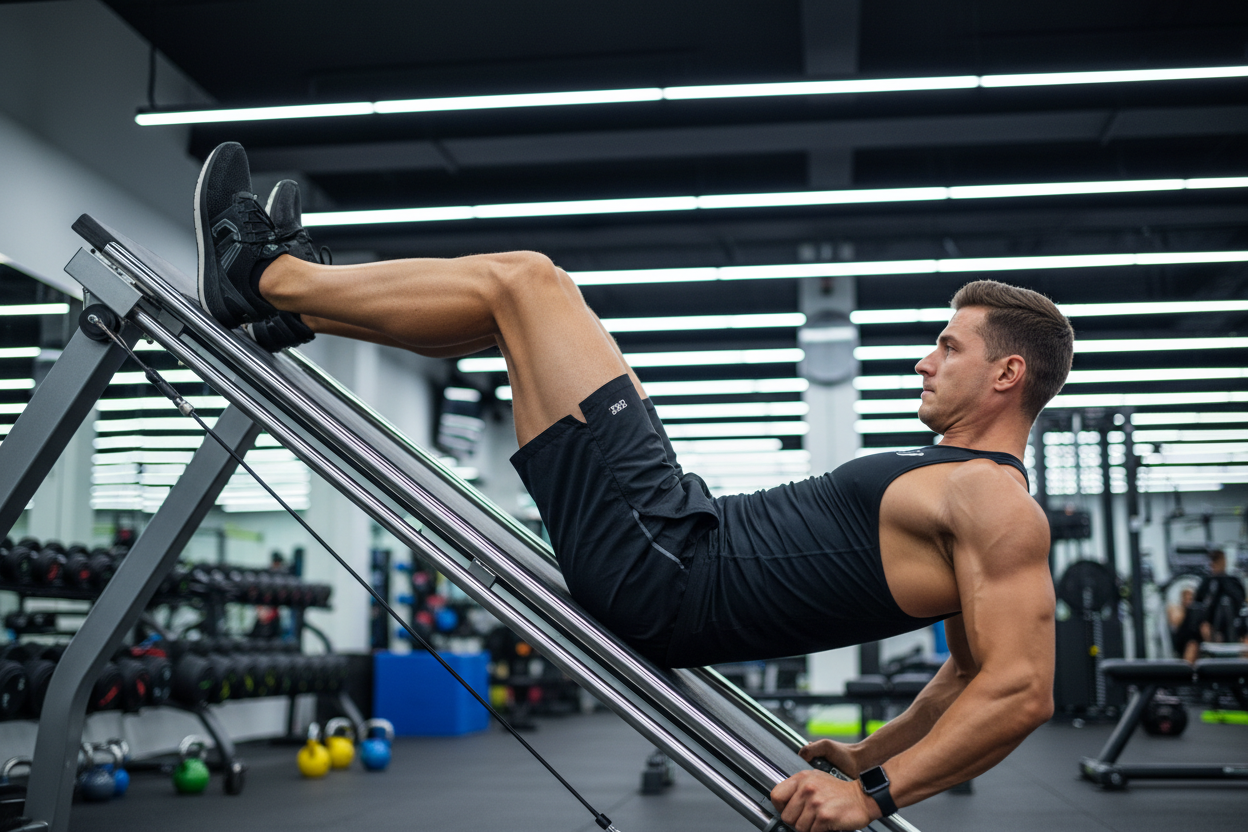
The foundation of any leg workouts on total gym equipment is the squat. Unlike a vertical leg press or a hack squat machine at a commercial gym, the glide board moves with you. This dynamic movement pattern requires you to control the descent more actively. To perform a proper total gym leg press, attach the squat stand to the base. Lie back on the glide board with your feet shoulder-width apart on the platform. As you lower yourself, ensure your lower back stays pressed firmly against the pad.
Foot placement changes everything here. Placing your feet higher on the platform shifts the emphasis to your glutes and hamstrings, while a lower placement isolates the quadriceps. Because the back support is consistent, you can safely push to failure without worrying about getting stuck under a bar. For those looking to increase difficulty, try single-leg squats. This unilateral movement exposes muscle imbalances immediately and is one of the most effective total gym quad exercises available. It prevents your dominant leg from taking over, ensuring both sides develop equally.
Targeting the Inner and Outer Thighs
One area where this equipment shines over free weights is in lateral movements. Traditional lunges work the legs in a sagittal (forward and backward) plane, but real-world movement is multi-directional. Total gym inner thigh exercises utilize the pulley system to target the adductors, which are often neglected. By attaching the ankle cuff to the lower pulley and lying sideways on the glide board, you can perform lying adductor pulls. This isolates the inner thigh without putting lateral stress on the knee joint.
For a comprehensive total gym inner thigh workout, combine these cable pulls with wide-stance squats on the squat stand. Turn your toes outward slightly (sumo style). This position engages the inner thigh muscles significantly more than a neutral stance. Conversely, to hit the outer thigh and abductors, you can perform abduction pulls using the cable system. These total gym thigh exercises help sculpt the shape of the leg and, more importantly, stabilize the hip complex, which protects your knees during running or jumping.
Constructing a Total Gym Lower Body Workout
Randomly picking exercises won't get you the results you want. A structured total gym lower body workout should flow from compound movements to isolation exercises. Start with your heaviest compound lift. Set the incline to a high level—level 6 or higher on most models—to maximize resistance. Begin with the standard two-legged squat to warm up the joints, then transition immediately into single-leg squats.
After fatiguing the large muscle groups, move to isolation. This is where you incorporate total gym leg exercises that focus on specific areas, like the hamstrings. If your model permits, performing a hamstring curl using the cables (lying face down) provides incredible peak contraction. If not, the "Sprinter Start" exercise is a phenomenal alternative. Kneeling on the glide board with one foot on the floor (or squat stand), you push the board up the rails using your glutes and hamstrings. This mimics the explosive drive of a sprint and creates a deep burn in the posterior chain.
The Logic Behind Total Gym Legs Training
Why choose total gym workouts for legs over a traditional gym membership? The answer lies in time under tension and transition speed. In a crowded gym, moving from the squat rack to the leg extension machine takes time, allowing your heart rate to drop. On a Total Gym, you can switch from a squat to a hamstring curl in seconds. This density of training elicits a strong metabolic response, burning fat while building muscle.
Furthermore, the total gym leg attachment (the squat stand) allows for plyometric training. By lowering the incline slightly, you can perform jump squats. You explode off the platform, the board glides up, and you land softly, absorbing the impact with your muscles rather than your bones. This plyometric variation is excellent for building explosive power in a safe environment.
Advanced Techniques for Hypertrophy
If you have been training for a while, you might worry that bodyweight resistance isn't enough. However, mechanical disadvantage is a powerful tool. To intensify your total gym leg workout, slow down the tempo. Take three full seconds to lower the glide board, pause for one second at the bottom, and explode up. This tempo removes momentum and forces the muscle fibers to do all the work.
Another method is the "1-and-a-half rep" technique. Go all the way down, come halfway up, go back down, and then return to the top. This counts as one rep. Applying this to your total gym lower body exercises keeps the muscles under tension for longer periods, triggering growth even with lighter loads. You can also add external weight. Many users wear a weighted vest or hold a weight plate on their chest during the leg press on total gym to increase the load significantly.
Sample Routine: The 20-Minute Leg Burner
Here is a practical application of these principles. Perform this circuit three times with minimal rest between exercises, and two minutes of rest between full rounds. This covers all the bases for a complete leg workout on total gym hardware.
1. **High-Incline Squats:** 15 reps (Warm-up and general mass)
2. **Single-Leg Squats:** 10 reps per leg (Focus on total gym quad exercises)
3. **Lying Hamstring Curls (or Sprinter Start):** 15 reps (Posterior chain)
4. **Side-Lying Inner Thigh Sweeps:** 12 reps per leg (Total gym inner thigh workout focus)
5. **Plyometric Jump Squats:** 20 reps (Burnout and explosive power)
This routine hits the quads, hamstrings, glutes, and adductors efficiently. By the time you finish the plyometrics, your legs will feel heavy, and your heart rate will be elevated. It proves that a total gym leg session can be just as grueling and effective as a session with iron plates.
Maximizing Safety and Longevity
While the machine is low impact, form still matters. When performing any leg workouts on total gym, ensure your knees track over your toes and do not collapse inward. This valgus collapse is a common cause of injury. Keep your core engaged throughout every movement; even though you are lying down, your spine needs support. The beauty of total gym legs training is the feedback the machine gives you. If you are pushing unevenly, the board will wobble or scrape. Listen to the machine, correct your form, and you will build a lower body that is not only aesthetically pleasing but functionally robust for years to come.