Resistance Training Exercises: Fundamental Movement Architecture, Full-Body Session Blueprints, and Home Floor Staging
Executing consistent resistance training exercises at home requires an understanding of primary movement mechanics alongside a deliberate approach to gym staging. Rather than viewing strength training as an arbitrary collection of isolated muscle drills, an organized approach treats every lift as an expression of fundamental movement patterns. When coupled with a secure footing foundation, proper floor density, and practical loading strategies, home resistance workouts provide balanced physical development without requiring industrial weight rooms.
The Five Primary Movement Vectors of Resistance Training
Organizing resistance training examples around biomechanical vectors ensures complete structural coverage, joint balance, and efficient session planning. By focusing on multi-joint patterns, lifters stimulate major muscular groups while learning spatial coordination under load.
Upper-Body Pressing and Pulling Vector Mechanics
Upper-body movement separates into horizontal and vertical vectors. Horizontal pressing movements, such as the standard push-up or flat dumbbell press, develop the chest, anterior shoulders, and triceps. Modifying hand placement or angle shifts focus across these muscle groups. Vertical pressing, represented by seated or standing dumbbell overhead presses, develops shoulder stability and upper back engagement.
Conversely, pulling patterns counterbalance pressing volume. Horizontal pulling exercises like bent-over dumbbell rows or chest-supported rows target the mid-back, rhomboids, and lats, promoting upright postural control. Vertical pulling, such as pull-ups or resistance band pulldowns, broadens back engagement while building grip and forearm endurance. When designing a multi-joint training protocol at home, consulting a structured body resistance exercise guide helps balance push-pull ratios across muscle groups.
Lower-Body Squat and Hinge Foundations
Lower-body resistance exercises fall primarily into knee-dominant and hip-dominant patterns:
- Knee-Dominant Patterns (Squats and Lunges): The goblet squat, front-loaded dumbbell squat, and reverse lunge train the quadriceps, adductors, and glutes. Maintaining an upright torso and full foot contact distributes load evenly across the knee and hip joints.
- Hip-Dominant Patterns (Deadlifts and Hinges): Romanian deadlifts and single-leg hip hinges prioritize posterior chain engagement, specifically the hamstrings and gluteal complex. The movement centers on driving the hips backward while maintaining a neutral spine, rather than flexing downward through the lumbar vertebrae.
Rotational Stability and Anti-Extension Core Work
Core development within a resistance training program relies heavily on resisting unwanted movement rather than excessive spinal flexion. Anti-extension exercises like planks, ab wheel rollouts, and hollow body holds teach the trunk to resist arching under load. Anti-rotation movements, such as the Pallof press and bird-dog variations, train the torso to stay rigid while forces attempt to twist the spine, directly translating to safer execution during standing compound lifts.
Structuring an Efficient 30-Minute Full-Body Resistance Workout
Athletes balancing limited schedules often review a comprehensive body resistance training guide to understand why frequency-based full-body sessions outperform complex body-part splits. Full-body routines recruit broad muscle mass within compact time windows, optimizing recovery between sessions.
Compound Movement Pairing Strategies
An effective resistance training session can be organized using non-competing supersets. Pairing an upper-body pushing movement with a lower-body hinge, or an upper-body pull with a knee-dominant squat, allows one muscle group to recover while another works, maintaining training density without excessive fatigue.
- Block A (Knee Dominant + Upper Pull): Dumbbell Goblet Squat paired with Neutral-Grip Dumbbell Rows. Perform 3 sets of controlled repetitions with minimal rest between opposing exercises.
- Block B (Hip Dominant + Upper Press): Dumbbell Romanian Deadlift paired with Incline Push-Ups or Floor Dumbbell Presses. Complete 3 sets per movement.
- Block C (Core and Loaded Carry): Alternating Reverse Lunges with an Anti-Rotation Press or Suitcase Hold to finish the session.
Managing Pacing, Rest Intervals, and Mechanical Fatigue
Maintaining structured rest periods between paired sets preserves lifting cadence and execution quality. Rushing through resistance training workouts compromises movement mechanics, whereas overly long pauses reduce the training stimulus. A steady cadence of roughly 60 to 90 seconds between paired efforts supports recovery and movement control.
Home Gym Floor Staging and Environmental Engineering for Resistance Lifts
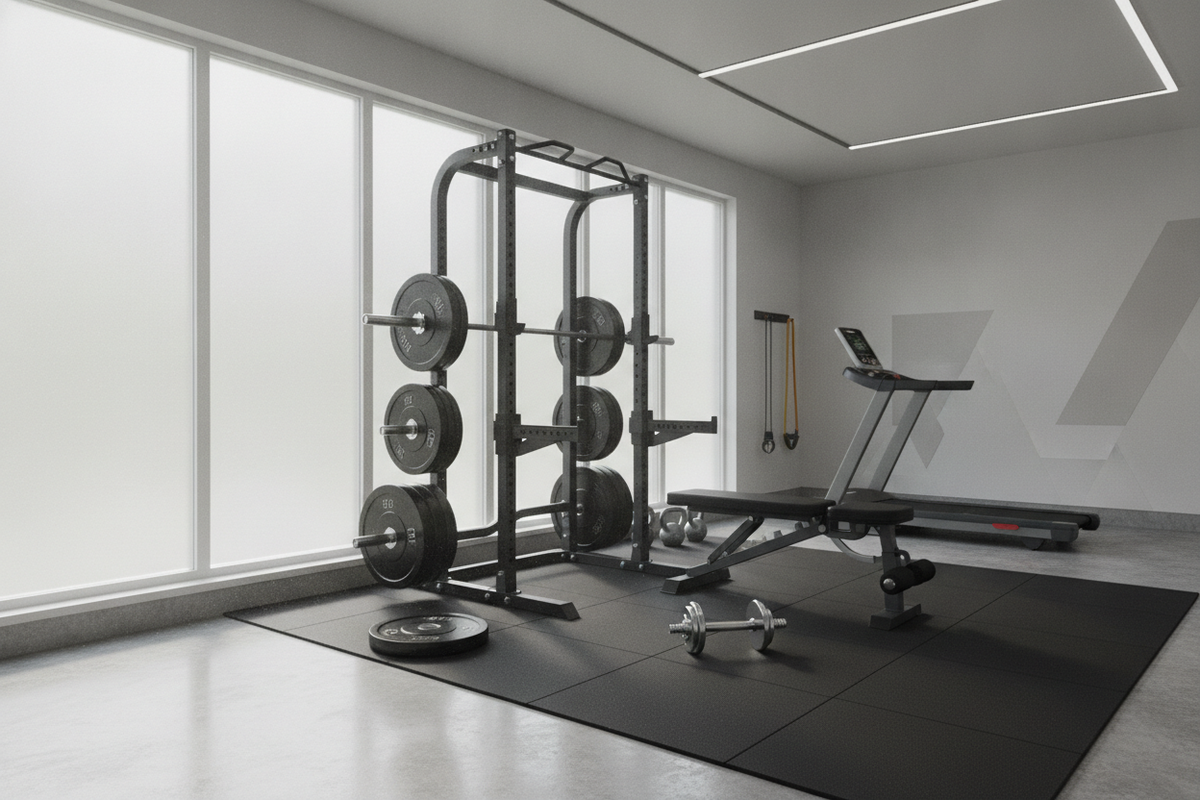
The physical environment plays a critical role in resistance training activities. Heavy dumbbells, dynamic lunges, and floor-based core work place substantial demands on residential flooring. Staging dedicated floor space with surfaces from a high-density exercise gym collection ensures stable footing during unilateral lunges and heavy dumbbell deadlifts.
Traction Dynamics and Force Dispersion Under Load
Subfloor protection and traction are essential when performing high resistance exercises. Soft, plush yoga mats collapse under heavier loads, compromising ankle alignment during squats. Conversely, bare hard floors offer inadequate slip resistance when sweat accumulates during demanding circuits. A firm, high-density surface creates a reliable base of support, allowing lifters to drive through the midfoot and heel without sliding or sinking.
Equipment Staging, Clearance Zones, and Surface Protection
Setting up an intentional training space prevents equipment damage and eliminates clutter hazards. For dynamic dumbbell circuits requiring both floor work and standing lifts, laying out an expansive exercise gym workout product provides continuous boundary-free protection. Keep weights organized at the periphery of the mat to ensure unrestricted clearance in all directions during multi-planar steps and overhead presses.
Progression Models, Load Management, and Long-Term Adaptation
Progressing in resistance training does not solely depend on adding heavy external weight. When working with a limited home equipment setup, adaptation can be driven through several progressive overload levers:
- Tempo Control: Slowing the eccentric (lowering) phase of a lift to three or four seconds increases time under tension without requiring heavier loads.
- Pause Integration: Introducing isometric holds at the bottom of a squat or the peak of a row builds control and eliminates elastic momentum.
- Unilateral Variations: Transitioning from bilateral squats to split squats or Bulgarian split squats increases balance demands and localized muscular load.
- Density Manipulation: Gradually decreasing rest intervals between sets while sustaining identical technique enhances work capacity over time.
Mat Maintenance and Flooring Care in Heavy Resistance Environments
Home gym flooring exposed to aggressive shoe treads, knurled dumbbells, and regular sweat requires routine care to maintain grip texture and surface integrity. Wipe down the mat surface after intense sessions using a mild soap solution or neutral pH fitness cleaner, avoiding abrasive chemicals that can degrade textured rubber surfaces. Inspect high-traffic contact zones regularly to verify that the mat remains completely flat against the subfloor, preserving an even and reliable base for every training session.