Exercises for Upper and Lower Body: Full-Body Movement Architecture, Supersetted Blueprints, and Home Floor Staging
Foundational Movement Patterns: Harmonizing Upper and Lower Kinetic Chains
Executing a balanced training regimen requires an understanding of how distinct movement mechanics interconnect across the entire body. Organizing exercises for upper and lower body development into unified training sessions allows athletes and home gym practitioners to train foundational movement patterns without excessive single-session time commitments. Combining multi-joint lower-body patterns with complementary upper-body pushes and pulls distributes biomechanical tension evenly across joints and connective tissues.
A well-structured session balances primary motor drivers, alternating between knee-dominant or hip-dominant leg movements and vertical or horizontal upper-body mechanics. This integrated approach not only reinforces balanced posture but also establishes a foundation of functional strength that supports everyday physical demands.
Lower-Body Drivers: Squat, Hinge, and Unilateral Mechanics
Lower-body movements form the structural anchor of total-body sessions. These patterns are generally categorized into knee-dominant actions, such as front squats and goblet squats; hip-dominant mechanics, such as Romanian deadlifts and hip thrusts; and unilateral variations, including split squats and reverse lunges. Each pattern requires deliberate tripod foot pressure—maintaining equal distribution across the heel, the base of the big toe, and the base of the fifth metatarsal.
Maintaining this solid base of support is essential during heavy bilateral and unilateral lifts. Athletes exploring specialized setups can review options in the lower body collection to evaluate equipment configurations that complement free-weight mechanics and provide stable footprints for controlled lower-body recruitment.
Upper-Body Complementary Patterns: Vertical/Horizontal Push and Pull
Upper-body mechanics serve as the functional counterbalance to lower-body loading. Structuring upper-body work around four primary quadrants—horizontal push (such as dumbbell bench presses and push-ups), horizontal pull (such as chest-supported rows and bent-over rows), vertical push (such as overhead presses), and vertical pull (such as pull-ups and lat pulldowns)—ensures complete shoulder girdle and upper back development.
Integrating these movements alongside lower-body compound lifts demands coordinated core stabilization. A horizontal row paired with a hinge pattern, for example, reinforces spinal neutrality and strengthens the posterior chain without placing concentrated fatigue on a single muscle group.
Programming Frameworks for Upper and Lower Body Workouts
Constructing a functional lower body upper body workout requires deliberate programming architecture. Rather than performing arbitrary collections of lifts, organizing exercises into paired sequences or managed circuits maintains high training quality across every working set.
Alternating Upper-Lower Supersets for Optimal Recovery
One of the most practical methodologies for full-body strength is the alternating upper-lower superset. In this model, a lower-body exercise is immediately followed by an upper-body movement that relies on a completely different primary muscle group. For instance, pairing a heavy dumbbell squat with an overhead press allows the legs to recover while the shoulders and triceps work, and vice versa.
This reciprocal recovery dynamic minimizes idle downtime while keeping heart rates elevated and movement quality high. Because local muscular fatigue is partitioned between distant kinetic segments, trainees can sustain consistent force output across multi-set blocks.
Density Circuit Frameworks for Structured Home Sessions
For individuals training within home gyms, density circuits offer an efficient way to combine resistance lifts and mobility work. Structuring three to four movements into a continuous rotation—such as alternating kettlebell deadlifts, push-ups, walking lunges, and plank variations—creates a predictable flow across the workout area.
Trainees looking for additional templates can consult a dedicated body weight workout guide to study systematic circuit progressions that blend calisthenic control with loaded implement work.
Core Multi-Joint Exercise Catalog for Integrated Strength Training
Selecting the right upper and lower body exercises involves prioritizing multi-joint lifts that recruit large volumes of muscle mass with minimal equipment complexity. By mastering compound movements, home lifters can execute comprehensive sessions within compact training footprints.
Compound Pairings: Squat-to-Press and Deadlift-to-Row Combinations
Compound hybrid exercises merge distinct movement patterns into a continuous kinetic chain. Classic examples include the squat-to-overhead-press (thruster) and the deadlift-to-bent-over-row. Executing these combinations demands strict bar path alignment, smooth hip extension, and seamless force transfer through the midsection.
When performing these dynamic pairings, lifters should emphasize clean transitions rather than rushing the cadence. Trainees seeking deeper movement breakdowns can explore the exercise weight training guide to understand kinetic sequencing, foot positioning, and hip mechanics under progressive loads.
Unilateral and Core Carries Across the Home Floor Space
Unilateral exercises and loaded carries introduce essential anti-rotational stability demands into an upper and lower body weight training routine. Movements such as single-arm suitcase carries, dumbbell farmer walks, and forward-to-reverse lunges force the deep core stabilizers, hip abductors, and upper back to coordinate under shifting loads.
Performing dynamic carries requires a secure, level floor boundary that resists shifting or bunching under foot strike. Firm surface grip ensures that the lifter can maintain straight-line tracking and torso uprightness during every step.
Home Gym Floor Staging and Room Protection Architecture
Executing dynamic full-body routines at home requires careful attention to the underlying workout surface. Combining heavy free weights with dynamic ground contacts creates concentrated point loads that can challenge residential flooring materials.
Subfloor Safeguards: High-Density Surface Cushioning Under Load
Hardwood, tile, and basic concrete subfloors are susceptible to scratching, cracking, or surface abrasion when heavy dumbbells, kettlebells, or barbells are lowered repeatedly. Installing a dedicated high-density mat provides a protective barrier that buffers equipment contact and preserves the subfloor integrity.
Selecting an expansive mat format, such as a specialized workout product, ensures that both the lifter and the equipment remain anchored on a uniform, supportive base throughout multi-exercise sessions.
Traction Mechanics: Preventing Mat Slippage During Explosive Plant Movements
Dynamic lower-body movements, including lateral bounds, lunges, and split-stance lifts, generate substantial horizontal shear forces against the floor. A mat with a textured bottom surface helps maintain grip against the subfloor, preventing sliding or bunching during aggressive foot plants.
Simultaneously, a non-slip top texture provides reliable traction for sweaty hands during push-ups, planks, and mountain climbers, reinforcing personal stability across all phases of training.
Equipment Placement, Station Flow, and Long-Term Surface Maintenance
Creating an organized layout within a home training area streamlines transitions between upper- and lower-body exercises, reducing distractions and maintaining safe walking lanes.
Optimizing Equipment Staging to Minimize Transition Delays
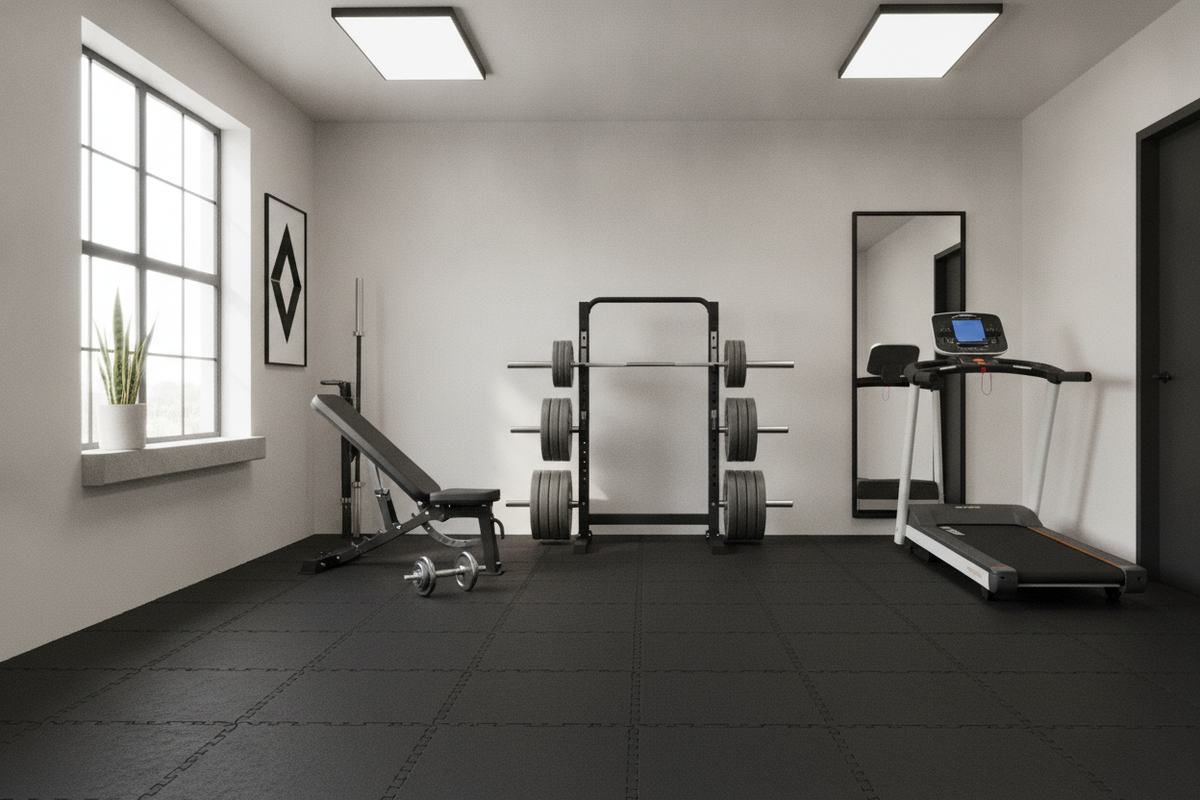
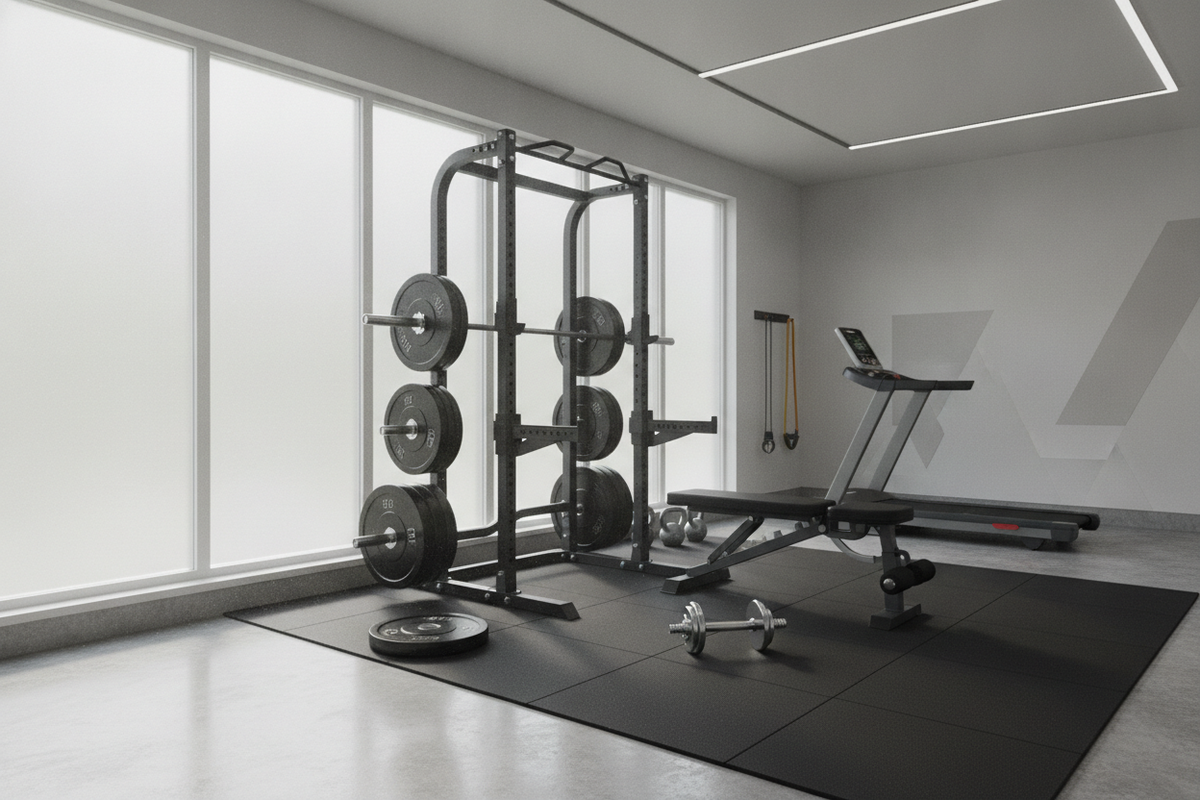
To maximize efficiency during supersets, arrange primary weights, adjustable benches, and resistance accessories along the outer boundary of the workout mat. Keeping the central surface area clear allows for unrestricted movement during dynamic exercises, floor presses, and mobility cool-downs.
Complementing primary stations with modular gear from a specialized training collection helps keep bands, collars, and grips organized and readily accessible along the perimeter of the training space.
Hygiene, Moisture Management, and Floor Durability Practices
Integrated full-body workouts naturally produce perspiration and environmental moisture. Maintaining gym mats requires a straightforward cleaning protocol using mild, pH-neutral cleansers and microfiber cloths after each session.
Periodic checks beneath the mat ensure that no moisture or dust has accumulated against the subfloor, preserving both the protective matting and the underlying residential floor over years of consistent home strength training.