Quick Home Exercise: The PHA Training Method
I have trained dozens of clients who hit a wall when their schedules explode. You know the drill: a newborn arrives, or a 60-hour work week kicks in, and suddenly your 90-minute gym session is a fantasy. When you only have a sliver of free time, you need a quick home exercise routine that actually moves the needle, not just a random assortment of jumping jacks that leave you sweaty but unchanged.
After testing hundreds of programming styles in cramped apartments and garage setups, I found the holy grail for a quick home workout: Peripheral Heart Action (PHA) training. It forces your body to work at maximum capacity in minimal time.
Quick Takeaways
- PHA training alternates upper and lower body movements to maximize cardiovascular strain without a treadmill.
- Traditional body-part splits waste too much time when you only have 15 minutes to train.
- A dedicated, slip-free 6x6 foot space is required for safe, rapid transitions between exercises.
- Active rest periods using core stabilization keep your heart rate up while primary muscles recover.
Why Most Short Workouts Fail
Most people try to cram a traditional bodybuilding routine into a 15-minute window. It simply does not work. If you spend your limited time doing three sets of bicep curls followed by three sets of lateral raises, you isolate small muscle groups but fail to trigger a systemic metabolic response. You just do not burn enough calories or create enough muscle fatigue when resting 90 seconds between sets of localized volume.
When time is the limiting factor, you have to shift your focus from localized muscle pumps to systemic intensity. You need a method that forces your heart and lungs to work in overdrive while simultaneously pushing your muscles to near failure. This is where most generic 10-minute YouTube circuits fall flat. They string together random plyometrics that spike your heart rate but lack the mechanical resistance needed to maintain or build muscle mass.
Understanding Peripheral Heart Action (PHA)
Peripheral Heart Action, or PHA, was popularized in the 1960s by Mr. America Bob Gajda. The physiological science behind it is brilliantly simple. Instead of doing three leg exercises in a row, you alternate an upper-body movement with a lower-body movement. For example, moving directly from a heavy goblet squat to a set of push-ups.
When you do this, your heart has to aggressively shunt blood from your lower extremities all the way up to your chest and arms, and then back down again. This constant redirection of blood flow creates a massive cardiovascular demand. You get the heart-pounding benefits of a sprint interval session without ever stepping on a treadmill or spin bike.
Because the upper body rests while the lower body works, you can keep moving continuously for 15 minutes with virtually zero rest. Your heart rate stays pegged at 140-160 BPM, maximizing fat loss, while the mechanical tension on the muscles preserves lean tissue. It is the most efficient way to tax both the aerobic and anaerobic systems simultaneously.
Setting Up Your Rapid-Transition Space
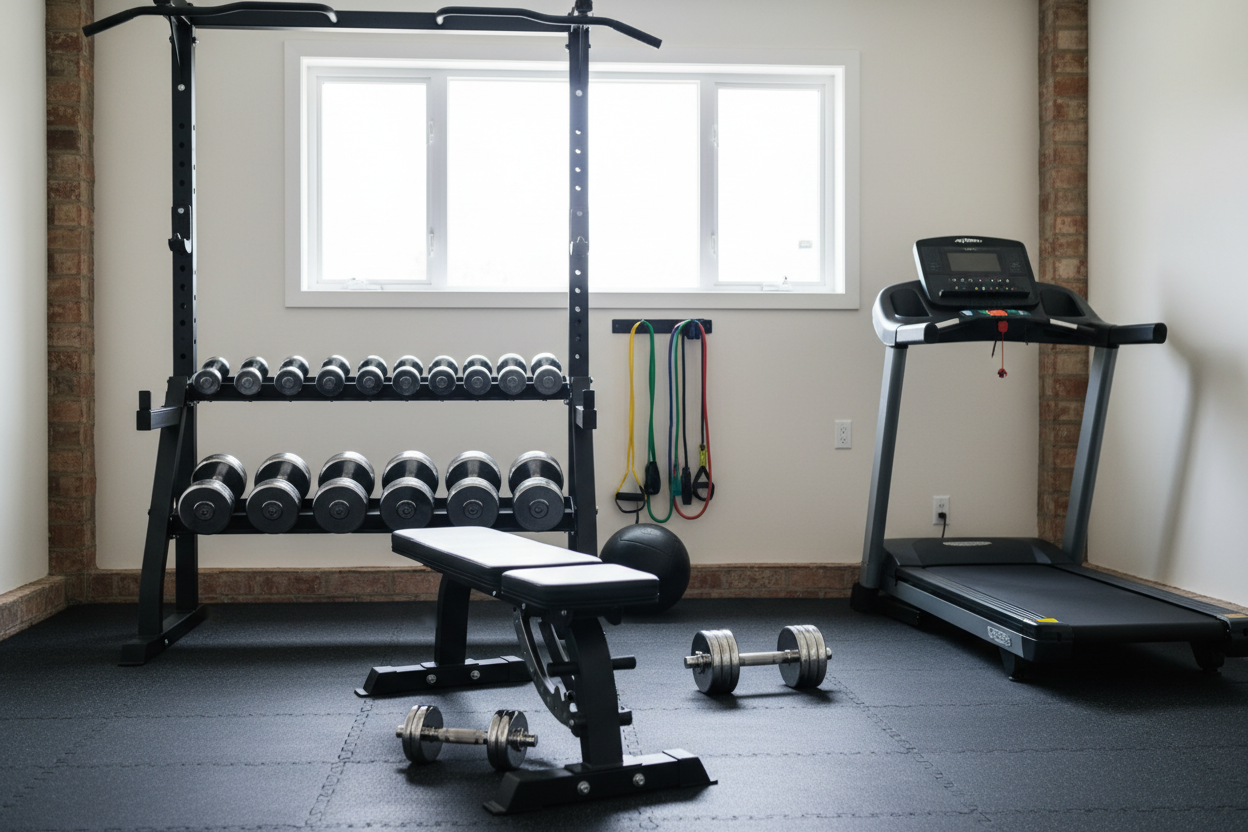
To pull off a PHA circuit, you cannot waste 30 seconds moving a coffee table or searching for a dumbbell. Friction is the enemy of a fast workout. You need a dedicated physical environment where you can drop from a standing lunge directly into a floor plank without hesitation.
In my experience setting up client spaces, the most critical piece of gear isn't a fancy adjustable dumbbell—it is a high-quality, high-traction surface. If you are sweating heavily and trying to transition fast on hardwood or a cheap, sliding yoga mat, you will eventually roll an ankle or tweak a wrist. I always have my clients invest in a large exercise mat for home gym use.
Having a wide, dedicated footprint of at least 6x6 feet means you can leave your weights at one edge, do your floor work in the center, and never have to rearrange your living room mid-circuit. You step onto the mat, and the work begins instantly.
Building Your 15-Minute Circuit
Constructing your own PHA loop requires selecting four non-competing movements. You want an upper body push, a lower body pull, an upper body pull, and a lower body push. This exact sequence ensures no single muscle group burns out prematurely.
Let's break down the mechanics. Your upper push might be a dumbbell floor press or a standard push-up. Your lower pull could be a Romanian deadlift or a glute bridge. Your upper pull is a bent-over row or a pull-up, and your lower push is a squat or forward lunge.
By running through these four stations back-to-back for 10 to 12 reps each, you create a seamless loop of continuous effort. You perform all four exercises, rest for exactly 45 seconds, and repeat the block four to five times. The beauty of this structure is its infinite scalability; as you get stronger, you simply increase the dumbbell weight or slow down the tempo.
Integrating Core Stabilization
If you want to push the intensity even further, you can swap out that 45-second passive rest for active core stabilization. Instead of sitting on your bench staring at the clock, hold a forearm plank or perform dead bugs. This keeps your heart rate elevated while your primary limbs recover from the heavy lifting.
I often point clients toward an 11-minute killer abs core workout as a masterclass in how to intensely target the midsection when short on time. Integrating these stabilization movements into your rest periods turns a standard circuit into a relentless, fat-melting engine that fortifies your lower back.
Two PHA Templates to Try Today
Here are two proven PHA templates you can run in your living room today. The first is a pure bodyweight loop. Perform 15 push-ups, 20 walking lunges, 15 inverted row reps (using a sturdy table or suspension trainer), and 20 air squats. Rest 30 seconds and repeat for four rounds. It sounds easy until you hit round three and your lungs are screaming.
The second template requires a set of dumbbells. I prefer 5-52.5 lb adjustable ones for space-saving efficiency. Do 12 dumbbell overhead presses, 12 dumbbell Romanian deadlifts, 12 renegade rows, and 12 goblet squats.
Because of the heavy sweat and dynamic floor-to-standing transitions required here, doing this on a premium 6x8ft exercise mat gym flooring is ideal for safely executing the movements without slipping. Run this weighted circuit for four rounds, aiming for zero rest between exercises and 45 seconds between rounds.
Efficient Warm-Ups and Cool-Downs
You cannot skip the warm-up, even when rushing. Spend two minutes doing high-knee marches, arm circles, and dynamic hip openers to lubricate the joints. This signals your nervous system that intense work is coming and prevents cold-muscle strains.
Post-workout, your heart rate will be through the roof. Spend two minutes doing a dedicated stretching workout at home to down-regulate your central nervous system. Focus on deep diaphragmatic breathing and static hip flexor stretches to prevent stiffness before you jump in the shower.
My Honest Take on PHA Training
Let me share a quick reality check from my own training. I tested a strict PHA dumbbell routine for a month using a set of 50-pound adjustable blocks in my garage. The cardiovascular conditioning I achieved was phenomenal, matching my best rowing machine sprint times. However, the honest downside to PHA is that it severely limits your top-end strength gains. Because you are constantly fatigued and breathing hard, you will never lift as heavy as you would with 3-minute rest periods. You sacrifice maximal strength for incredible time efficiency and fat loss.
Frequently Asked Questions
How often should I do a PHA workout?
Three to four times a week is the sweet spot. Because the intensity is high and the volume is moderate, your central nervous system needs those recovery days to rebuild muscle tissue.
Can I build muscle with only 15-minute workouts?
Yes, provided you push close to muscular failure. The key is progressive overload. You must gradually increase the weight or reps over time, even within a short 15-minute time frame.
Do I need heavy weights for PHA?
Not necessarily. While dumbbells accelerate muscle growth, you can manipulate bodyweight exercises by slowing down the eccentric (lowering) phase to increase time under tension and simulate a heavier load.