Leg Press for Inner Thighs: The Foot Placement Secret
Most lifters hop on the sled, place their feet in the middle of the platform, and start pumping out reps. While that’s fine for general quad development, it completely misses a massive opportunity for leg width and stability. If you want to target the adductors, you have to intentionally modify your setup for the leg press for inner thighs.
The inner thigh (adductor complex) is often neglected in favor of the "teardrop" muscle or the outer sweep. But without developed adductors, your legs will lack that thick, three-dimensional look. More importantly, weak inner thighs are a leading cause of knee instability during heavy squats. Let's break down exactly how to shift the mechanical tension from your quads to your inner thighs using the leg press.
Quick Summary: Targeting Adductors
- Stance Width: Place feet significantly wider than shoulder-width (Sumo stance).
- Toe Angle: Flare toes out at approximately 45 degrees to align with the femur.
- Depth: A deeper range of motion increases the stretch on the adductors.
- Tempo: Slow eccentric (lowering) phase to prevent the hips from shooting up.
The Science of Leg Press Foot Placement for Inner Thighs
Foot position dictates muscle recruitment. It isn't bro-science; it's biomechanics. When you use a standard, narrow stance, the primary movers are the vastus lateralis and rectus femoris (outer and middle quads).
To engage the leg press inner thigh musculature, specifically the adductor magnus and longus, you must adopt a wide stance. By widening your base, you increase the degree of hip abduction required. When you descend, the adductors are put under a significant loaded stretch. This stretch is where the magic happens for hypertrophy.
The "Sumo" Position
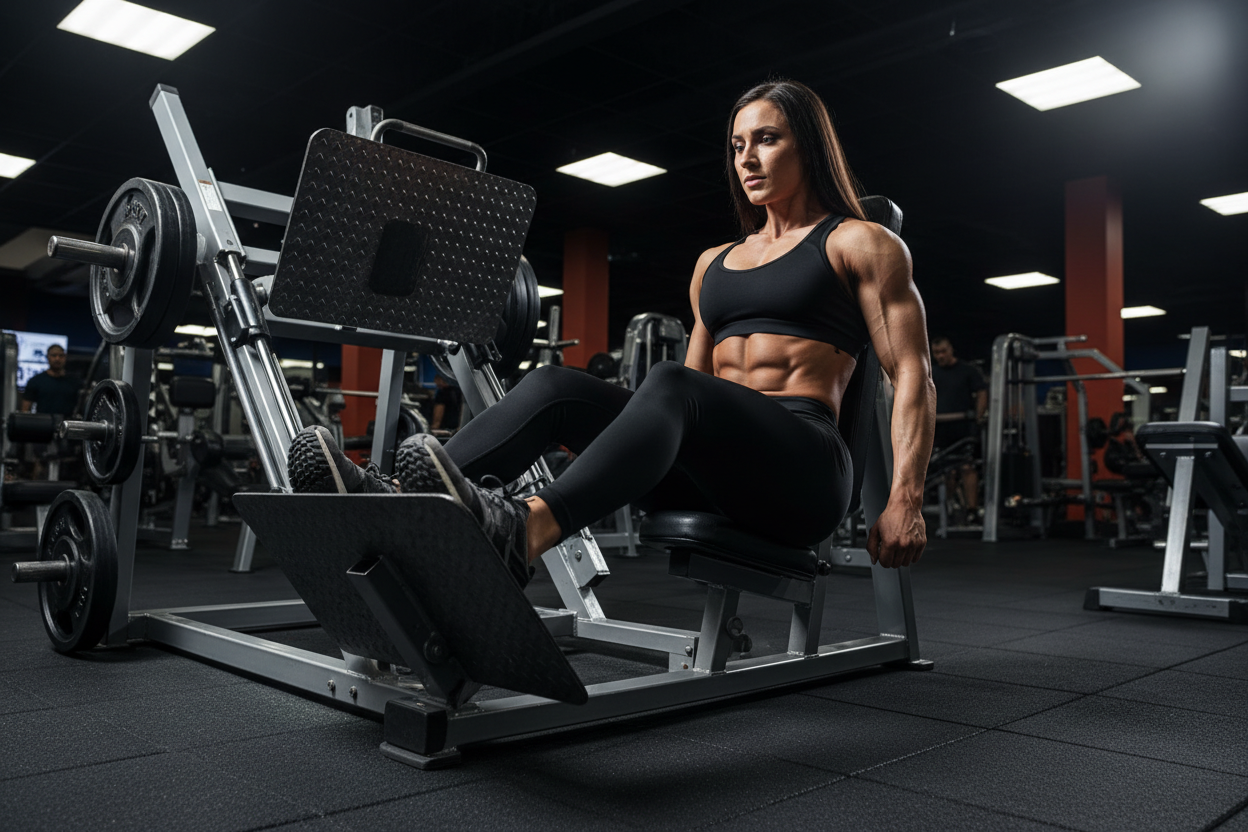
Think of this as a Sumo Deadlift but on a machine. This leg press position for inner thighs requires you to place your feet near the edges of the platform. If the platform is narrow, your toes might even hang off slightly—that is acceptable as long as your heels are planted firmly.
How to Execute the Inner Thigh Workout Leg Press
Proper execution is safer and more effective than simply piling on weight. Here is the step-by-step protocol:
1. The Setup: Load a weight that is about 70% of your normal working set. Sit in the machine and press your lower back firmly against the pad. Place your feet high and wide.
2. The Toe Flare: Rotate your toes outward. This external rotation is crucial. If your feet are wide but your toes point straight up, you risk torquing your knee joint. Your knees must track in the same direction as your toes.
3. The Descent: Unlock the safeties. Lower the weight slowly. Focus on "opening" your hips as the weight comes down. You should feel a deep stretch in the groin area. This is the essence of the leg press inner thigh workout.
4. The Drive: Push through your heels. Do not let your knees cave inward (valgus collapse) as you push. Keep them forced out wide.
Inner Quad Leg Press vs. Inner Thigh
There is often confusion between the "inner quad" (Vastus Medialis Oblique or VMO) and the "inner thigh" (Adductors). While they are neighbors, they require slightly different stimuli.
The inner quad leg press usually benefits from a slightly lower foot placement to increase knee flexion, whereas the adductor-focused press relies on a wider stance and hip abduction. However, the wide stance described here hits both effectively. You get the adductor stretch at the bottom and the VMO engagement at the lockout.
Common Mistakes to Avoid
Ego Lifting: The adductors are generally weaker than the quads. If you use your normal heavy weight, your body will instinctively narrow the stance or cut the depth to compensate.
Lifting the Glutes: This is a major red flag. If you lower the weight so far that your butt curls off the seat, you are placing dangerous sheer force on your lumbar spine. Stop the rep the moment your hip flexibility maxes out.
My Personal Experience with leg press for inner thighs
I started prioritizing adductor work after a minor groin strain kept nagging me during heavy squats. I shifted to the leg press to stabilize the load without the balance requirements of free weights.
The first thing I noticed wasn't just the burn—it was the awkward friction. When you really widen your stance for a true leg press for thighs focus, your pants tend to catch and drag against the vinyl seat as your hips open up. I actually had to start wearing slicker synthetic shorts because the cotton ones were bunching up and limiting my range of motion at the very bottom of the rep.
Another detail most guides skip is the "shaking" that happens on the negative. Because the adductors aren't used to stabilizing heavy loads in isolation, my legs would tremble uncontrollably on the descent for the first three weeks. It wasn't fatigue; it was neurological learning. Once that shaking stopped, my squat numbers shot up because my hole stability was rock solid.
Conclusion
Building impressive legs requires hitting them from every angle. The wide-stance leg press is the most effective compound movement for bringing up lagging adductors safely. Drop the weight, widen your feet, and focus on the stretch.
Frequently Asked Questions
Does a wide stance leg press really work inner thighs?
Yes. Electromyography (EMG) studies suggest that a wider stance significantly increases the activation of the adductor muscles compared to a narrow stance, which predominantly targets the outer quads.
Is the leg press better than the adductor machine?
They serve different purposes. The adductor machine (suspenders) is an isolation movement. The leg press is a compound movement. For overall mass and strength, the leg press is superior, but the isolation machine is excellent for finishing a workout.
Where should I place my feet for inner thighs?
Place your feet wider than shoulder-width, ideally near the edges of the platform. Ensure your toes are flared out at 30 to 45 degrees so your knees track properly over your toes during the movement.