No Rack, No Problem: A Dumbbell Leg Day Routine That Actually Builds Mass
You do not need a barbell, a squat rack, or a leg press machine to build impressive, strong legs. While heavy compound lifts are often touted as the gold standard for hypertrophy, relying solely on them creates a mental barrier that suggests you can't get a quality workout without waiting in line for the power rack. The truth is, dumbbells offer a unique advantage: they force unilateral stabilization, increase your range of motion, and can humble even the strongest lifters when applied correctly.
If you are looking to construct a solid dumbbell leg day routine, the secret lies in intensity and volume rather than absolute load. Because you likely won't be squatting 400 pounds in dumbbells, you have to manipulate other variables—specifically tempo, rest times, and unilateral movements—to force the muscle to grow. This approach not only builds size but also improves athleticism and balance in a way that bilateral barbell training sometimes misses.
The Myth of Heavy Metal
I learned the hard way that weight on the bar doesn't always equal growth. A few years back, I was traveling for work for three weeks and only had access to a hotel gym. The heaviest dumbbells they had were 50 pounds. As someone used to squatting heavy, I thought I was going to lose all my gains. I was wrong. I decided to focus on high-volume Bulgarian Split Squats and slow-tempo Goblet Squats.
By the end of the trip, my quads were more defined, and my glutes were sore in places I didn't know existed. The lack of heavy external load forced me to focus on the mind-muscle connection and perfect form. When I returned to my home gym, my barbell squat form had improved, and my knee pain had vanished. That experience shifted my perspective entirely: you don't need to crush your spine to crush your legs.
Anatomy of a Leg Dumbbell Workout Routine
To create a comprehensive workout, you need to hit the major movers: the quadriceps, hamstrings, glutes, and calves. A barbell allows you to hide imbalances; if your right leg is stronger, it takes over. Dumbbells expose these weaknesses immediately.
A successful leg dumbbell workout routine should start with your most demanding compound movement and move toward isolation. Since grip strength can be a limiting factor with dumbbells, we structure the workout to prioritize the heaviest holds when you are freshest.
1. The Goblet Squat
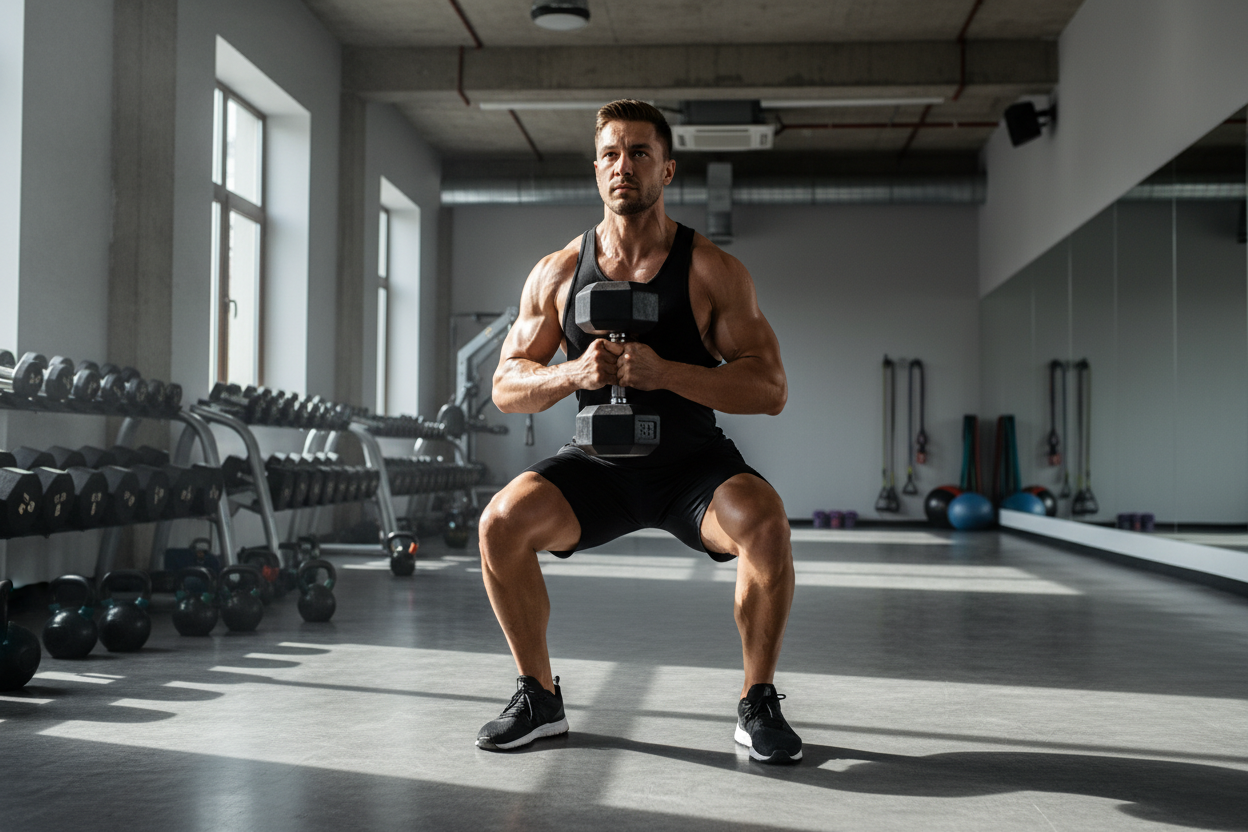
This is your primary mass builder. Hold a single heavy dumbbell vertically against your chest, cupping the top end with both hands. This front-loaded position acts as a counterbalance, allowing you to sit deeper into the squat than you typically can with a back squat. This depth stretches the quads under load, which is a primary driver of hypertrophy.
Keep your elbows tucked in. If your elbows touch your knees, you hit the proper depth. Because the weight is lower than a barbell squat, aim for higher reps—think 12 to 15—and control the descent for a count of three seconds.
2. Romanian Deadlifts (RDLs)
For the posterior chain, the Dumbbell RDL is non-negotiable. Hold a dumbbell in each hand in front of your thighs. Keep a slight bend in your knees, but do not squat. Hinge at the hips, pushing your glutes backward as if you are trying to close a car door with your butt.
Lower the weights until you feel a deep stretch in your hamstrings. The dumbbells should stay close to your shins throughout the movement. Drive your hips forward to return to standing. This movement targets the hamstrings and glutes while reinforcing lower back stability.
3. Bulgarian Split Squats
This is the exercise everyone loves to hate, but it is the cornerstone of any effective dumbbell leg day routine. Place one foot on a bench or sturdy surface behind you and hold a dumbbell in each hand (or one heavy one at your chest). Lower your back knee toward the ground until your front thigh is parallel to the floor.
This unilateral movement isolates the quad and glute of the working leg, removing any chance of the dominant leg taking over. It also places a massive demand on your balance stabilizers. If you want to bias the glutes, lean your torso forward slightly. For quads, keep your torso upright.
4. Walking Lunges
Lunges add a dynamic component to the session. Walking lunges challenge your coordination and cardiovascular system while torching the legs. Holding dumbbells at your sides, take a step forward and drop the back knee. Drive through the heel of the front foot to step into the next lunge.
This serves as a metabolic finisher. By the time you reach this point in the workout, your grip might be failing. If that happens, use lifting straps or switch to a bodyweight variation with higher reps to ensure your legs reach failure before your hands do.
5. Dumbbell Calf Raises
Don't neglect the lower leg. Stand holding a dumbbell in one hand and use the other hand to balance against a wall or rack. Perform single-leg calf raises, focusing on a full stretch at the bottom and a hard contraction at the top. Unilateral calf work is generally superior to bilateral because it allows for a greater range of motion and focus.
The Complete Routine
Here is how to put it all together. Perform this routine twice a week with at least two days of rest in between sessions.
- Goblet Squats: 4 sets of 12-15 reps (Rest 60-90s)
- Dumbbell RDLs: 4 sets of 10-12 reps (Rest 60-90s)
- Bulgarian Split Squats: 3 sets of 10 reps per leg (Rest 90s)
- Walking Lunges: 3 sets of 20 steps total (Rest 60s)
- Single-Leg Calf Raises: 3 sets of 15-20 reps per leg (Rest 45s)
Progressive Overload Without Heavier Weights
Eventually, you might max out the dumbbells available at your gym or home. When 50 or 70 pounds becomes too easy for 15 reps, you do not necessarily need to buy heavier weights. You need to increase the density of the workout.
Reduce your rest periods. If you were resting 90 seconds, cut it to 60. Alternatively, utilize "1.5 reps." Go all the way down, come halfway up, go back down, and then come all the way up. That counts as one rep. This technique drastically increases the time under tension, making a light weight feel incredibly heavy.
Safety and Form Considerations
Dumbbells offer freedom of movement, but that freedom requires control. Avoid swinging the weights or using momentum to complete reps. Since you are not locked into a fixed bar path, your stabilizers are working overtime. Ensure your core is braced before every lift to protect your lower back, especially during RDLs and squats.
Also, pay attention to your grip. It is often the first thing to give out during a leg dumbbell workout routine. If your grip fails before your legs, you are not stimulating the leg muscles enough. Invest in a pair of straps or chalk to ensure your quads and hamstrings are the limiting factor, not your forearms.
Frequently Asked Questions
Can I really build mass with just dumbbells?
Yes, muscle hypertrophy occurs through tension and fatigue, not just the specific type of equipment used. By training close to failure with sufficient volume and utilizing exercises like split squats, you can stimulate significant muscle growth comparable to barbell training.
How often should I do this leg workout?
For most intermediate lifters, performing this routine twice a week is optimal. This frequency allows for sufficient recovery while providing enough stimulus to spark growth, assuming you are eating enough protein and sleeping well.
What if I have bad balance for single-leg exercises?
Start by doing split squats or lunges near a wall or sturdy object that you can lightly touch for support. As your stabilizer muscles strengthen over a few weeks, you will naturally become less reliant on the support and can move to free-standing reps.