Nervous About Training in the Gym? Start Your Prep at Home
I remember my first personal training client, Sarah. She had a commercial facility membership for six months but never went past the cardio section. The sprawling weight room floor felt like a gladiator arena to her. If you have ever stood at the edge of the free-weight section, heart pounding, trying to figure out how a cable stack works while navigating the crowds, you know exactly what I mean. The anxiety of training in the gym is a massive barrier for most newcomers.
But what if you didn't have to figure it all out under the fluorescent lights of a public facility? Over the years of building home setups for my clients, I have developed a bridging strategy. We start in their living rooms, mastering the mechanics of a gym weight workout with minimal equipment. By the time they step foot in a commercial facility, they aren't guessing. They know their stance, they know their grip, and they own their space.
Quick Takeaways
- Mastering basic movement patterns at home eliminates 90% of beginner anxiety.
- You can simulate a complete beginner strength training gym routine using just a pair of adjustable dumbbells and a mat.
- Focusing on strict form and timed rest periods at home builds the exact discipline needed for a public weight room.
- Transitioning to commercial equipment is seamless once you understand the underlying mechanics of pushes, pulls, squats, and hinges.
Why Practice Training in the Gym from Home First?
"Gymtimidation" is a very real psychological hurdle. When you walk into a fitness center, your brain is processing a dozen new stimuli: the layout, the etiquette, the specialized equipment, and the perceived judgment of others. Trying to learn how to properly brace your core or hinge at the hips while dealing with this sensory overload is a recipe for frustration.
Practicing your weight training for beginners at gym routine at home isolates the learning process. You do not have to worry about how much weight is on the bar or if someone is tapping their foot waiting to use your bench. You can drop a dumbbell, lose your balance, or take five minutes to watch a form video on your phone without feeling rushed or embarrassed.
In my experience testing gear and coaching clients, I have found that three to four weeks of home practice builds an incredible baseline of neuromuscular efficiency. Your brain learns how to fire the right muscle groups. When you finally buy that commercial membership, you aren't a true beginner learning how to lift; you are simply adapting movements you already know to new, heavier equipment.
Your First Gym Weight Workout: Simulating the Experience
To make this strategy work, your home sessions cannot just be random push-ups during commercial breaks. You need to simulate the pacing and focus of an actual beginner strength training gym session. This means dedicating 45 minutes, putting on your workout shoes, and following a structured plan from start to finish.
Start by treating your living room like a squat rack. Set a timer for your rest periods—aim for 60 to 90 seconds between sets. This teaches you the rhythm of a standard lifting session. When you eventually transition to a commercial facility, this internal clock will keep you from awkwardly lingering between sets or rushing through your routine.
You also want to replicate the stability and targeted tension that commercial equipment provides. While you might be tempted to research the best weight training machines to buy for your garage, you can easily mimic their effects using controlled free-weight movements. Focus on a slow, three-second eccentric (lowering) phase for every rep. This time-under-tension builds the same foundational strength you would get from a selectorized chest press or leg extension machine.
Setting Up Your Practice Floor (Equipment Needs)
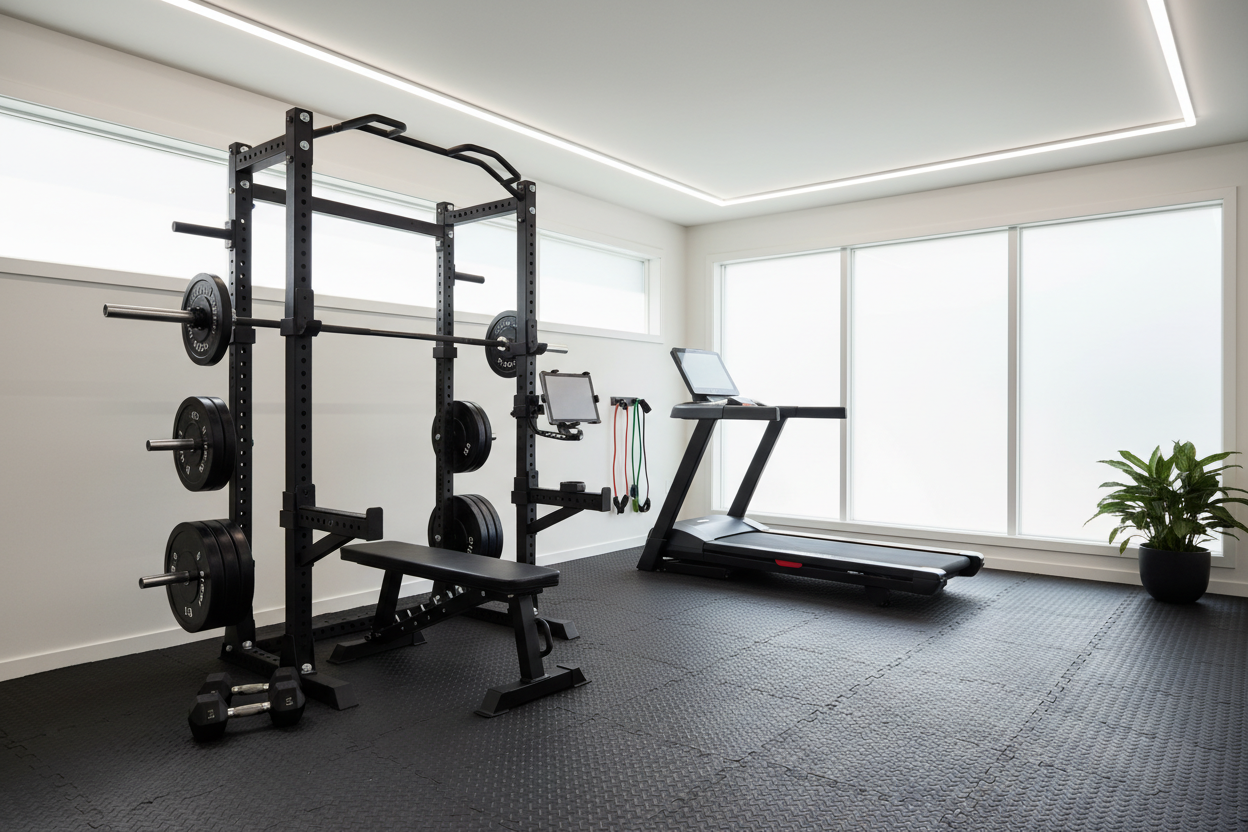
You do not need a massive budget to prepare for the weight room. I usually have my clients start with a pair of adjustable dumbbells ranging from 5 to 52.5 pounds. This gives you enough resistance to practice heavy goblet squats while still allowing for lighter lateral raises.
Beyond the weights, spatial awareness is critical. In a public setting, you have a defined working area. To replicate this, I highly recommend laying down a large exercise mat in your living room or garage. This creates a physical boundary for your workout, teaching you how to manage your footprint—a vital skill when the floor gets crowded at 5 PM.
One honest downside to home practice is the lack of a sturdy bench. You can do floor presses instead of bench presses, but your range of motion will be slightly limited because your elbows hit the ground. However, for learning the initial mechanics, the floor actually provides excellent physical feedback for keeping your shoulder blades retracted and tight.
Choosing the Right Surface for Safety
When you are holding weights and learning to balance, the last thing you want is a living room rug sliding out from under your feet. Commercial facilities use thick rubber flooring for a reason: it absorbs impact, protects your joints, and provides a high-traction surface for heavy lifts.
To recreate this safely at home, invest in a heavy-duty 6x8ft exercise mat. This specific size perfectly accommodates the footprint of a standard lifting session, giving you enough room to step out into lunges or lie down fully for core work. It also dampens the noise, which your downstairs neighbors will appreciate when you set down a 30-pound dumbbell.
The Core Routine: Strength Training for Beginners at Gym
A solid strength training blueprint relies on four main pillars: the squat, the hinge, the push, and the pull. If you can master these at home, you can conquer any piece of equipment in a public facility.
Start with the goblet squat. Hold a single dumbbell vertically against your chest. Push your hips back and sink down until your elbows touch your knees. This movement teaches you core bracing and upright posture, which translates directly to the barbell back squat or the leg press machine.
Next, practice the Romanian Deadlift (RDL) with a pair of dumbbells. This is your hinge. Keep your legs mostly straight with a soft bend in the knee, push your glutes toward the wall behind you, and feel the stretch in your hamstrings. Mastering this at home prevents the dreaded rounded-back deadlift that so many beginners struggle with.
For the push, utilize the floor press. Lie on your back, knees bent, and press the dumbbells over your chest until your triceps hit the floor. For the pull, use a single-arm dumbbell row, bracing your non-working hand on a sturdy chair or couch to keep your back flat.
Replicating Gym Weight Training for Beginners
When translating these home movements to a commercial setting, remember that gym weight training for beginners is essentially the same biomechanics applied to different tools. A dumbbell floor press becomes a machine chest press. A dumbbell row becomes a seated cable row.
By practicing with free weights first, you are actually taking the harder path. Dumbbells require you to stabilize the weight yourself. When you eventually sit down at a chest press machine, the machine handles the stabilization for you. You will likely find the commercial equipment feels significantly easier because you have already built the stabilizing muscles in your living room.
Making the Leap: Weights at the Gym for Beginners
How do you know when it is time to pack your bag and head out? I tell my clients to look for two signs. First, you are maxing out your adjustable dumbbells on squats and RDLs. Second, you can perform your entire home routine smoothly without having to look up form videos.
When you walk into the commercial facility for the first time, stick to the exact routine you have been doing at home. Grab some dumbbells, find a quiet corner, and execute the movements you already own. Transitioning to weights at the gym for beginners is about changing the environment, not the workout. Once you feel comfortable in the space, you can start exploring the machines and barbells with total confidence.
Frequently Asked Questions
How long should I train at home before joining a facility?
Most clients need about 4 to 6 weeks of consistent home workouts (training 3 days a week) to build the muscle memory and confidence required to feel comfortable in a commercial setting.
What if I don't have heavy enough weights at home?
Focus on tempo and form. Slow down your repetitions, pausing for two full seconds at the bottom of a squat or the top of a row. This increases the intensity and builds muscle even with much lighter weights.
How do I handle the anxiety of my first public workout?
Go with a plan. Write your routine down in a notebook or on your phone. When you feel overwhelmed, look at your list. Having a specific task to focus on grounds you and stops you from worrying about what others are doing.