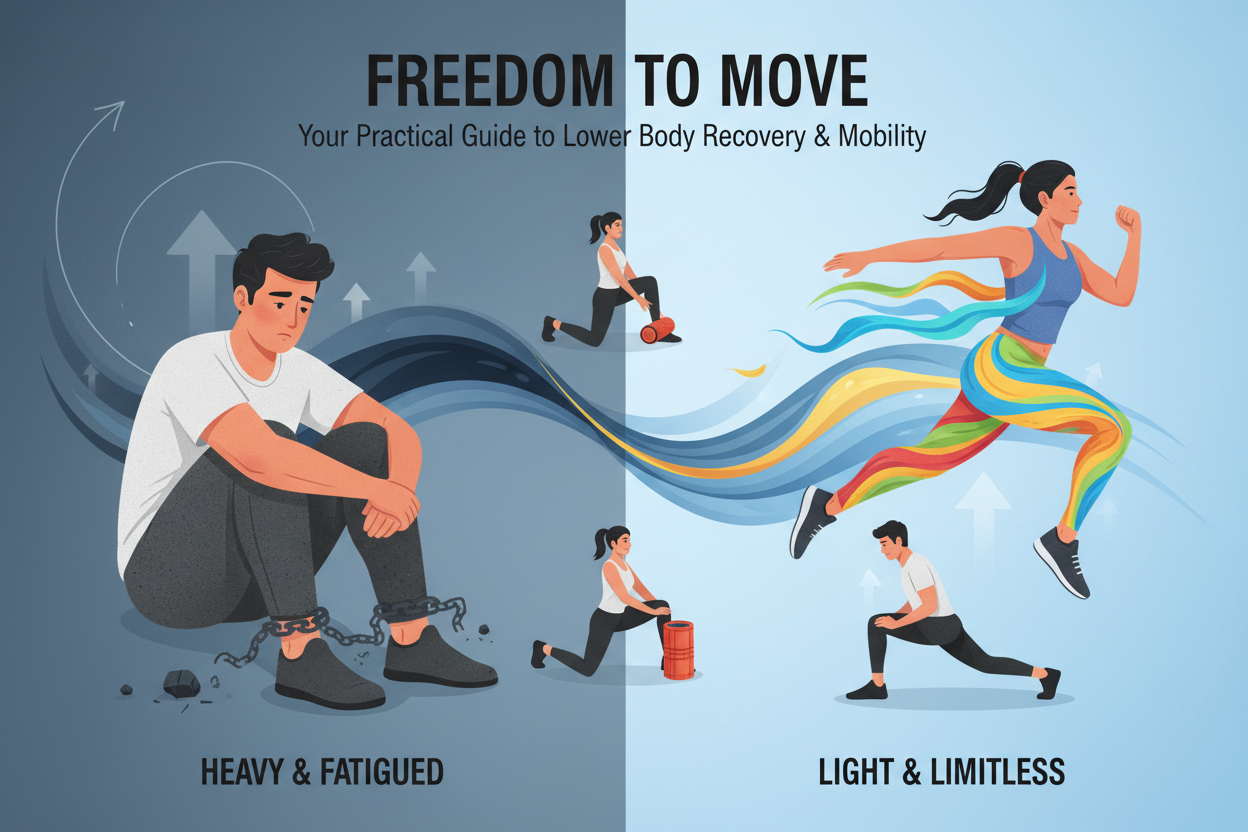
My Legs Feel Like Concrete: A Practical Guide to Reclaiming Lower Body Freedom
You know that feeling when you stand up after a long drive or a few hours at your desk, and your hips refuse to straighten out? That stiffness isn’t just aging; it is a sign that your joints are craving movement. Most people assume they need to stretch more, pulling on their hamstrings until they hurt, but flexibility is only half the battle. The real solution lies in leg mobility—the ability to move your joints actively through a full range of motion with control.
If you are looking for the short answer on how to fix this: stop holding static stretches for 30 seconds before your workout. Instead, adopt a dynamic lower body mobility routine that forces your muscles to engage at their end ranges. You need to grease the groove of the joint capsule, not just lengthen the muscle fiber.
Why Your Static Stretching Isn't Working
I spent years thinking that touching my toes was the gold standard of health. I would sit on the floor, reaching forward, trying to force my hamstrings to lengthen. Yet, the moment I tried to squat deep with a barbell or run a trail, my hips felt locked. I had flexibility (passive range), but I had zero lower body mobility (active control).
There was a specific moment that changed my perspective. I was working with a physical therapist for some nagging knee pain, and he asked me to lift my leg while standing without leaning back. I could barely get my knee to hip height. He told me, "You have plenty of length, but you have no control over it." That was the missing link. Mobility exercises for legs are designed to bridge that gap between how far you can be pushed and how far you can move yourself.
The Foundations of a Solid Leg Mobility Workout
To build a functional lower half, you cannot focus on just one muscle group. The kinetic chain connects your ankles, knees, and hips. If your ankles are stiff, your knees take the beating. If your hips are tight, your lower back suffers. A comprehensive lower body mobility workout addresses all three.
Here is a breakdown of movements that yield the highest return on investment. These aren't just stretches; they are active inputs for your nervous system.
1. The 90/90 Hip Switch
The hips are the centerpiece of mobility legs require. The 90/90 switch is non-negotiable because it targets both internal and external rotation simultaneously. Most people lack internal rotation, which leads to hip impingement and lower back pain.
Sit on the floor. Position your front leg bent at a 90-degree angle directly in front of you, and your back leg bent at 90 degrees out to the side. Keeping your torso tall, drive your knees into the floor. Without using your hands (if possible), lift your knees and rotate them to the other side, ending up in the mirror image position. This is one of the most effective leg mobility exercises because it flushes the hip capsule with movement.
2. Ankle Dorsiflexion Pries
We often ignore the ankles until we sprain them. Poor ankle mobility is the silent killer of squat depth and running mechanics. If your knees cannot travel over your toes, your body compensates elsewhere.
Get into a half-kneeling position. Keep your front heel glued to the floor. Drive your front knee forward over your toes until you feel a stretch in the Achilles and calf. Pulse in and out of this end range. This specific mobility exercise for legs ensures that your foundation can handle the load of walking, running, or lifting.
3. The Cossack Squat
Lower mobility often suffers in the lateral plane. We walk forward, sit forward, and run forward. We rarely move side-to-side. The Cossack squat opens up the adductors (inner thighs) and restores lateral hip function.
Stand with a very wide stance. Shift your weight to one side, bending that knee while keeping the other leg straight. Rotate the toes of the straight leg up toward the ceiling. Sink as deep as you can while keeping your heels down, then drive back up. Incorporating this into your lower body mobility exercises library will drastically improve how your hips feel during everyday tasks.
4. The Jefferson Curl
While controversial to some, when done with light weight and control, this is fantastic for the posterior chain. It articulates the spine and lengthens the hamstrings under load. Stand on a box holding a light weight. Tuck your chin and slowly roll your spine down, vertebra by vertebra, letting the weight pull you into a deep forward fold. Reverse the motion slowly. This serves as both a back and mobility leg exercise.
Structuring Your Routine
You do not need an hour to see results. Consistency beats intensity when it comes to joint health. A simple 10-minute lower mobility workout done daily is superior to a one-hour session done once a week.
Try this sequence before your main workout or as a morning wake-up call:
- Ankle Pries: 10 reps per side
- 90/90 Switches: 10 reps total
- Cat-Cows (for spinal prep): 10 reps
- Deep Squat Hold: 30 seconds (rocking side to side)
- Cossack Squats: 6 reps per side
This circuit covers all the bases of lower body mobility. It wakes up the nervous system and prepares the tissue for load. If you are a runner, these mobility exercises for legs are crucial for preventing plantar fasciitis and runner's knee.
Common Pitfalls in Lower Mobility Training
When starting lower mobility exercises, the biggest mistake is forcing range of motion that isn't there yet. If you feel a sharp, pinching pain in the front of your hip during a squat, stop. That is a bone-on-bone or impingement sensation. Pushing through it will not make you more mobile; it will just cause inflammation.
Another error is holding your breath. Leg mobility requires oxygen. If you are holding your breath, your nervous system perceives a threat and will tighten your muscles to protect you. Breathe deeply into the diaphragm to signal safety to your body, allowing you to access deeper ranges in your lower body mobility routine.
The Long-Term Benefit
Treating mobility leg exercises as a hygiene habit—like brushing your teeth—changes the trajectory of your physical aging. You stop feeling like the Tin Man every time you get out of a car. Your squat depth improves naturally. Your lower back pain often dissipates because your hips are finally doing their job.
Remember that lower mobility is use-it-or-lose-it. The modern world is designed to restrict us to chairs and car seats. By actively fighting against that restriction with targeted leg mobility exercises, you preserve your independence and physical capability for decades to come.
Frequently Asked Questions
How often should I do mobility exercises?
Ideally, you should perform some form of mobility work every single day. Since mobility training is generally lower intensity than strength training, it doesn't require long recovery periods. A short 10-minute session daily is more effective than one long session per week.
Can mobility work replace my warm-up?
Yes, dynamic mobility work is actually the best kind of warm-up. Unlike static stretching, which can temporarily weaken muscles, active mobility drills increase blood flow, body temperature, and joint lubrication, preparing you specifically for the workout ahead.
Is it normal to feel cramping during these exercises?
Absolutely. When you engage muscles in shortened positions (like the glutes or hamstrings during hip rotations), they often cramp because they aren't used to firing in that range. This is often called a "neurological confusion" and usually improves as your body adapts to the new positions.