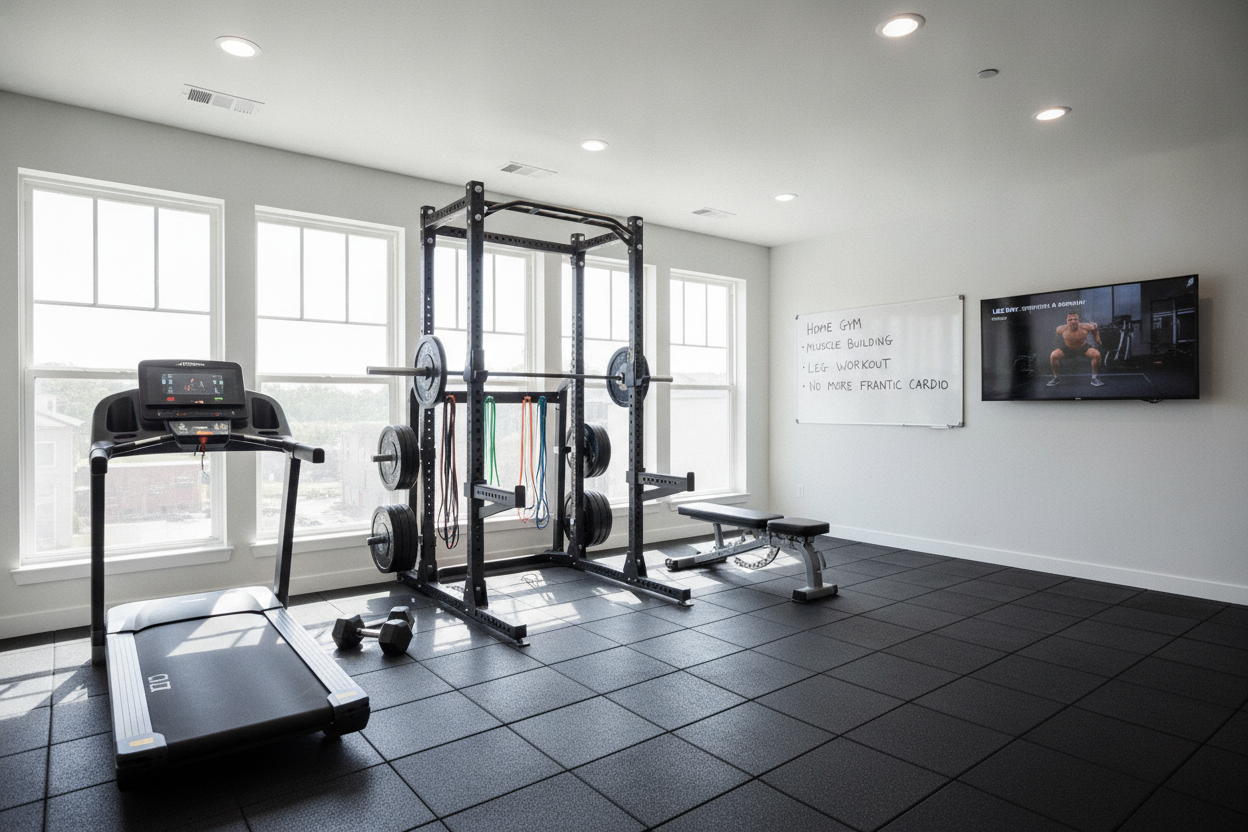
Most Leg Workout Videos at Home Are Just Frantic Cardio
I spent years thinking that if I ended a session in a puddle of sweat, I was winning. I would fire up a high-energy trainer on my TV and hop around my living room like a caffeinated kangaroo. But my quads stayed exactly the same size. I was getting fitter, sure, but I wasn't getting stronger. The reality is that most leg workout videos at home are designed to keep your heart rate high so you feel like you got your money's worth, while your muscle fibers are barely being challenged.
- High-rep bodyweight squats are cardio, not strength training.
- Stability is the foundation of force—if you're sliding, you aren't growing.
- The 'pause' button is your best friend for actual hypertrophy.
- Adding external load is mandatory once you master the movement patterns.
The 'Sweat Equals Progress' Trap
We have all been there. You finish a 30-minute session, your shirt is soaked, and your heart is hammering against your ribs. You think you have absolutely crushed it. But here is the cold truth: being out of breath has almost nothing to do with making your legs bigger or stronger. This is the difference between metabolic fatigue and mechanical tension.
Hypertrophy—the actual growth of muscle tissue—requires mechanical tension. That means putting your muscle fibers under enough load to force them to adapt. Most follow-along routines rely on 'metabolic fatigue.' They keep you moving fast so you feel 'the burn,' but your muscles are never actually reaching the failure point that triggers growth. If you can do 45 seconds of rapid-fire jump squats without your form breaking down, you are training your lungs, not your legs. When you move that fast, momentum takes over. You are bouncing off your tendons rather than forcing your quads and glutes to control the weight. To grow, you need to slow down and make the muscle work through the entire range of motion, which rarely happens in a 'frantic cardio' style leg workout video at home.
What a Good Leg Workout Video at Home Actually Looks Like
If you want to actually change the shape of your legs, you need to look for videos that prioritize control over calories. A quality routine won't ask you to do 100 air squats. Instead, it will focus on unilateral (one-legged) movements that naturally increase the load on the working limb. Think Bulgarian split squats, staggered-stance RDLs, and lateral lunges with a deliberate pause at the bottom.
A great example of this is a 13 Min Leg Booty Thigh Workout. This type of routine works because it doesn't waste time with 'filler' movements like jumping jacks. It stays focused on the target muscles and uses specific tempos to keep the tension high. When you see a trainer holding a deep squat for three seconds before driving up, that is a sign they know what they are doing. You want a video that emphasizes the eccentric (lowering) phase of the movement. That is where the magic happens. If the video feels 'slow' but your muscles feel like they are about to explode, you have found a winner.
You're Slipping Because of Your Floor, Not Your Fitness
One thing nobody tells you about those polished YouTube trainers is that they are filming in professional studios with high-grip athletic flooring. You, meanwhile, are likely trying to do lunges on a dusty hardwood floor or a piece of carpet that slides three inches every time you push off. This is a massive problem for muscle growth. If your brain senses that your feet aren't stable, it will literally 'throttle' the amount of force your muscles are allowed to produce to prevent you from falling. It is a built-in safety mechanism.
I realized this when I tried to do a heavy set of split squats on a rug. I spent more energy trying not to do the accidental splits than I did actually loading my quads. To fix this, you need a dedicated training surface. A 6x8ft exercise mat is the easiest fix for a living room setup. It gives you enough space to move dynamically without worrying about the floor. Once you have a stable base, you can actually drive through your heels and hit full depth on your squats. You will notice an immediate difference in how much 'heavier' your bodyweight feels when your feet are actually locked into the ground.
How to Modify the Screen's Pacing for Real Strength
The biggest mistake you can make is being a slave to the video's timer. If the trainer says 'go' for 45 seconds, but your form starts to get sloppy at 30, stop. Or, better yet, ignore their pace entirely. If you want to build serious size, you need to treat these videos as a blueprint, not a command. I always keep a pair of heavy dumbbells next to me when I follow a video. If the trainer is doing bodyweight lunges, I am holding 50s. This means I might only get 8 reps while they do 20, but my 8 reps are doing significantly more for my muscle mass than their 20 reps of cardio.
Don't be afraid to hit the pause button. Most videos have 15-second rest intervals, which is nowhere near enough time for your ATP stores to replenish if you are actually lifting heavy. Give yourself 60 to 90 seconds between difficult sets. You want every set to be high quality. If you are still gasping for air when the next exercise starts, you are back in the cardio trap. Control the video; don't let the video control you. Use the trainer for motivation and movement ideas, but use your own logic for the intensity and rest.
Personal Experience: The Rug Incident
A few years back, I tried to follow a 'hardcore' leg routine on my bedroom floor. I was wearing socks on a laminate surface. Halfway through a set of explosive skaters, my foot caught a loose edge of a small rug and I went flying into my nightstand. Not only did I bruise my hip, but I realized I hadn't actually felt my legs working for the previous ten minutes because I was so focused on not slipping. I bought a real mat the next day and stopped doing 'jump' variations entirely, switching to slow, weighted movements. My legs grew more in the next three months than they had in the previous three years.
FAQ
Can I build big legs with just bodyweight?
Yes, but it is harder. You have to use advanced variations like pistol squats or very slow tempos (5 seconds down, 5 seconds up) to create enough tension without extra weight.
Why do my knees hurt during these videos?
Usually, it is because the pace is too fast. When you rush, your knees often cave inward (valgus) or your heels lift off the floor. Slow down and focus on keeping your knees tracked over your toes.
Are 'burners' at the end of a video worth it?
They are fine for a 'finish,' but they shouldn't be the meat of the workout. Think of them as the cherry on top, not the sundae itself.