Mastering the Full Body 4 Day Workout: Training Frameworks, Recovery Pacing, and Home Floor Staging
Organizing training volume around a full body 4 day workout offers an adaptable framework for lifters aiming to develop strength, movement quality, and physical resilience. Rather than isolating single muscle groups on specific days, a four-day full-body model distributes primary movement archetypes across the training week. This approach stimulates major kinetic chains regularly, supports balance between opposing muscle groups, and allows adequate intervals between sessions for restorative pacing.
To execute a sustainable 4 day full body workout program within a home training environment, thoughtful movement design must be paired with an organized physical setup. Establishing dedicated floor staging, managing loading zones, and maintaining reliable footing ensure that transitions between heavy compound lifts, unilateral accessories, and ground-based movements remain smooth and focused.
Understanding the Biomechanical Architecture of a 4-Day Full Body Routine
Distributing weekly stimulus across four distinct workouts allows lifters to accumulate meaningful movement practice without accumulating excessive localized fatigue in a single session. When training the entire body multiple times per week, each session engages the musculature through foundational motor patterns rather than exhaustive isolation work.
This frequency-focused structure distributes work across upper-body pushing, upper-body pulling, knee flexion, hip extension, and trunk stabilization. By practicing these movement vectors across separate days, lifters can approach foundational lifts with higher movement quality and cleaner technical execution. Balancing systemic demand across four sessions helps manage joint stress and neuromuscular fatigue throughout the training cycle.
Weekly Movement Architecture: Structuring the 4-Day Split Matrix
Designing an effective full body 4 day workout routine requires intentional variation between primary and secondary movement patterns. Alternating the mechanical emphasis of each session ensures balanced development while giving loaded tissues sufficient intervals to recover.
Day-by-Day Movement Pairing and Plane Variation
A balanced weekly structure often alternates movement priority across sessions. For instance, one session may feature a bilateral knee-dominant movement paired with an upper-body horizontal pull and vertical push, while the subsequent session highlights a hip-dominant hinge, horizontal push, and vertical pull. Exploring structured frameworks like a dedicated full body workout guide provides additional perspective on managing frequency and alternating training days effectively.
- Day 1 (Squat & Horizontal Pull Focus): Bilateral knee flexion, horizontal pulling, secondary vertical pressing, and anti-extension core work.
- Day 2 (Hinge & Horizontal Push Focus): Posterior chain hip hinging, horizontal pressing, secondary vertical pulling, and lateral hip stabilization.
- Day 3 (Unilateral Lower & Vertical Pull Focus): Split-stance lower body loading, vertical pulling, secondary horizontal pressing, and rotational trunk control.
- Day 4 (Posterior Chain & Overhead Push Focus): Romanian deadlifts or hip thrusts, overhead pressing, chest-supported rows, and loaded carries.
Systemic Fatigue Management and Weekly Pacing
Because every session recruits whole-body kinetic chains, weekly pacing must prevent cumulative joint strain. Lifters can structure the four training days with an alternating schedule (such as training on Monday, Tuesday, Thursday, and Friday) or an every-other-day sequence. Managing proximity to technical failure on compound lifts leaves sufficient systemic reserve for subsequent workouts, supporting long-term consistency.
Core Exercise Archetypes for a 4 Day Full Body Workout Program
Constructing a well-rounded exercise library involves selecting versatile compound foundations and purposeful accessory movements. Combining these archetypes creates a complete full body lifting workout routine that builds functional capability across diverse physical demands.
Compound Bilateral and Unilateral Foundations
Foundational exercises form the baseline of each training session. Bilateral squatting patterns and multi-joint hip hinges build baseline lower-body force transmission, while unilateral variations—such as Bulgarian split squats, reverse lunges, and single-leg Romanian deadlifts—address side-to-side asymmetries and strengthen joint stabilizers.
Upper-body mechanics should balance horizontal pushing (such as flat or incline dumbbell bench presses) with horizontal pulling movements like barbell rows, single-arm dumbbell rows, or seated cable rows. Pairing vertical presses with vertical pulls maintains structural symmetry across the shoulder girdle and thoracic spine.
Accessory Loading and Multi-Planar Core Stabilization
Accessory movements reinforce posture, joint tracking, and movement mechanics. Incorporating anti-rotational exercises, such as Pallof presses, side planks, and suitcase carries, helps maintain core stiffness during heavy compound lifts. Targeted accessories for the rotator cuff, hamstrings, and upper back further enhance movement longevity across frequent full-body training.
Dedicated Floor Staging and Home Gym Layout for Full-Body Training
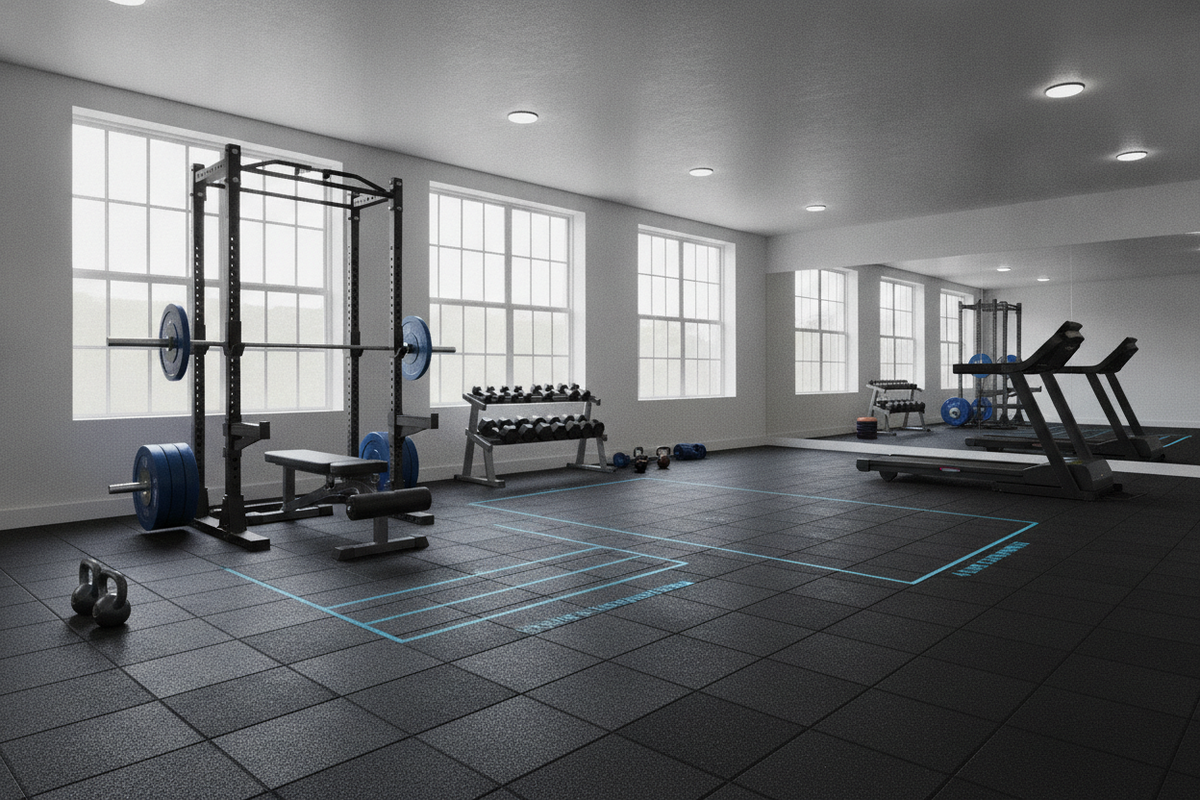
Executing a full-body routine requires moving between free weights, benches, and floor-based movements within a single session. Establishing dedicated workout flooring creates a dependable, safe foundation for both lifter and equipment.
Subfloor Protection and Kinetic Absorption Under Heavy Compound Loads
Heavy compound lifting involves repeated mechanical contact between weighted equipment and the floor. Utilizing a dense, large-format exercise mat shields underlying residential surfaces from point-load pressure and reduces direct surface impact during dumbbell sets, kettlebell work, and barbell training. Firm, non-compressible gym flooring also gives the lifter a solid, level surface for stable foot positioning during heavy bilateral squats and hinges.
Station Consolidation and Footing Stability for Dynamic Lifts
A unified, expansive training mat eliminates shifting seams and uneven gaps between separate tiles, reducing tripping hazards during dynamic transitions. Positioning adjustable benches, weight racks, and dumbbells on a cohesive non-slip surface maintains organization and smooth workflow throughout multi-exercise supersets.
Surface Maintenance, Grip Integrity, and Training Longevity
Preserving training surface traction and floor cleanliness supports consistent footing over extended training cycles. Sweat accumulation, dust, and chalk residue can reduce surface grip if left unaddressed. Routine care preserves the mat's texture and protective qualities.
- Regular Debris Removal: Sweep or vacuum the floor staging area regularly to eliminate dust, dirt, and grit that compromise traction.
- Gentle Surface Cleaning: Wipe down mat surfaces after intensive sessions using mild, non-abrasive soapy water and a soft cloth or mop.
- Moisture Management: Allow the flooring surface to dry completely after cleaning to maintain slip-resistant properties and material durability.
- Zoned Storage: Keep weight plates and heavy accessories on perimeter storage racks to maximize usable training floor space.
For more home gym planning recommendations, exercise strategies, and setup blueprints, visit our home training workout hub to support your long-term fitness routine.