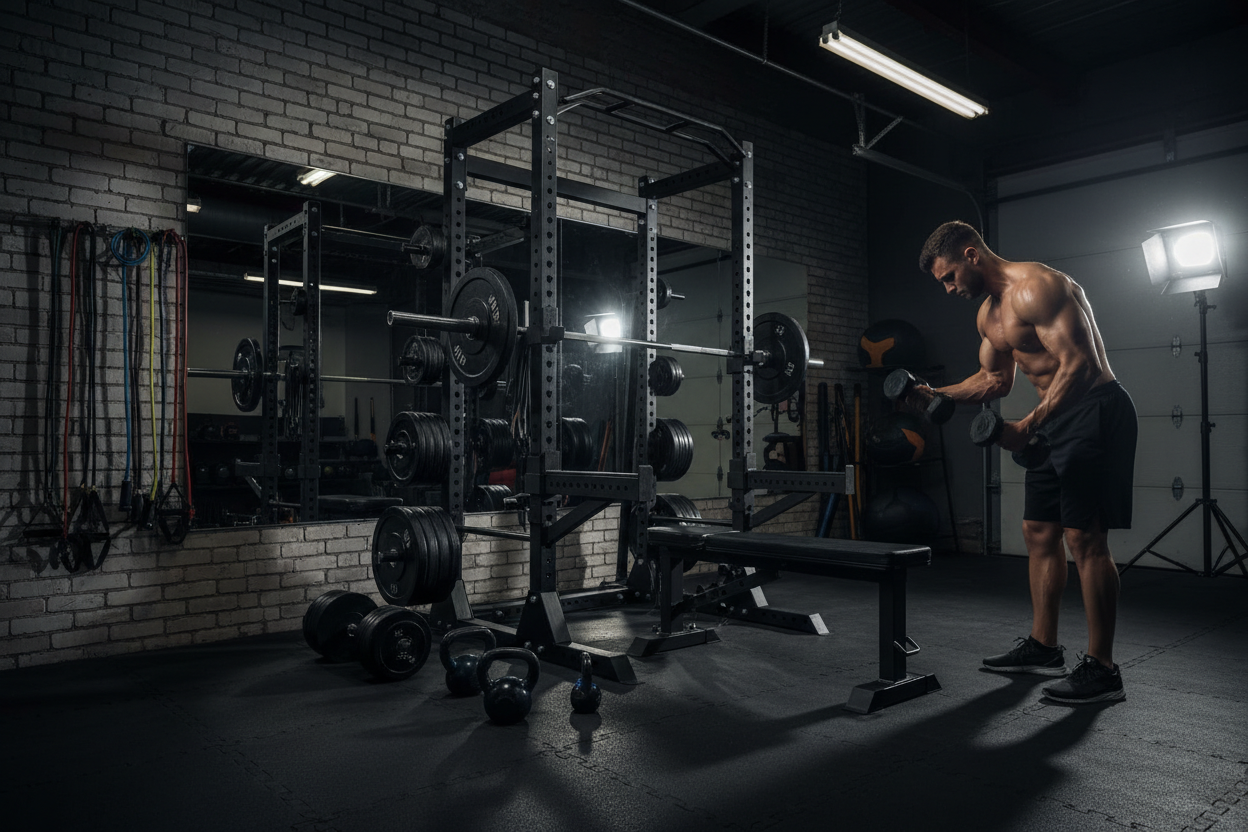
Mastering Exercise at Home Gym: The Ultimate Guide for Results
You bought the equipment. You cleared the space in the garage or the spare bedroom. Yet, for many, effective exercise at home gym setups remains elusive. It is not a lack of willpower; it is usually a lack of structure.
Training where you sleep and eat presents a unique set of psychological and logistical hurdles. Without the commute to a commercial facility, the line between "relaxing" and "training" blurs. This guide strips away the marketing fluff and focuses on the physiological and psychological pillars required to build a physique in your living room.
Key Takeaways: Home Training Essentials
If you want to maximize your results without a membership, focus on these core principles:
- Create Environmental Separation: Visually or physically separate your training area from your living area to trigger the right mindset.
- Prioritize Compound Movements: Squats, presses, and pulls give you the highest return on investment for limited equipment.
- Track Progressive Overload: You must log every session. Without a coach watching, the numbers are your only accountability.
- Master Tempo: If you lack heavy weights, slow down your rep speed to increase time under tension.
The Psychology of Home Gym Training
The biggest mistake lifters make isn't choosing the wrong barbell; it's failing to switch mental gears. When you perform a workout in home gym environments, you are fighting against the comfort of your own home.
To combat this, establish a "ritual." This might be putting on specific shoes (never train barefoot if you wouldn't do it at a commercial gym) or playing a specific playlist. You need a trigger that tells your brain, "We are no longer lounging; we are working."
Structuring the Best at Home Gym Workout
Stop looking for complex isolation movements. The best at home gym workout is boring, brutal, and basic. Because you likely don't have a leg press or a cable crossover station, your programming must rely on free weights and body mechanics.
The "Big Four" Framework
Every effective program should revolve around four movement patterns:
- Knee-Dominant: Squats, lunges, or step-ups.
- Hip-Dominant: Deadlifts, kettlebell swings, or hip thrusts.
- Push: Overhead press, bench press, or push-ups.
- Pull: Chin-ups, barbell rows, or band pull-aparts.
By sticking to these patterns, you ensure full-body development without needing machines that take up half your floor space.
Overcoming the "Light Weight" Problem
A common complaint with home gym training is a lack of heavy plates. Eventually, you might max out your adjustable dumbbells. Does progress stop there? No.
When you cannot add weight, you must add difficulty through other variables. Use mechanical disadvantage. For example, if a standard goblet squat is too easy, switch to a split squat. If push-ups are effortless, elevate your feet. Increasing the range of motion or decreasing stability forces the muscles to adapt even if the absolute load stays the same.
Common Mistakes in Gym Training Home Setups
Avoid these pitfalls to ensure longevity in your training:
Ignoring Floor Protection
Dropping weights on concrete or carpet is a recipe for disaster. Proper horse stall mats or high-density foam are non-negotiable. They protect your foundation and your joints.
The "Storage" Trap
Don't let your gym become a storage unit. The moment you place a laundry basket on your bench or a box on your treadmill, the friction to start a workout increases. Keep the equipment clear at all times.
My Training Log: Real Talk
Let's step away from the theory. I have spent the last five years training exclusively in a converted garage, and I need to be honest about the unpolished reality of exercise at home gym sessions.
It’s not always the Instagram-perfect montage. The hardest part for me wasn't the discipline to lift; it was the temperature. I remember a specific deadlift session in mid-January where the knurling on the barbell was so cold it felt like it was burning my hands, even through the chalk. I had to rest the bar in front of a space heater between sets just to make it touchable.
There is also the silence. In a commercial gym, the background noise fuels you. At home, when you are under a heavy squat and struggling, the only sound is your own ragged breathing and the refrigerator humming in the corner. It forces a different kind of internal focus. If you drop a weight, you don't look around to see who saw you; you freeze and hope you didn't crack the tile. That is the gritty reality of home training—it is just you and the iron, with zero distractions and nowhere to hide.
Conclusion
Building a physique at home is entirely possible, but it requires a shift in approach. Gym training home setups offer freedom, but that freedom requires discipline. Focus on compound lifts, respect the environment, and track your numbers religiously. The equipment doesn't build the muscle; your consistency does.
Frequently Asked Questions
Can you build muscle effectively with a home gym?
Yes, absolutely. Muscles respond to tension and progressive overload, not the location of the workout. As long as you are challenging your muscles with resistance—whether through bands, dumbbells, or bodyweight—and increasing that challenge over time, hypertrophy will occur.
How much space do I need for a home gym exercise routine?
You need less space than you think. A 6x8 foot area is sufficient for most free-weight exercises. The key is vertical storage and using equipment that can be moved easily, like adjustable dumbbells or kettlebells, rather than bulky fixed machines.
What is the most essential piece of equipment for home gym training?
If you can only buy one item, get a pair of high-quality adjustable dumbbells. They allow you to perform hundreds of variations of squats, presses, and pulls, and they grow with you as you get stronger, offering the best space-to-utility ratio.