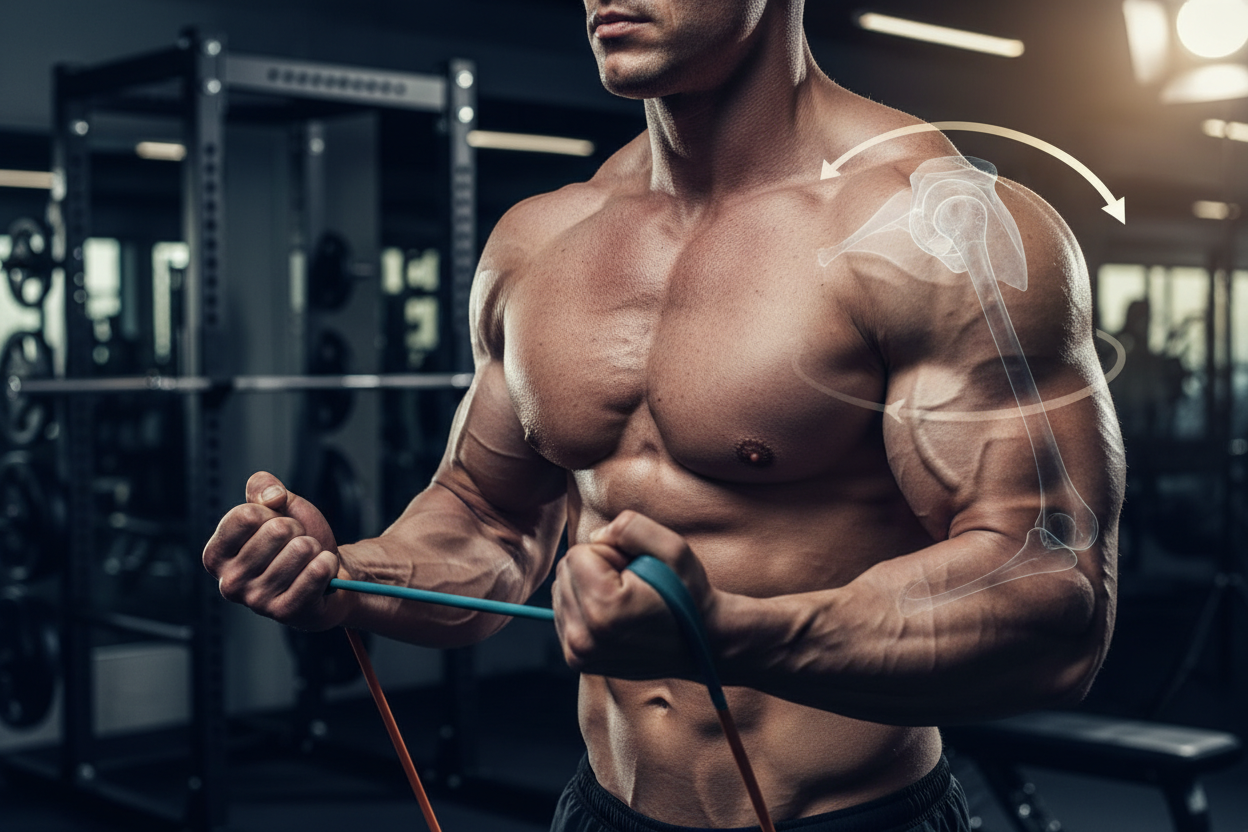
Mastering Actions of the Shoulder Muscles: The Complete Biomechanics Guide
The glenohumeral joint is an engineering marvel and a total nightmare. It is the most mobile joint in the human body, allowing you to throw a fastball, scratch your back, and press heavy iron overhead. But that mobility comes at a steep price: instability.
If you don't understand the specific actions of the shoulder muscles, you are lifting blind. You risk grinding your rotator cuff into dust or wasting years doing exercises that don't actually target the fibers you think they do. To build a 3D look and bulletproof function, we need to look at the mechanics, not just the aesthetics.
Key Takeaways: Shoulder Biomechanics
- Flexion: Raising the arm forward (Anterior Deltoid, Pectoralis Major, Coracobrachialis).
- Extension: Moving the arm backward (Latissimus Dorsi, Teres Major, Posterior Deltoid).
- Abduction: Lifting the arm out to the side (Supraspinatus initiates, Middle Deltoid takes over).
- Adduction: Bringing the arm down to the side (Pectoralis Major, Latissimus Dorsi).
- Rotation: Internal and external twisting of the humerus (Rotator Cuff group).
The Deltoid Complex: The Prime Movers
When most people search for shoulder muscles and actions, they are thinking about the deltoids. These are the visible caps of the shoulder. However, their function depends entirely on the angle of the arm.
Anterior Deltoid (Flexion)
The front head is responsible for shoulder flexion. This is the action of raising your arm straight out in front of you. It is heavily involved in pressing movements like the bench press and overhead press. A common mistake is overtraining this head while neglecting the others, leading to a hunched-forward posture.
Lateral Deltoid (Abduction)
The side head handles abduction—moving the arm away from the body's midline. But here is the catch: the deltoid has poor leverage for the first 15 to 30 degrees of movement. That initial lift? That’s not your deltoid; that is the supraspinatus (a rotator cuff muscle). The lateral delt really kicks in once the arm is already slightly away from the body.
Posterior Deltoid (Horizontal Extension)
Often the most neglected area. The rear delt pulls the arm backward in a horizontal plane. Think of a reverse fly. Weakness here is a primary cause of shoulder impingement because it fails to counteract the strong internal rotation forces of the pecs and lats.
The Rotator Cuff: Stabilization and Rotation
You cannot discuss shoulder muscles action without the rotator cuff. These four small muscles (Supraspinatus, Infraspinatus, Teres Minor, Subscapularis) act as a suction cup, keeping the head of the humerus centered in the socket.
The Critical Role of Muscle Attachments
To understand leverage, look at the muscle attachments shoulder anatomy. The rotator cuff muscles attach very close to the joint axis on the humerus. This gives them terrible mechanical advantage for power, but excellent advantage for speed and stabilization.
If the large prime movers (like the delts) pull hard without the rotator cuff stabilizing the joint, the arm bone can migrate upward and pinch the soft tissues against the shoulder blade. This is the mechanism behind impingement syndrome.
Scapulohumeral Rhythm: The Hidden Factor
The shoulder joint does not act alone. For every 2 degrees your arm moves up, your shoulder blade (scapula) must rotate upward by 1 degree. This is called scapulohumeral rhythm.
If your Serratus Anterior or Lower Trapezius are weak, the scapula won't rotate enough. The result? Your arm bone runs out of room and crashes into the acromion process. Training the shoulder muscles and actions requires training the scapula stabilizers just as hard as the deltoids.
My Personal Experience with actions of the shoulder muscles
I spent the first five years of my lifting career obsessed with overhead pressing. I wanted boulder shoulders. I ignored the biomechanics and just pushed weight.
Eventually, I developed a nagging, sharp pinch right at the front of my acromion whenever I raised my arm past parallel. It wasn't a muscle sore; it felt like a deep, toothache-style throb inside the joint.
I remember trying to do lateral raises and feeling a distinct "clunk" halfway up the movement. It felt like a guitar string snapping over a bone. I realized I was doing lateral raises with my thumbs down (internal rotation), thinking it isolated the side delt better. In reality, I was internally rotating the humerus, clearing the way for the greater tuberosity to smash directly into my rotator cuff.
Once I adjusted the action—switching to a slight thumbs-up position in the "scapular plane" (about 30 degrees forward)—the grinding stopped immediately. The tension on the muscle remained, but the mechanical impingement vanished. That subtle shift in understanding the action saved my shoulders.
Conclusion
Understanding the actions of the shoulder muscles transforms your training from guesswork to precision engineering. It allows you to select exercises that match the natural function of the joint, ensuring longevity and consistent growth. Respect the complexity of the joint, prioritize stabilization, and the aesthetics will follow.
Frequently Asked Questions
What is the primary action of the middle deltoid?
The primary action of the middle (lateral) deltoid is shoulder abduction, which involves lifting the arm out to the side away from the body. It works most effectively after the first 15-30 degrees of movement.
Which muscles are responsible for shoulder external rotation?
External rotation is primarily handled by the Infraspinatus and the Teres Minor. These muscles are part of the rotator cuff and are crucial for decelerating the arm during throwing motions.
Why do my shoulders click during certain actions?
Clicking often occurs when a tendon flicks over a bony prominence or due to air bubbles in the joint fluid (cavitation). However, painful clicking usually indicates friction or impingement where the muscle attachments rub against the acromion.