Master the Unilateral Row Machine for a Thicker, Symmetrical Back
If you have been lifting for any length of time, you likely have a dominant side. You pull harder with your right arm, or your left lat lags behind in development. This is a natural consequence of being human, but it wreaks havoc on your physique and strength potential. Enter the unilateral row machine.
This piece of equipment isn't just a fancy alternative to dumbbells. It provides a level of stability and fixed movement patterns that allow you to overload individual muscles without the systemic fatigue of barbell work. If you want to build a dense, detailed back, you need to understand how to use this tool correctly.
Key Takeaways: Why Use This Machine?
Here is the quick summary of why this movement deserves a prime spot in your routine:
- Corrects Imbalances: Forces the weaker side to work independently, preventing the dominant side from taking over.
- Increased Stability: The chest support removes momentum, allowing for pure isolation of the latissimus dorsi and rhomboids.
- Fixed Path of Motion: Unlike dumbbells, the unilateral machine row guides your elbow through an optimal arc, keeping constant tension on the muscle.
- Safety: Reduces shear force on the lower back compared to bent-over barbell rows.
The Mechanics of Isolation
Many lifters confuse the unilateral row with a standard dumbbell row, but the mechanics are distinct. When you use free weights, a significant amount of energy goes into stabilizing your torso. You have to brace your core, lock your hips, and fight gravity just to stay in position.
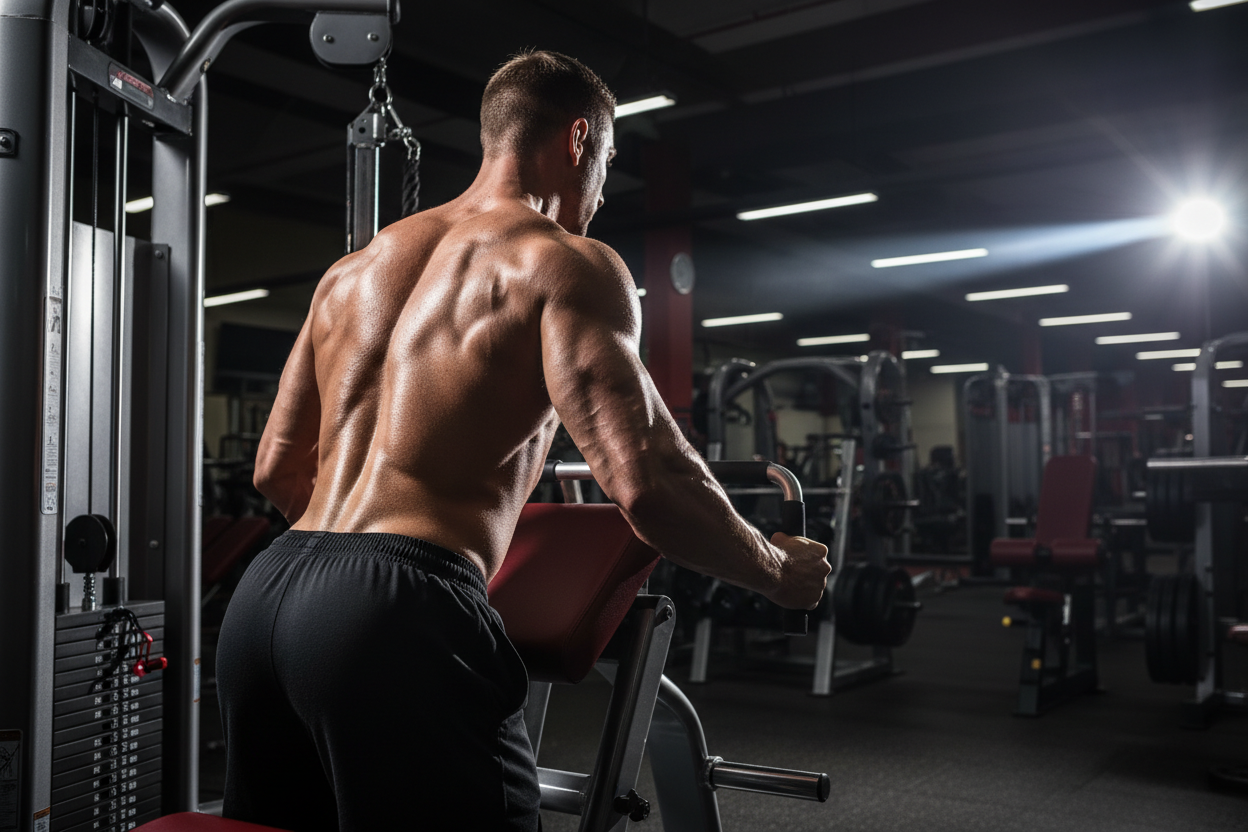
The machine removes that variable. By locking your chest against the pad, you eliminate the need for stabilization. This means 100% of your neural drive can go into driving the elbow back and contracting the muscle. This is the difference between "lifting a weight" and "training a muscle."
Proper Setup and Execution
Most people hop on the seat and just start pulling. That is a mistake. The setup dictates which muscle fibers you recruit.
1. Seat Height Matters
Adjust the seat so the chest pad sits comfortably against your sternum. If the seat is too low, the handle will be too high, forcing you to shrug your shoulders. This shifts tension to the upper traps rather than the lats. You want your hand to be roughly in line with your lower chest or upper abs at the bottom of the movement.
2. The Reach and Pull
Grab the handle with one hand. Before you pull, let your shoulder blade drift forward slightly. This stretches the lats. Initiate the movement by driving your elbow back toward your hip, not just pulling with your hand.
Squeeze hard at the peak contraction. Because this is a machine, the resistance curve is often consistent, so don't rush the lockout.
3. The Non-Working Arm
Use your free hand to brace yourself against the machine frame or the other handle. This creates a rigid structure, allowing you to generate more force with the working side.
Common Mistakes to Avoid
Even with a fixed path, things can go wrong. Watch out for these errors:
Torso Rotation
The goal is to move the weight with your back muscles, not by twisting your spine. Keep your chest glued to the pad. If you have to twist your body to get the weight back, the load is too heavy.
Head Position
Don't crane your neck forward or look at the ceiling. Keep your neck neutral. I often see lifters jutting their chin out as the set gets hard, which creates unnecessary cervical strain.
My Training Log: Real Talk
I want to be honest about my experience with the unilateral row machine, specifically the plate-loaded leverage variety found in most serious gyms. While the biomechanics are great, there is a specific discomfort no one mentions: the chest pad compression.
When I’m rowing heavy—approaching three or four plates per side—the pressure against the sternum becomes a limiting factor for breathing. I’ve found that I have to time my breath very specifically: inhale deeply before the rep, brace hard against the pad (almost pushing my chest into it), and exhale forcibly only past the sticking point.
Also, there's the grip issue. On older machines with aggressive knurling, doing high-volume unilateral work tears up my hands faster than a deadlift because the handle often rotates slightly in the palm during the arc. I almost always use straps on this machine—not because my grip is weak, but because without them, the friction distracts me from the mind-muscle connection in my lower lat.
Conclusion
The unilateral row machine is a precision tool. It allows you to expose weaknesses and fix them with heavy loads safely. Stop treating it like a finishing exercise and try making it your primary compound movement for a block of training. Your back density will thank you.
Frequently Asked Questions
Is the unilateral row machine better than dumbbell rows?
It isn't necessarily "better," but it is different. Dumbbells require more stabilization and engage the core, while the machine offers higher stability and better isolation. For pure hypertrophy (muscle growth), the machine often has the edge because you can train to failure safely.
How heavy should I go on unilateral rows?
Go as heavy as you can while maintaining full contact with the chest pad. As soon as your chest leaves the pad to generate momentum, you have lost the benefit of the machine. Focus on the 8-12 rep range for the best balance of tension and load.
Can I do both arms at the same time on this machine?
Yes, but that defeats the purpose of the "unilateral" design. Doing one arm at a time allows for a greater range of motion, as you can wrap your elbow slightly around your torso. Doing both arms simultaneously often restricts how far back you can pull.