Massive Quads, No Gym: The Real Way to Train Legs at Home
You do not need a squat rack, a leg press, or hundreds of pounds of iron to build impressive lower body strength. Many people believe that once they step away from the heavy machinery of a commercial gym, their progress will stall, but that is a misconception born from a lack of creativity. If you understand the mechanics of tension and progressive overload, figuring out how to train legs at home becomes a matter of effort rather than equipment. You can build muscle, increase stability, and torch fat right in your living room if you are willing to embrace the burn of high-volume and unilateral training.
The secret lies in shifting your focus from moving maximum weight to maximizing tension on the muscle. When you take away the heavy barbell, you have to find other ways to make the movement difficult. This usually involves slowing down the tempo, increasing the range of motion, or shifting the load to one leg at a time. If you execute these movements with enough intensity, a bodyweight session can leave you just as sore as a heavy day under the bar.
My Wake-Up Call With Home Training
I used to be a gym purist. If I wasn't loading up a barbell, I didn't think it counted. That changed a few years ago when a minor back injury forced me to stay away from spinal loading for three months. I couldn't squat heavy, and I couldn't deadlift. I was terrified my legs would shrink.
I was forced to pivot to high-volume calisthenics and dumbbell variations in my garage. I remember my first session vividly: I attempted 100 walking lunges followed by pause squats. By the halfway mark, my quads were shaking uncontrollably. I realized then that I had been relying on mechanical leverage in the gym, whereas this home leg exercise routine was exposing all my weak points. My stabilizers were on fire, and my conditioning was being tested in a way the leg press never did. That experience taught me that gravity is often resistance enough if you use it correctly.
The Principles of Leg Training Home Workouts
To get results without heavy weights, you need to manipulate the variables of training intensity. You cannot simply do three sets of ten reps and expect to grow. Since the absolute load is lower, you must increase the time under tension.
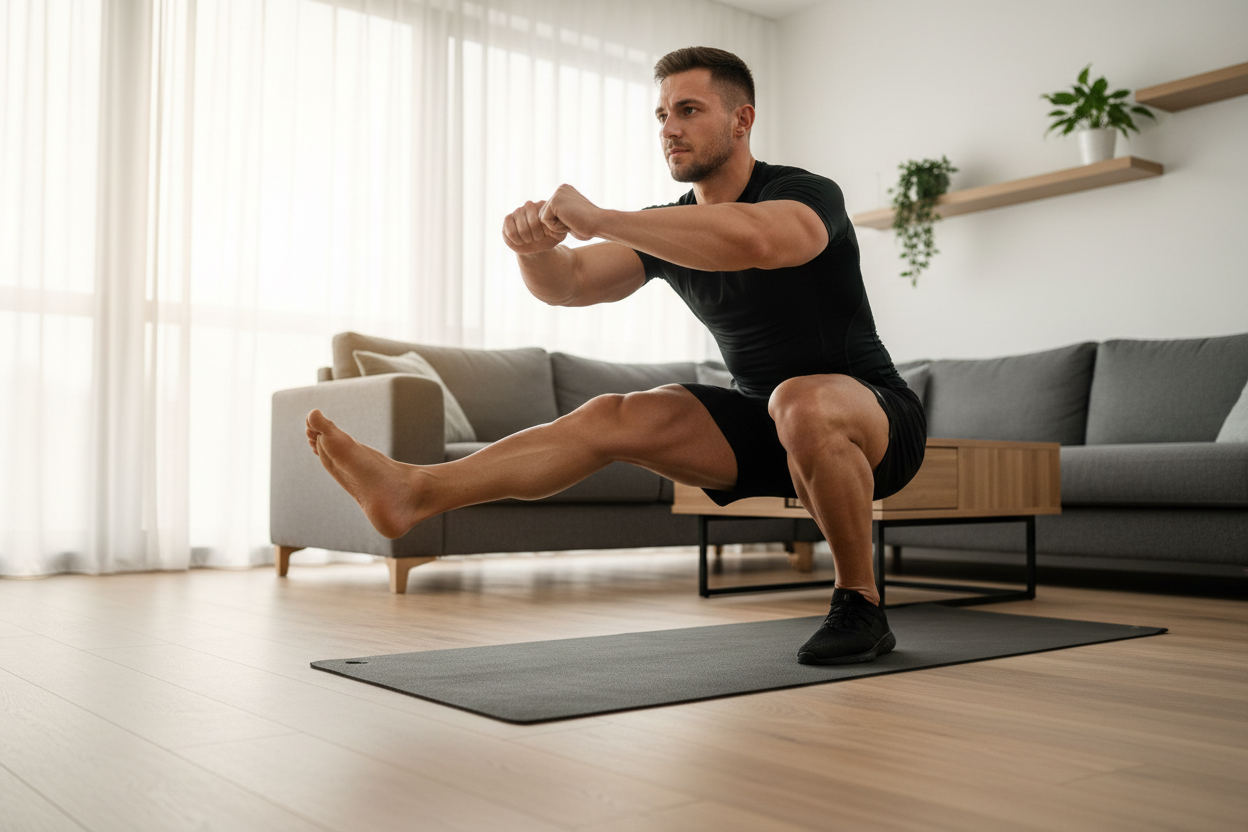
Focus on the eccentric phase of the movement—the lowering part. If you are doing a squat, take three to four seconds to lower yourself. Pause at the bottom for a full second to kill the momentum, then explode up. This technique recruits more muscle fibers and creates the metabolic stress required for hypertrophy. Another crucial element is unilateral training. Working one leg at a time effectively doubles the load on that limb relative to your body weight and demands significant core engagement.
Essential Leg Exercise to Do at Home
Building a routine requires selecting movements that target the quads, hamstrings, and glutes from different angles. Here are the most effective movements that belong in every leg workout to do at home.
The Bulgarian Split Squat
This is arguably the king of leg exercises, gym or no gym. Place your rear foot on a couch, chair, or bench, and step your other foot out. Lower your hips until your back knee almost touches the floor. This movement stretches the hip flexors of the rear leg while placing an immense load on the front quad and glute. It fixes imbalances quickly. If bodyweight becomes too easy, holding a water jug or a backpack filled with books instantly turns this into a strength challenge.
The Single-Leg Romanian Deadlift (RDL)
Most home routines neglect the posterior chain, leading to knee issues. The single-leg RDL is a fantastic leg workout you can do at home to target the hamstrings and glutes. Stand on one leg with a slight bend in the knee. Hinge at the hips, sending your back leg straight behind you like a lever. Keep your back flat. You should feel a deep stretch in the hamstring of the standing leg. This movement requires balance, so don't be afraid to hold onto a wall for support until you master the pattern.
The Nordic Hamstring Curl
If you want bulletproof hamstrings, this is the gold standard. You will need a partner to hold your ankles or a heavy piece of furniture to anchor your feet under. Kneel on a soft surface with your ankles anchored. Keep your body in a straight line from knees to shoulders. Slowly lower your torso toward the floor using only your hamstrings to control the descent. Most people cannot pull themselves back up initially, so focus on controlling the drop as slowly as possible and push yourself back up with your hands. It is humble work, but incredibly effective.
How to Do Leg Day at Home: Structuring the Session
A random collection of exercises won't yield the best results. You need structure. A good session should start with a warm-up to mobilize the hips and ankles, move into your most difficult compound movement, and finish with higher-repetition metabolic work.
Here is a sample structure for a high-intensity session:
- Warm-up: 5 minutes of bodyweight squats and lunges.
- Primary Compound: Bulgarian Split Squats – 4 sets of 8-12 reps per leg. (Focus on depth).
- Posterior Chain: Single-Leg RDLs – 4 sets of 12-15 reps per leg. (Focus on the stretch).
- Volume/Burnout: Walking Lunges – 3 sets of 20 steps total.
- Finisher: Wall Sit – Hold for as long as possible, rest 60 seconds, repeat twice.
This specific sequence ensures you hit the heavy mechanical tension early when you are fresh, and then exhaust the muscles safely at the end. It is a simple but brutal leg workout to do at home that covers every base.
Progressing Without Weights
The biggest question people ask is how to keep making gains once the exercises feel easy. The answer is not always "add more weight." You can decrease rest times between sets to improve metabolic conditioning. You can add "1.5 reps," where you go all the way down, come halfway up, go back down, and then come all the way up. That counts as one rep. This technique keeps the muscle under tension for longer periods and induces significant fatigue with light weights.
Consistency remains the most critical factor. Good leg workouts to do at home are only "good" if you actually do them. Because you are at home, distractions are everywhere. Treat your workout time with the same respect you would give a scheduled appointment. Put your phone away, turn up the music, and focus on the movement. Your legs won't know the difference between a gym floor and your living room carpet; they only know tension and effort.
Frequently Asked Questions
Can I actually build size with just bodyweight leg exercises?
Yes, absolutely. Muscle growth occurs when you fatigue the muscle fibers and provide enough protein for repair. By using high reps, slow tempos, and unilateral movements (single-leg), you can create enough stimulus to build significant muscle mass without external weights.
How often should I train legs at home?
Since bodyweight and light-weight training generally causes less central nervous system fatigue than heavy barbell training, you can train more frequently. Aim for 2 to 3 times per week, allowing at least 48 hours of rest between sessions to ensure full recovery.
What if I have bad knees?
Home training can actually be better for bad knees because the absolute loads are lighter. Focus on posterior chain exercises like glute bridges and hamstring curls to support the knee joint. Avoid deep lunges initially and stick to box squats (sitting onto a chair) to control your range of motion until your strength improves.