Lower Body Push Exercises List: Muscle Mechanics, Movement Progressions, and Training Mat Staging
Understanding Lower Body Push Mechanics and Primary Muscle Groups
Strength training splits frequently categorize movements by functional patterns rather than isolated muscle groups alone. A lower body push movement is characterized primarily by knee-dominant extension paired with simultaneous hip extension. In practical terms, whenever you push the floor away to drive your body upward or press an external load away from your torso using the legs, you are executing a lower body push movement pattern.
Primary and Secondary Lower Body Push Muscles
Understanding which tissues drive these movements ensures better mind-muscle connection and balanced programming. The primary lower body push muscles include:
- Quadriceps Femoris: Comprising the rectus femoris, vastus lateralis, vastus medialis, and vastus intermedius, this muscle group acts as the primary driver of knee extension.
- Gluteus Maximus: Functions as a powerful hip extensor, working in tandem with the quadriceps to drive out of the bottom position of squats, lunges, and step-ups.
- Adductor Magnus: Assists in hip extension and stabilizes the femur during deep flexion angles.
- Calves (Gastrocnemius and Soleus): Provide plantarflexion and stabilize the ankle joint against the floor during dynamic and loaded stances.
- Core Stabilizers: The rectus abdominis, obliques, and erector spinae maintain an upright or rigid torso position, transferring force efficiently between the lower and upper body.
Knee-Dominant vs. Hip-Dominant Load Distribution
The primary distinction between lower body push and pull exercises lies in joint mechanics. Pushing movements feature significant knee travel and knee flexion angles, placing peak mechanical tension across the anterior chain and quadriceps. In contrast, lower body pull movements—such as deadlifts and hip thrusts—are hip-dominant hinges that emphasize hamstring and posterior glute recruitment with minimal forward knee excursion. Categorizing exercises based on primary joint torque allows lifters to structure balanced training days that distribute joint stress evenly.
Comprehensive Lower Body Push Exercises List: Bilateral and Unilateral Movements
A well-rounded training plan incorporates multiple variations across different planes of motion and loading configurations. Use this comprehensive list lower body guide to structure your weekly training sessions effectively.
Bilateral Squat Variations for Maximum Force Output
Bilateral exercises permit the highest loading potential and form the foundation of raw strength development:
- Barbell Back Squat: The gold standard for total lower body force production. Placing the bar across the upper trapezius (high bar) or rear deltoids (low bar) allows deep knee flexion and heavy axial loading. For detailed troubleshooting, consult our dedicated lower body push guide.
- Front Squat: Loading the barbell across the anterior deltoids enforces an upright torso posture, shifting greater relative emphasis to the quadriceps and thoracic spine extensors.
- Goblet Squat: Holding a single dumbbell or kettlebell vertically against the chest makes this an accessible variation for mastering squat depth, hip mobility, and proper knee tracking.
- Zercher Squat: Holding the barbell in the crooks of the elbows challenges upper back stability, anterior core bracing, and quad drive from deep hip angles.
Unilateral and Split-Stance Push Progressions
Unilateral push exercises isolate individual limbs, correcting side-to-side strength disparities and demanding higher levels of hip and ankle stabilization:
- Bulgarian Split Squat: Elevating the rear foot on a bench increases the range of motion and quad-glute stretch on the lead leg while reducing lower back spinal compression.
- Reverse Lunge: Stepping backward into knee flexion minimizes shearing forces at the patellofemoral joint compared to forward lunges, making it a knee-friendly push option.
- Walking Lunge: Introduces a dynamic locomotion component, requiring continuous balance, deceleration, and explosive push-off through the midfoot.
- Step-Up: Stepping onto a raised box or platform trains vertical drive and unilateral hip extension while mimicking natural climbing mechanics.
- Pistol Squat: An advanced single-leg bodyweight exercise requiring exceptional ankle dorsiflexion, hip flexor strength, and unilateral balance.
Machine and Resistance-Assisted Push Patterns
Fixed-path equipment and resistance bands provide targeted quad overload while reducing the balance and stabilizing demands of free weights. Lifters exploring dedicated home gym setups often look toward items within the lower body collection to diversify their training stimulus:
- Leg Press: Allows intense loading of the quads and glutes with zero axial spinal compression, offering customizable foot placements to emphasize specific quad heads.
- Hack Squat: Maintains a fixed back angle that guides the lifter through deep knee flexion, directing continuous tension into the quadriceps throughout the movement path.
- Belt Squat: Suspends the load from the waist, completely removing spinal fatigue while maintaining deep squat mechanics.
- Sissy Squat: Isolates the quadriceps by locking the lower legs into place and emphasizing terminal knee extension and quad stretch under bodyweight or loaded resistance.
Structuring Push Movements into Home Strength Training Splits
Programming knee-dominant pushing patterns requires careful management of volume, intensity, and structural balance across the training week.
Balancing Push and Pull Ratios for Joint Longevity
A balanced lower body routine pairs quad-focused knee extensions with hamstring-focused hip hinges and knee curls. In an upper/lower or push/pull/legs split, lifters typically include one heavy compound push (such as a back squat or leg press), followed by a unilateral push (such as a split squat), and balance them with equivalent posterior chain volume. Maintaining a balanced ratio between anterior and posterior movements supports overall joint comfort and symmetrical muscular development.
Progressive Overload and Tempo Variations
Progressive overload can be achieved through methods beyond simply adding weight to the bar. Incorporating tempo controls—such as a three-second eccentric lowering phase or a two-second pause at the bottom of a squat—increases mechanical tension and eliminates reliance on momentum. Manipulating repetition schemes, rest intervals, and movement range provides continuous stimulus for strength adaptation without excessive joint strain.
Home Gym Floor Mat Staging and Equipment Placement for Pushing Movements
Executing heavy squats, dynamic lunges, and loaded step-ups requires a stable ground interface. Proper home gym mat staging provides the grip and subfloor defense necessary for consistent training performance.
Surface Traction, Footing Stability, and Energy Dissipation
Unlike soft, yielding surfaces that cause foot collapse and balance loss, high-density rubber flooring creates a firm, non-compressible foundation. When executing a heavy barbell squat or loaded split squat, your feet must maintain continuous ground contact through the heel, first metatarsal, and fifth metatarsal (the tripod foot concept). Dense rubber mats provide non-slip traction that prevents foot slippage during wide-stance squats or explosive lunges, allowing direct and uncompromised force transfer into the ground.
Floor Protection Under Free Weights and Loading Zones
Heavy push movements involve significant concentrated loads. When setting up your training area:
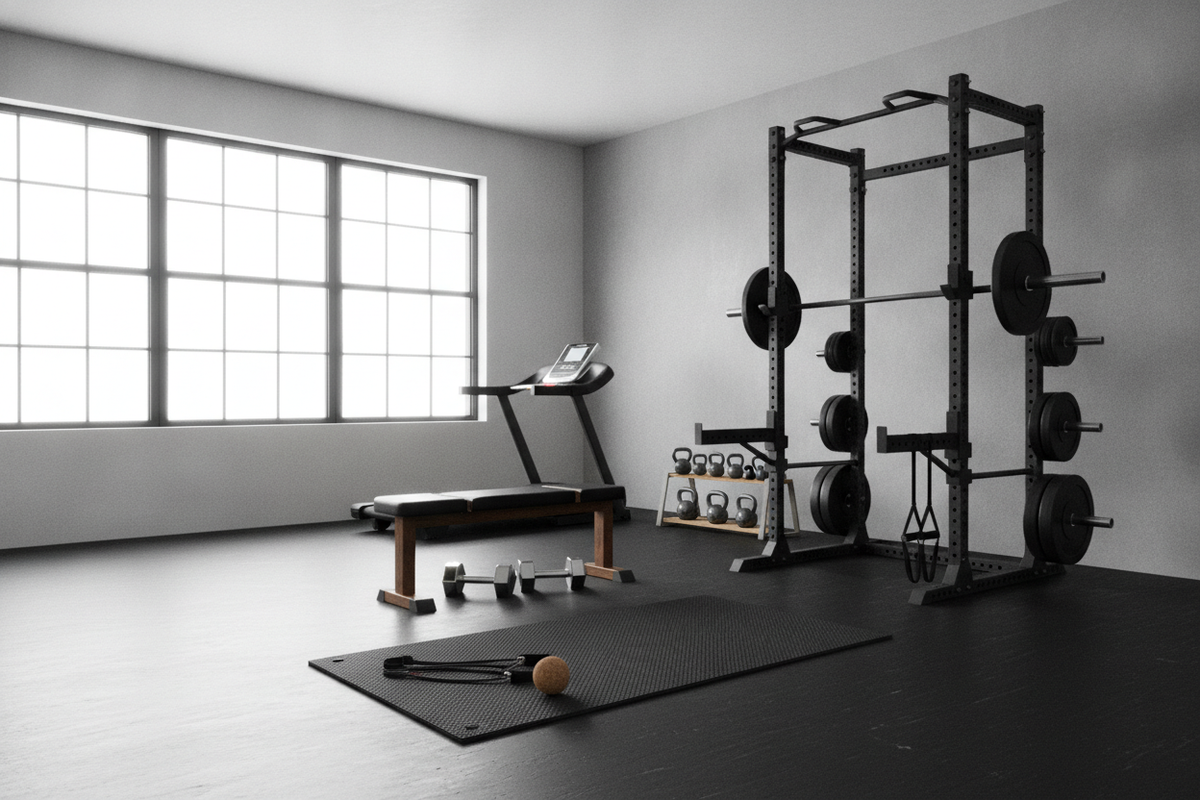
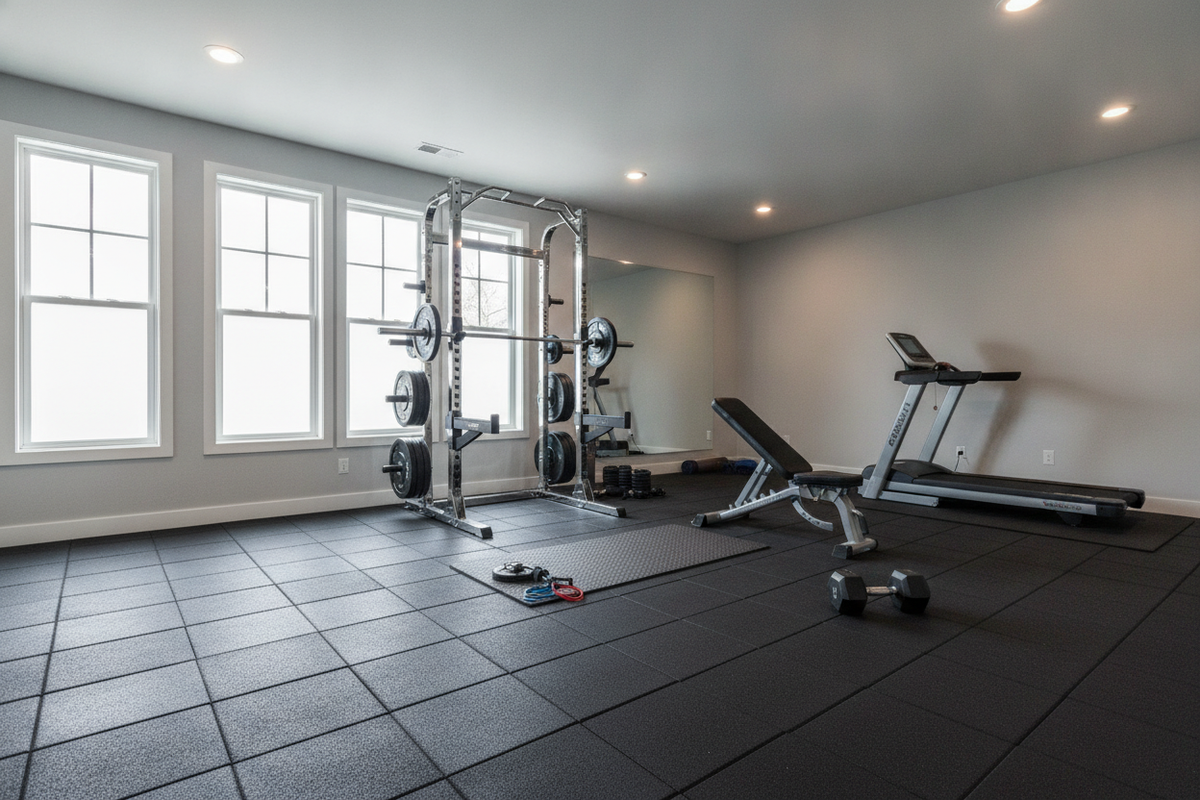
- Position squat stands and power racks directly over seamless, high-density rubber matting to distribute the frame weight and prevent point-load damage to underlying concrete, tile, or hardwood floors.
- Establish clear loading perimeters around barbell collars and dumbbell racks to safeguard surfaces against incidental contact during plate changes.
- Ensure adjustable benches used for Bulgarian split squats or step-up boxes rest on textured rubber surfaces to prevent unwanted sliding during set execution.
Mat Care, Sweat Resistance, and Long-Term Maintenance
High-intensity lower body training naturally generates sweat and chalk accumulation. To maintain surface traction and hygiene, wipe down rubber mats periodically with a damp mop and mild, pH-neutral soap solution. Avoid oil-based cleaners or harsh chemical solvents that can degrade rubber compounds or create slick films on the surface. Routine surface care preserves the texture and slip resistance essential for demanding lower body push workouts.