Lose Weight with Weights Workout: Movement Architecture, Routine Blueprints, and Home Floor Stability
Fundamentals of Designing a Lose Weight with Weights Workout
Executing a productive lose weight with weights workout involves more than simply moving resistance through space; it requires a structured approach to movement selection, pacing, and structural tension. Resistance training serves as a fundamental stimulus for physical conditioning, encouraging body composition improvements when paired with thoughtful daily habits.
Why Multi-Joint Loading Outperforms Isolated Fatigue
When planning a program focused on training with weights for weight loss, prioritizing multi-joint compound movements over single-joint isolation exercises creates broad mechanical engagement. Exercises such as squats, presses, and rows demand coordinated recruitment across multiple muscle groups simultaneously. This broad involvement generates substantial systemic work during each repetition, making every training block more efficient than spending equivalent time on isolated arm or calf variations.
Preserving Lean Structure During Caloric Deficits
When energy intake is managed, the body requires an active stimulus to preserve existing muscular structure. Applying progressive resistance signals that muscle tissue is actively required for mechanical output. A well-designed weights workout for weight loss reinforces body composition goals by focusing on retaining strength and structural stability rather than merely depleting energy reserves through unmanaged fatigue.
Core Movement Categories for Full-Body Energy Demand
Constructing a balanced routine requires categorizing movements into fundamental physical patterns that challenge the body across multiple planes of motion. In our view, organizing sessions around foundational movement tiers makes consistent progression straightforward to manage over time.
Lower-Body Anchor Lifts: Squat and Hinge Patterns
Lower-body movements form the core of effective weight exercises to lose weight. Patterns such as goblet squats, front-loaded split squats, and Romanian deadlifts engage the largest muscle groups in the hips, thighs, and posterior chain. These compound patterns challenge systemic balance and require sustained bracing throughout each set. Exploring a dedicated weight training workout guide can provide additional perspective on integrating compound lower-body tiers into a comprehensive weekly split.
Upper-Body Push-Pull Dynamics and Loaded Carries
Balancing lower-body demands with upper-body push-pull exercises creates complete physical engagement. Pairing overhead presses or push-up variations with chest-supported rows and bent-over dumbbell rows creates antagonistic balance across the shoulder girdle. Complementing these with loaded carries—such as suitcase or farmer carries—demands continuous trunk stiffness and grip endurance, rounding out a dynamic weight loss workout with weights.
Structuring Your Weights for Weight Loss Program
How movements are sequenced within a session determines both training density and movement quality. Structuring exercises logically helps maintain high output while allowing local muscle recovery.
Antagonistic Supersets and Density Training
Antagonistic supersetting involves pairing two non-competing exercises back-to-back with short transition intervals. For instance, moving from a dumbbell bench press directly into a neutral-grip row allows the pressing musculature to rest while the pulling musculature works. This organization increases overall training density within a given timeframe without requiring excessive rest pauses between individual exercises. Those interested in complementary conditioning structures can review a workout weight loss guide to see how varied pacing models operate.
Weekly Frequency and Session Cadence
A consistent schedule provides the balance needed between training stimulus and systemic recovery. Organizing a weights for weight loss program around three to four sessions per week using full-body or alternating upper-lower splits helps distribute volume evenly. This cadence allows sufficient recovery between workouts so that movement mechanics and positional control remain reliable throughout every training session.
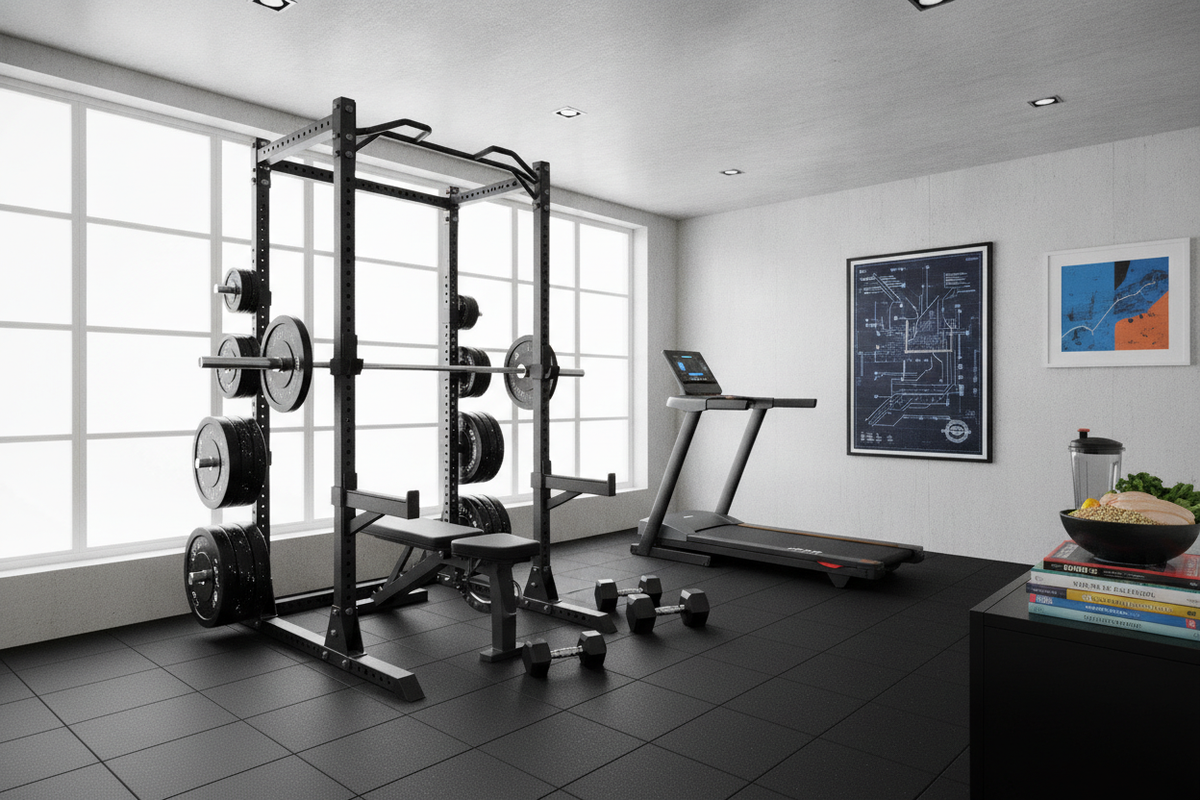
Home Gym Environment: Equipment Placement and Subfloor Protection
Executing heavy multi-joint lifts at home requires attention to the physical training surface. Domestic flooring is often not designed to endure localized impacts or repeated point loading from heavy fitness implements.
Managing Point Loads and Impact Absorption
Dumbbells, kettlebells, and adjustable benches concentrate mechanical force into small contact areas. Dropping or firmly setting heavy weights on unprotected hardwood, tile, or laminate can cause structural cracking, surface scratching, or subfloor depression. Integrating an exercise workout product provides a protective buffer layer that distributes point loads across a broader surface area and protects domestic subfloors.
Traction and Footing Stability During Weighted Transitions
Dynamic lower-body lifts, lunges, and loaded carries require dependable footing to maintain proper joint tracking and spinal alignment. A shifting surface compromises balance and technique under load. Utilizing dense, non-migrating workout flooring ensures that your base of support remains stable across dynamic transitions and stance changes throughout a workout with weights to lose weight.
Surface Maintenance and Routine Longevity
Maintaining your home gym setup ensures that equipment remains hygienic, functional, and ready for regular training demands.
Sweat Management and Mat Hygiene
Intense lifting sessions inevitably generate sweat, which can degrade lower-grade foam surfaces or create slipping hazards if left unmanaged. Closed-cell, moisture-resistant exercise mats prevent perspiration from permeating the interior core. Wiping down the mat surface after each session with a mild, pH-neutral cleaner preserves grip texture and maintains a clean home training environment. You can explore a broader exercise collection to find durable surfaces suited for heavy residential training layouts.
Equipment Staging and Clear Movement Corridors
Maintaining an organized training footprint is essential when transitioning between paired exercises. Staging weights, collars, and benches in designated perimeter zones keeps active lifting lanes clear of tripping hazards. Establishing distinct movement corridors allows you to step, lunge, and reset comfortably between sets without spatial restriction.
Frequently Asked Questions
Should beginner lifters train with free weights or machines for weight management?
Free weights offer versatile multi-planar movement patterns and encourage natural joint mechanics, making them well-suited for adaptable home gyms. Machines provide fixed movement paths that can assist in learning basic joint trajectories. Incorporating free weights encourages active core bracing and stabilizer engagement across everyday movement patterns.
How does lifting tempo impact a weight loss workout?
Lifting tempo refers to the speed of the lowering, pausing, and lifting phases of a repetition. Controlling the eccentric (lowering) phase enhances positional awareness and increases muscle tension without requiring excessive external loads. A controlled cadence helps maintain structural integrity and technical consistency throughout demanding sets.
What mat thickness works best for free weight circuits?
For standing compound lifts and free weight exercises, a firm, dense mat is preferable over a thick, squishy surface. Overly soft foam compresses unevenly underfoot, which can destabilize ankle alignment during squats or lunges. A dense mat provides the right balance between subfloor protection and a firm, predictable platform for lifting.