Is the best gym workout plan to build muscle actually barefoot?
I spent years chasing the perfect lifting shoe. I bought the high-heeled Romaleos for squats and the flat-as-a-pancake Chuck Taylors for deadlifts. I even tried those weird toe-shoes that make you look like a prehistoric caveman. But it wasn't until I started training in my own garage that I realized my best gym workout plan to build muscle was being held back by the very gear I thought was helping me.
Most of us are literal 'gym shoe' addicts. We think the cushion and the brand name are doing us favors, but if you're lifting on a squishy sole, you might as well be squatting on a pair of marshmallows. It creates an unstable base that kills your force production before the weight even leaves the rack.
Quick Takeaways
- Running shoes absorb energy that should be going into the barbell.
- Barefoot lifting increases 'proprioception,' helping you recruit more muscle fibers.
- High-density rubber flooring is mandatory to prevent slipping and joint shock.
- A slow transition is key to avoiding foot strain or plantar fasciitis.
The Sneaky Power Leak in Your Lifting Shoes
If you're serious about your best gym workout routine to gain muscle, you need to understand kinetic energy. When you drive upward during a heavy squat or leg press, that force travels from your muscles, through your bones, and into the floor. In a standard running shoe, that force hits a layer of EVA foam first. That foam is designed to compress. It's literally built to 'leak' energy to protect your joints during a run.
In the weight room, that compression is your enemy. As the foam squishes, your ankle wobbles to find stability. This micro-instability forces your central nervous system (CNS) to dial back the power output as a safety mechanism. You aren't just losing balance; you're losing the ability to lift 5-10% more weight. Imagine trying to push a car while standing on a mattress—that's what you're doing to your quads every time you wear cushioned shoes for leg day.
I've seen guys plate-out at 315 lbs for months, only to hit a PR the week they switched to a hard, flat surface. By removing the 'mush' between you and the ground, you turn your legs into solid pillars. This immediate boost in stability allows you to handle heavier loads, which is the primary driver for hypertrophy. If your shoes are soaking up your effort, your muscles aren't getting the stimulus they deserve.
Why Ground Contact Upgrades Your Entire Routine
Your feet are marvels of engineering, containing 26 bones and over 100 muscles, tendons, and ligaments. They are also packed with sensory receptors that tell your brain exactly where your center of gravity is. When you wrap them in thick rubber and cloth, you're essentially 'blinding' your CNS. Going barefoot restores this sight.
This is the 'Proprioceptive Grounding' perspective. When your feet are in direct contact with a firm surface, your brain can more accurately map the movement. You'll find your toes naturally 'clawing' the floor, which creates a more stable arch and better knee tracking. This isn't just bro-science; understanding the science behind the best leg workout involves recognizing how ground force reaction increases quadriceps and glute activation. When your brain feels a stable floor, it gives your muscles the 'green light' to contract with maximum intensity.
This grounding effect is particularly noticeable during compound movements. On a heavy deadlift, feeling the weight shift across your midfoot allows for better posterior chain engagement. You stop pulling with your lower back and start pushing the world away with your heels. This shift in mechanics is often the missing link for the best gym workout routine to gain muscle because it ensures the target muscles are doing the heavy lifting, not your joints or lower back. You'll feel a level of 'connectedness' to the weight that simply doesn't exist when you're elevated on a 2-inch foam heel.
Don't Try This on Raw Concrete
Before you go kicking your shoes off in your garage, let's talk about the surface. Raw concrete is unforgiving. It's usually covered in a fine layer of dust that makes it as slick as an ice rink once your feet get a little sweaty. I've seen more than one person nearly tear an adductor because their lead foot slid out during a set of lunges. Concrete also has zero 'give,' which can lead to bruised heels or arch pain if you're dropping into a heavy squat.
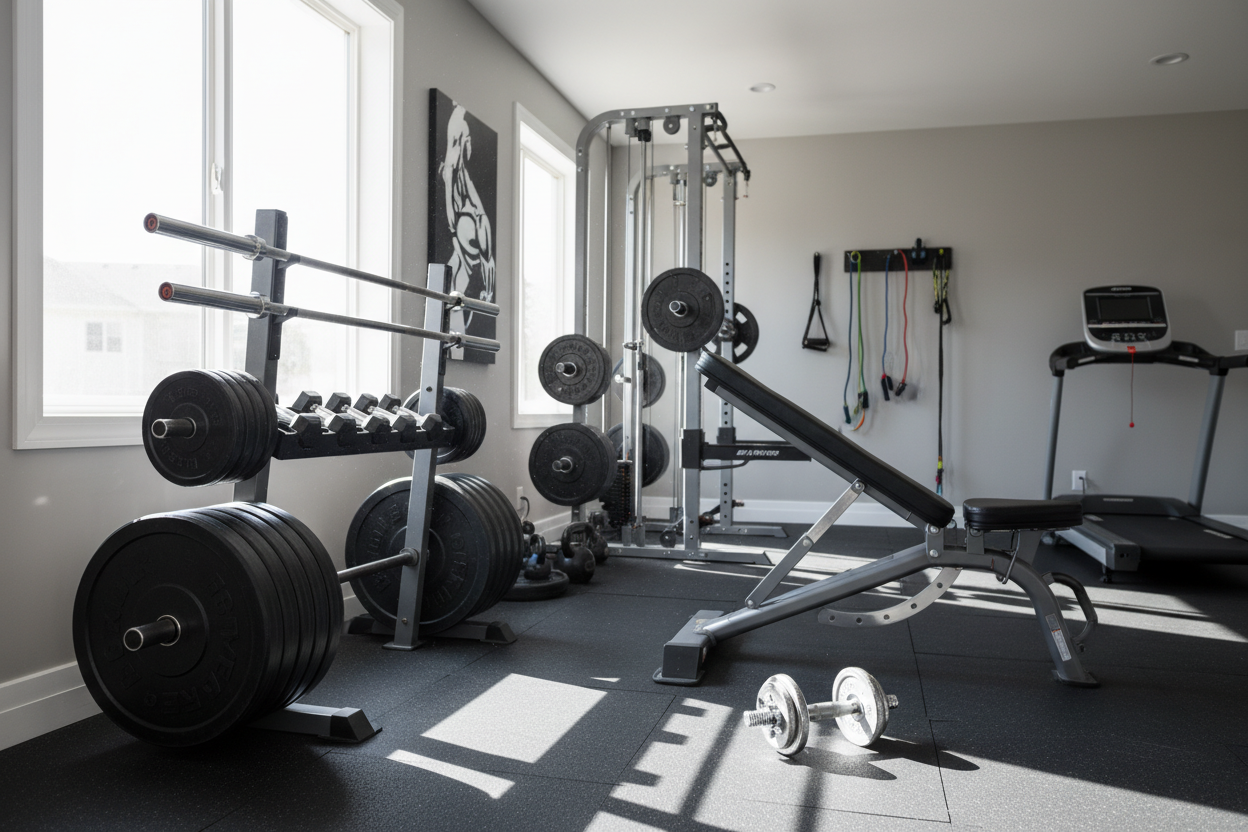
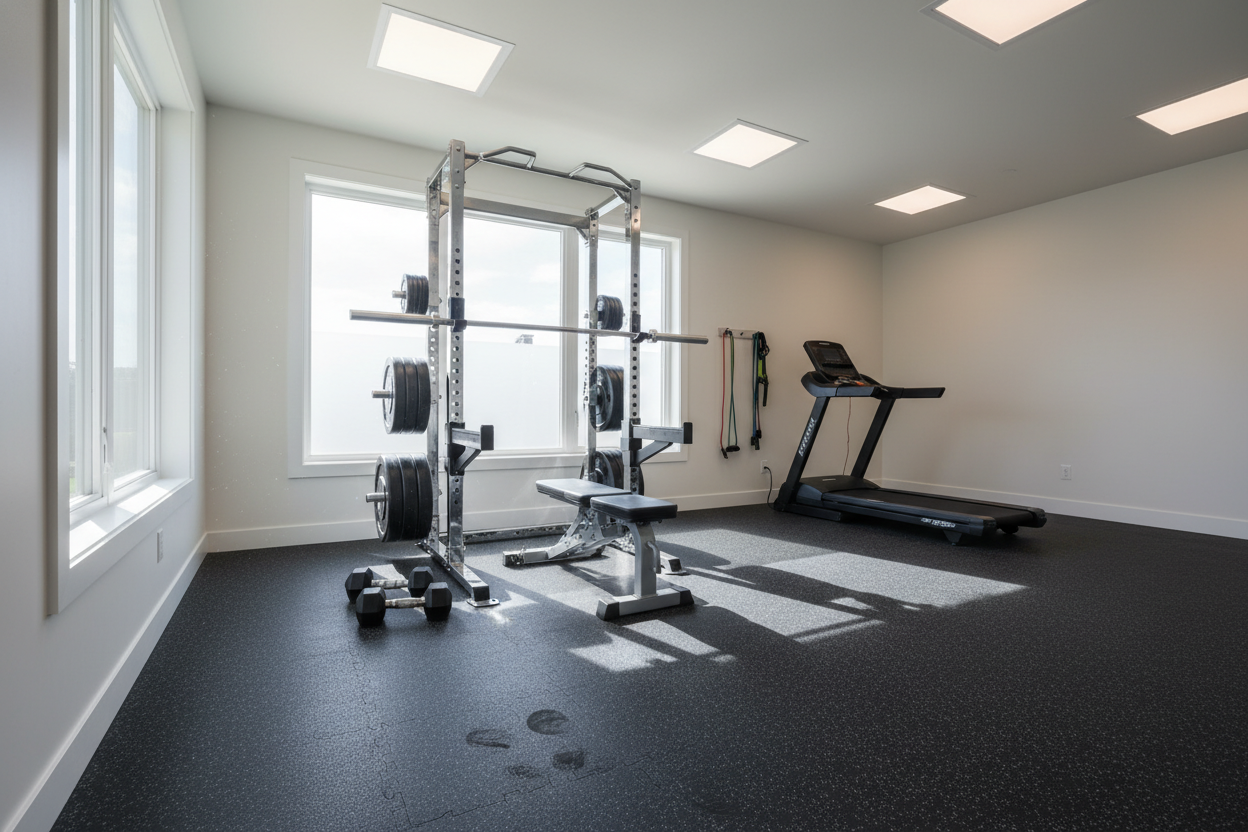
To make barefoot lifting viable, you need a dedicated large exercise mat for home gym use. You're looking for high-density rubber—something that doesn't compress like a yoga mat but offers enough 'bite' for your skin to grip. A 6x8ft exercise mat gym flooring is the sweet spot for most home setups. It's wide enough for a full sumo deadlift stance and long enough for walking lunges or split squats without stepping off onto the cold concrete.
Quality flooring acts as a shock absorber for your joints without being 'squishy.' It provides the friction necessary to keep your feet locked in place, even when you're dripping with sweat. If you can't jump on your gym floor barefoot without feeling a jarring shock in your ankles, it's too hard. If you can see your footprints lingering in the material after you step off, it's too soft. You want that 'Goldilocks' density that supports a 400-lb load without flinching.
How to Safely Transition to Shoeless Lifting
You can't just go from wearing orthotics to 100% barefoot training overnight. Your feet have been 'cast' in shoes for decades, and the intrinsic muscles are likely weak. If you jump straight into a high-volume leg day, you're asking for a bout of plantar fasciitis. This is a classic example of why a program to gain muscle fails in a garage gym—people have the right plan but the wrong execution for their environment.
Start small. For the first two weeks, only go barefoot for your warm-ups and your first accessory movement, like Romanian Deadlifts (RDLs). RDLs are perfect because they are controlled and emphasize the mind-muscle connection in the hamstrings. Once your arches feel strong, move to split squats. These will challenge your balance and force those tiny stabilizer muscles in your feet to wake up. By week four, you can probably handle your heavy compound sets shoeless.
Pay attention to your 'tripod foot'—the three points of contact: your heel, the base of your big toe, and the base of your pinky toe. If you feel one of these lifting, you're losing stability. Correct it, reset, and go again. This mindful approach to foot placement will do more for your leg growth than any fancy machine ever could.
My Personal Barefoot Blunder
I learned the importance of flooring the hard way. About three years ago, I decided to go barefoot on a cheap, 1/4-inch foam mat I bought at a big-box store. I was halfway through a set of heavy goblet squats when the mat actually 'bunched up' under my feet. The foam wasn't dense enough to stay flat under my weight, and I ended up rolling my ankle. It took me six weeks to get back to a barbell. It taught me that while the shoes are the problem, the floor is the solution. Now, I use a 7mm high-density rubber mat that stays put no matter how much I torque my feet. It's an investment in your safety, not just your gains.
Barefoot Lifting FAQ
Won't I drop a weight on my feet?
Shoes provide almost zero protection against a 45-lb plate. Unless you're wearing steel-toed boots, your feet are at risk regardless. The solution is better spatial awareness and a tidy gym floor, not more foam.
What if I have flat feet?
Lifting barefoot actually helps strengthen the muscles that support your arch. Most 'flat feet' are just weak feet. Start slow, and you might find your arch height actually improves over time.
Can I wear socks instead?
Only if they have rubberized 'grippers' on the bottom. Normal socks on a gym mat are a sliding hazard. If you don't want to go skin-to-mat, look into minimalist 'barefoot' shoes that have zero drop and a thin sole.