Is a Complete Body Exercise Machine Actually Worth the Space?
I remember staring at a late-night infomercial for a machine that promised to replace an entire commercial gym with a single folding frame. It looked sleek, the models looked ripped, and it cost less than a year's membership at the local powerhouse. I bought it. Three weeks later, I was using the 'lat bar' to hang my wet laundry and the 'leg extension' to prop open the garage door. Buying a complete body exercise machine is a rite of passage for home gym owners, but most of us learn the hard way that 'doing everything' usually means doing nothing well.
Quick Takeaways
- Most all-in-one units compromise ergonomics to fit a small footprint, making exercises feel 'clunky.'
- Cable-based functional trainers are vastly superior to fixed-path machines for long-term progress.
- Weight stack ratios (2:1 vs 1:1) significantly change how heavy the resistance actually feels.
- Standard foam flooring will be crushed by a heavy machine; high-density rubber is a non-negotiable.
The Infomercial Curse: Why 'Doing Everything' Usually Means Doing Nothing
The '75-in-1' exercise claim is the biggest red flag in the fitness industry. When a manufacturer tries to cram that many movements into a single device, they have to make massive compromises on the pivot points. I have tested machines where the 'chest press' handles are so high they practically choke you, or the 'row' setting requires you to sit on the floor at an angle that would make a physical therapist weep. You end up with a glorified coat rack because the friction of the setup kills your motivation to train.
Real training is about momentum and flow. If you have to move three pins, swap two cable handles, and adjust a seat height just to transition from chest to back, you are going to skip your accessory work. I have seen countless people buy these 'whole body workout equipment' sets only to realize that the resistance feels 'mushy' because the pulleys are made of cheap nylon that drags against the frame. If the machine feels like it is fighting you instead of the weight, it is a lemon.
The ergonomics of these budget stations are often designed for a 'standard' human height of 5'9". If you are 6'2" or 5'2", the range of motion will likely be cut short or feel unnaturally forced. I once tried a total body exercise machine where the leg curl station hit me mid-calf instead of at the ankle. It was unusable. Do not be seduced by the exercise count; look at how many of those exercises you can actually perform with a full, natural range of motion.
The Biomechanics of a Complete Body Exercise Machine
Resistance curves are the silent killer of cheap home equipment. In a commercial gym, the machines are engineered so the weight feels consistent throughout the entire rep. Cheap total body workout equipment often uses plastic pulleys and thin cables that 'stretch' or catch mid-rep. This creates a jerky movement that is hard on your tendons and useless for building muscle. You want a smooth, consistent pull that allows you to focus on the muscle contraction, not the cable snapping.
When you are looking for the best at home exercise machines for a full body workout, you need to prioritize units that mimic the natural arc of your limbs. Fixed-path machines—where the handles move in one set direction—can be dangerous if your joints do not perfectly align with the machine's pivot point. This is why I always lean toward cable-based systems for home use. They allow your body to find its own natural path, reducing the risk of impingement in your shoulders and elbows.
I have spent hours loading up stacks on various home full body workout equipment, and the difference usually comes down to the pulley quality. High-end machines use sealed bearings and aluminum pulleys. They are silent, they are smooth, and they do not develop that annoying 'squeak' after three months of use. If you are serious about training, do not settle for a machine that feels like a toy.
Fixed Path vs. Functional Trainers
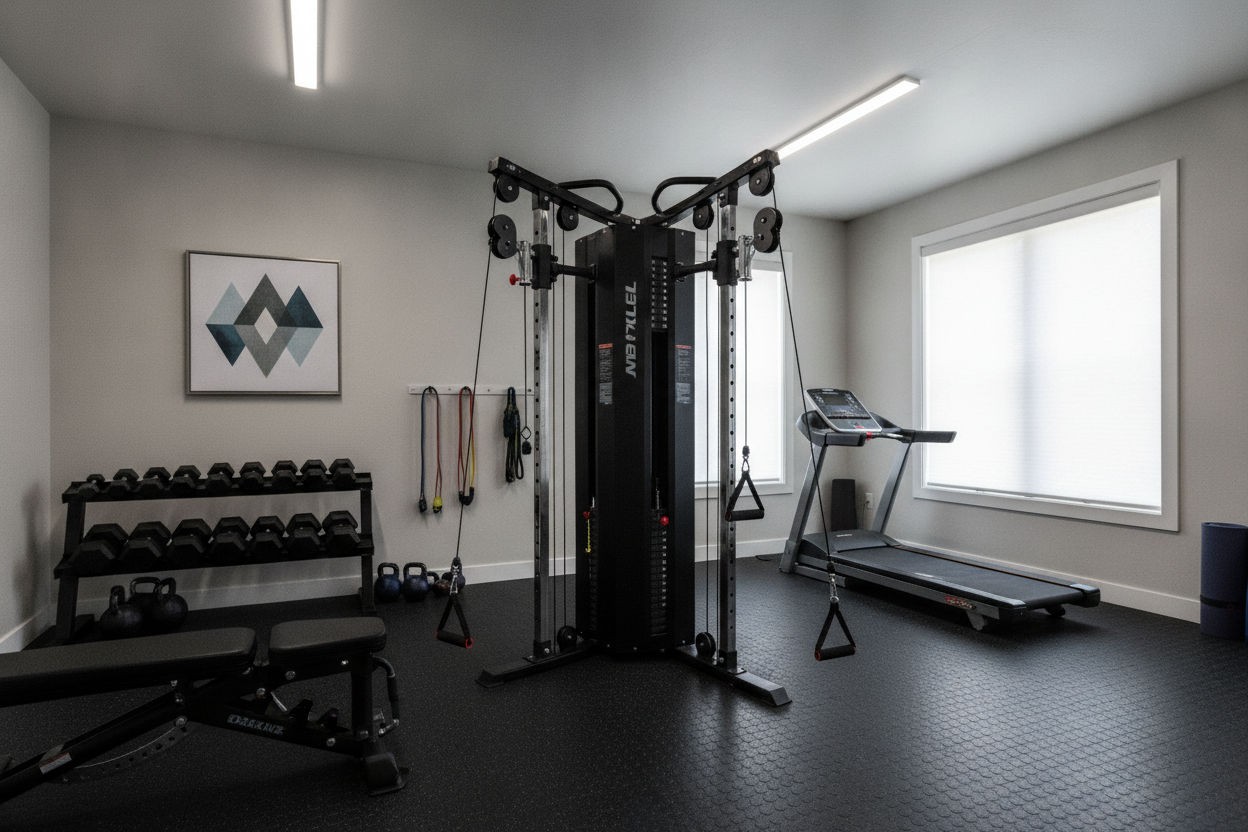
A fixed-path machine, like a home Smith machine or a basic multi-press station, is rigid. It is great for beginners who do not have the stability yet, but it becomes a prison for your progress. Functional trainers, which use two adjustable pulley towers, are the gold standard for a total body home gym. They allow for 3D movement. You can do cable crossovers, lunges with resistance, and even woodchoppers for core strength. They offer a vastly superior full body stimulus because they force your stabilizer muscles to work, unlike a rigid machine that does the balancing for you.
Protecting Your Floors From 400-Pound Weight Stacks
Let's talk about the 400-pound elephant in the room. A total body exercise machine with dual 200-lb stacks isn't just heavy; it is a 'point load' nightmare. The entire weight of that machine is often concentrated on four small feet. I once made the mistake of putting a multi-station gym on those cheap 1/2-inch interlocking foam tiles. Within a week, the feet of the machine had sliced through the foam and left permanent, deep gouges in my expensive hardwood flooring.
Standard foam flooring is for yoga and bodyweight work, not for heavy iron. You need a high-density, single-piece protective layer. I highly recommend getting a large exercise mat for home gym use that is specifically rated for heavy equipment. We are talking 1/4-inch to 3/8-inch of solid rubber. This does more than just protect the floor; it dampens the noise when the weight stack drops and prevents the machine from 'walking' or shifting across the room during explosive movements.
If you are setting up in a second-story spare room, you also need to consider the structural load. A 500-lb machine plus a 200-lb human is a lot of stress on residential joists if it is all sitting in one corner. Distributing that weight with a proper mat is the bare minimum you should do to avoid a call to a contractor.
The 3 Specs That Actually Matter for Total Body Training
When you are evaluating an exercise machine for full body workout potential, ignore the glossy photos and look at the spec sheet. Here are the three things I check first:
- Pulley Ratio (2:1 vs 1:1): A 2:1 ratio means that 100 lbs on the stack feels like 50 lbs in your hand. This is common in functional trainers because it allows for more cable travel (you can walk further away from the machine). A 1:1 ratio is 'true weight' and is better for heavy movements like lat pulldowns or seated rows. Know what you are buying.
- Guide Rod Material: If the rods aren't solid, chrome-plated steel, do not buy it. Hollow tubes or painted rods will eventually flake or bow. Once a guide rod is slightly bent, the weight stack will stick, and your workout is ruined.
- Footprint and Lateral Stability: A machine might look small in the photo, but you need to account for the 'working area.' If you are doing cable flys, you need 8 to 10 feet of width, even if the machine is only 4 feet wide. Also, shake the machine. If it wobbles under lateral loads, it is not safe for heavy training.
I have seen people spend $3,000 on a machine only to realize it doesn't fit in their 10x10 spare room once they actually try to use the attachments. Measure your ceiling height too—many of these towers are 82-84 inches tall, which can be a tight squeeze in a basement with a drop ceiling.
Should You Just Buy Free Weights Instead?
I will be honest: a power rack, a barbell, and 300 lbs of iron will always be the superior muscle builder. It takes up a similar footprint and generally costs less. However, not everyone wants a garage that looks like a dungeon, and not everyone wants to deal with the risk of a heavy barbell over their neck while training alone. A high-quality total body workout machine offers a level of safety and convenience that is hard to beat for a busy professional.
If you decide to go the machine route, spend the extra money on a unit with a weight stack rather than one that uses resistance bands or 'power rods.' Real weight provides a consistent eccentric phase (the lowering of the weight), which is where most of your muscle growth happens. My personal mistake was trying to save $400 by buying a rod-based system; I hated the 'snap back' feel so much that I stopped training for two months. Buy the iron stack. It lasts forever, and it feels like a real gym.
FAQ
Can I really get a full body workout on one machine?
Yes, provided the machine has a high and low pulley system. You can hit legs with goblet squats or lunges, back with rows, chest with presses, and arms with curls/extensions. The key is having enough weight on the stack to keep challenging yourself.
Are home gym machines as good as commercial ones?
The high-end residential units are very close, but they usually have smaller weight stacks (160-200 lbs vs 300 lbs). The main difference is the thickness of the steel frame and the quality of the pulley bearings. For one or two users, a high-end home unit is plenty.
How do I maintain my exercise machine?
Keep the guide rods clean. Wipe them down once a month with a dry cloth and apply a tiny bit of silicone-based lubricant. Never use WD-40; it attracts dust and will gum up the movement over time.