I Ruined My Gains By Chasing 'Perfect' Exercise Technique
I spent three years chasing a ghost. Every Sunday night, I’d scroll through biomechanics accounts on Instagram, convinced that my lack of quad growth was due to a three-degree hip shift or the wrong foot angle. I’d head into my garage gym, set up the tripod, and record every single set of squats. If the rep didn’t look like a textbook animation, I’d strip the weight and start over. I was obsessed with exercise technique, and it was the biggest mistake of my training career.
Quick Takeaways
- Perfectionism leads to paralysis; your body needs load to grow, not just 'pretty' reps.
- Technical failure is a signal to stop, but reaching it requires actually pushing yourself.
- Skill practice (technique workouts) should be a warm-up, not the main event.
- A stable environment like high-quality gym flooring is more important than a 'perfect' joint angle.
The Trap of the 'Textbook' Rep
Social media has created a generation of lifters who are terrified of their own shadows. We’ve been told that if our knees travel too far forward or our lower back rounds a fraction of an inch, we’re destined for a disc herniation. This fear-mongering has turned the gym into a laboratory. Instead of training, people are performing 'movement assessments.' They spend 45 minutes on a foam roller and 10 minutes actually lifting. I was one of them. I’d obsess over the exact degree of external rotation in my shoulders before I’d even consider touching a 45-lb plate.
The reality is that human bodies are resilient and adaptable. There is no such thing as a universal 'perfect' form because everyone has different femur lengths, hip socket depths, and arm spans. When you prioritize a theoretical ideal over progressive overload, you stop growing. If you’re constantly resetting your progress because a rep felt 'off,' you’ll never accumulate the volume needed for hypertrophy. If you are looking for a complete home training guide, find one that teaches you to embrace the grind rather than over-analyzing every twitch of a muscle fiber.
When 'Good Enough' is Actually Better
There is a massive difference between 'dangerous form' and 'imperfect form.' Dangerous form is when you’re ego-lifting a weight you can’t control, and your joints are taking 100% of the load. Imperfect form is when you’re grinding out the 10th rep of a heavy set and your hips rise slightly faster than your chest. That’s called training. To build muscle, you need to reach a point of technical failure—the point where you can no longer maintain 100% precision. If you stop three reps before that just because you want to keep your fitness technique looking like a YouTube tutorial, you’re leaving gains on the table.
I’ve found that hitting 85% perfect form with a weight that actually makes you sweat is infinitely more effective than 100% perfect form with a weight you could lift for 50 reps. Hypertrophy requires mechanical tension. You need to put the muscle under enough stress that it is forced to adapt. If the load isn't heavy enough to occasionally challenge your stability, it isn't heavy enough to spark growth. Stop being afraid of a little grit in your sets. If the bar is moving and the target muscle is screaming, you’re doing it right.
Why a Technique Workout Doesn't Build Muscle
There’s a trend of people going to the gym to do a technique workout with a PVC pipe or an empty barbell for weeks on end. While skill acquisition is vital for beginners, you have to move past the 'practice' phase eventually. Think of it like learning to drive. You can practice in a parking lot for a year, but you won't actually learn how to handle a car until you get on the highway. The same applies to the squat, bench, and deadlift. You can’t learn how to brace against a 315-lb load by practicing with a wooden dowel.
Skill acquisition is phase one, not the entire journey. Once you know the basic path of the bar, the best way to improve your technique is to add 5 lbs. Your body will naturally find the most efficient way to move that weight. Over-coaching yourself leads to 'paralysis by analysis,' where you’re so focused on 'tucking the elbows' or 'spreading the floor' that you forget to actually exert force. Use your warm-ups for practice, but when the working sets start, your only goal should be moving the weight with intent.
Protect Your Joints Without Paralyzing Your Progress
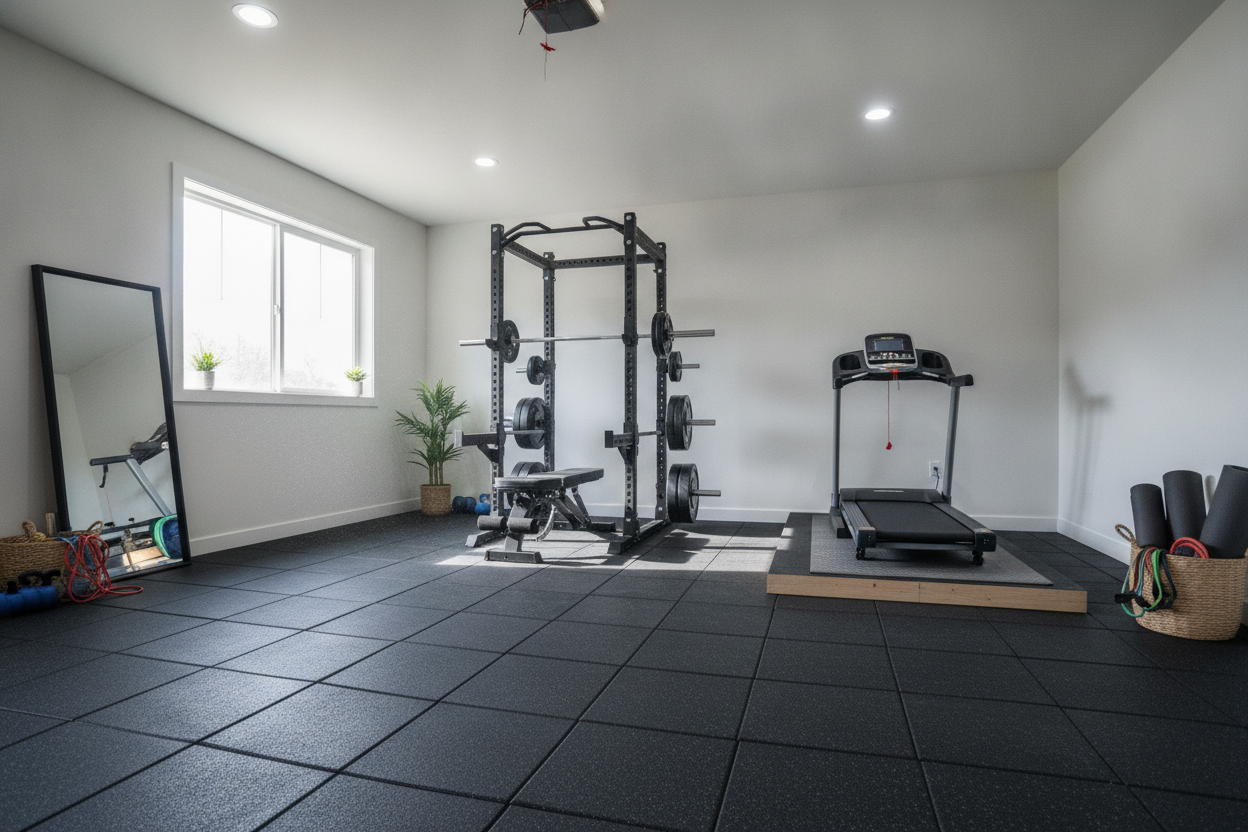
You don't need a degree in kinesiology to stay safe in your home gym. Instead of trying to force your body into an unnatural 'standard' movement, focus on stability and bracing. The biggest cause of injury isn't a slightly rounded back; it’s a lack of stability. If your feet are sliding or your rack is wobbling, your nervous system will 'cut power' to your muscles to protect you. This is why investing in high-quality gym flooring is one of the best things you can do for your progress. It provides a non-slip, dense surface that allows you to root your feet into the ground.
When you feel stable, your body naturally moves more efficiently. I used to try and squat on cheap, squishy foam tiles, and I wondered why my knees always felt 'loose.' Once I swapped to a proper 3/4-inch rubber surface, my stance felt locked in. I stopped worrying about my knee tracking because I finally felt stable enough to just drive through the floor. Focus on the big rocks: keep a neutral spine, brace your core like someone is going to punch you in the gut, and ensure your equipment isn't moving. If those three things are in place, your 'imperfect' movement is perfectly safe.
The Floor is Your Best Form Coach
If you’re still worried about your form, stop looking in the mirror and start using the floor. Floor-based variations are the ultimate 'self-correcting' exercises. A floor press, for example, physically prevents you from over-extending your shoulders at the bottom of a bench press. A dead bug or a floor-supported row gives you immediate tactile feedback on whether your back is arching. The floor acts as a hard stop that prevents you from using momentum or going into a dangerous range of motion.
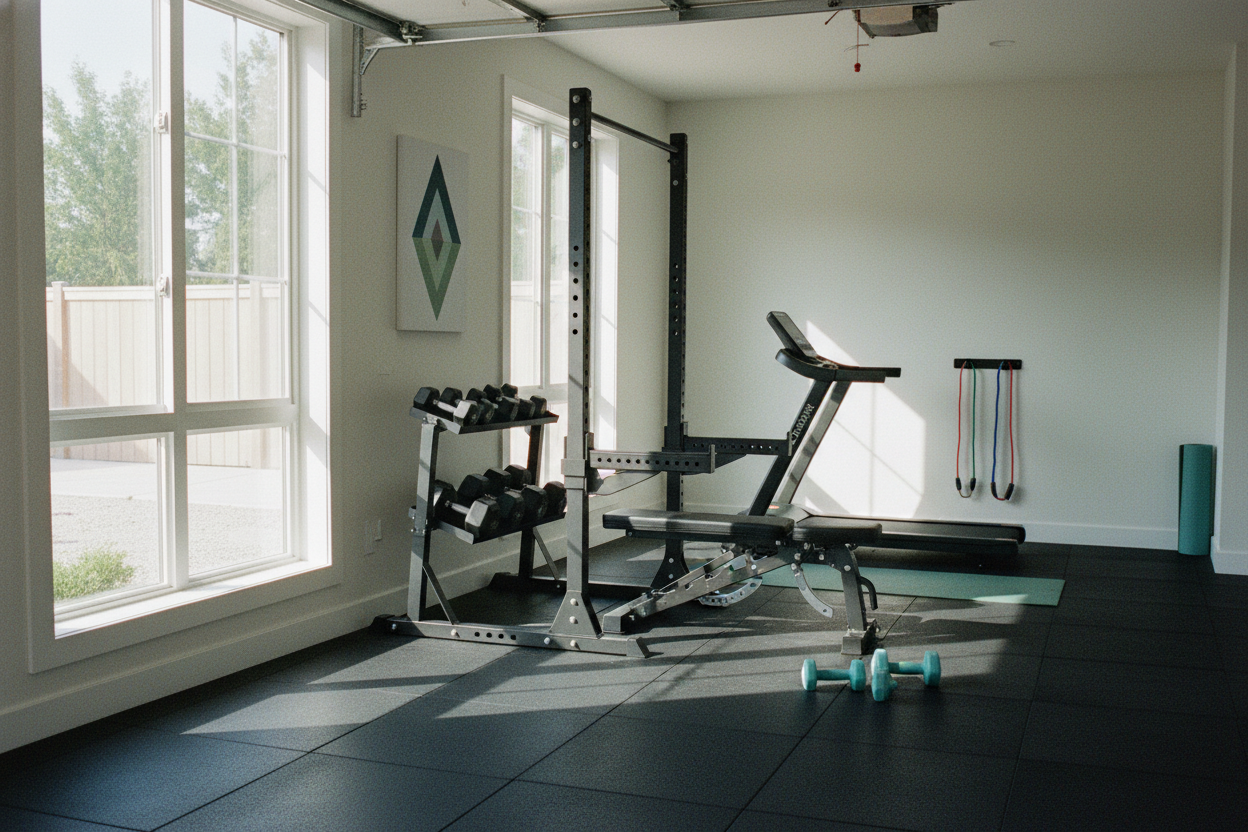
To do this right, you need enough space to actually move without hitting your power rack or your storage pegs. I always recommend clearing out a dedicated space on a large exercise mat so you can spread out. When you have 48 square feet of grippy, stable space, you can perform these floor-based 'checks' comfortably. It’s a lot easier to fix your posture when you have a flat, level surface telling you exactly where your spine is in space. It beats a coach screaming at you every time.
Personal Experience: The Two-Year Plateau
I wasted nearly two years of my prime lifting age being a 'form nerd.' I was so concerned about my 'butt wink' in the squat that I never went above 185 lbs, even though I could have easily handled 275. I’d see guys with 'ugly' reps getting huge, and I’d tell myself they were going to get injured. Guess what? They didn't. They got strong, while I stayed small and 'technically proficient.' I finally broke through when I stopped filming every set and started focusing on how the weight felt. I realized that my body would tell me if a rep was actually bad. Now, I aim for 'solid' reps, and I don't freak out if the last one looks a little rough. My legs have grown more in the last six months than they did in the previous three years.
FAQ
Is it okay if my form breaks down slightly?
Yes, on the last rep or two of a very heavy set. It's called 'technical breakdown.' As long as it's a minor shift and not a total collapse, it's a sign you're pushing your limits. Just don't make it a habit for every rep.
How do I know if my technique is 'good enough'?
If you can feel the target muscle working, your joints don't hurt, and the weight is moving in a controlled manner, you're 90% of the way there. Don't overcomplicate the last 10%.
Should I ever use a PVC pipe?
Only for a 5-minute warm-up to get your joints moving. If you're spending more than that on 'technique work' without weight, you're practicing a hobby, not training for strength.