I Ditched the Machines: Heavy Gym In Home Exercises That Work
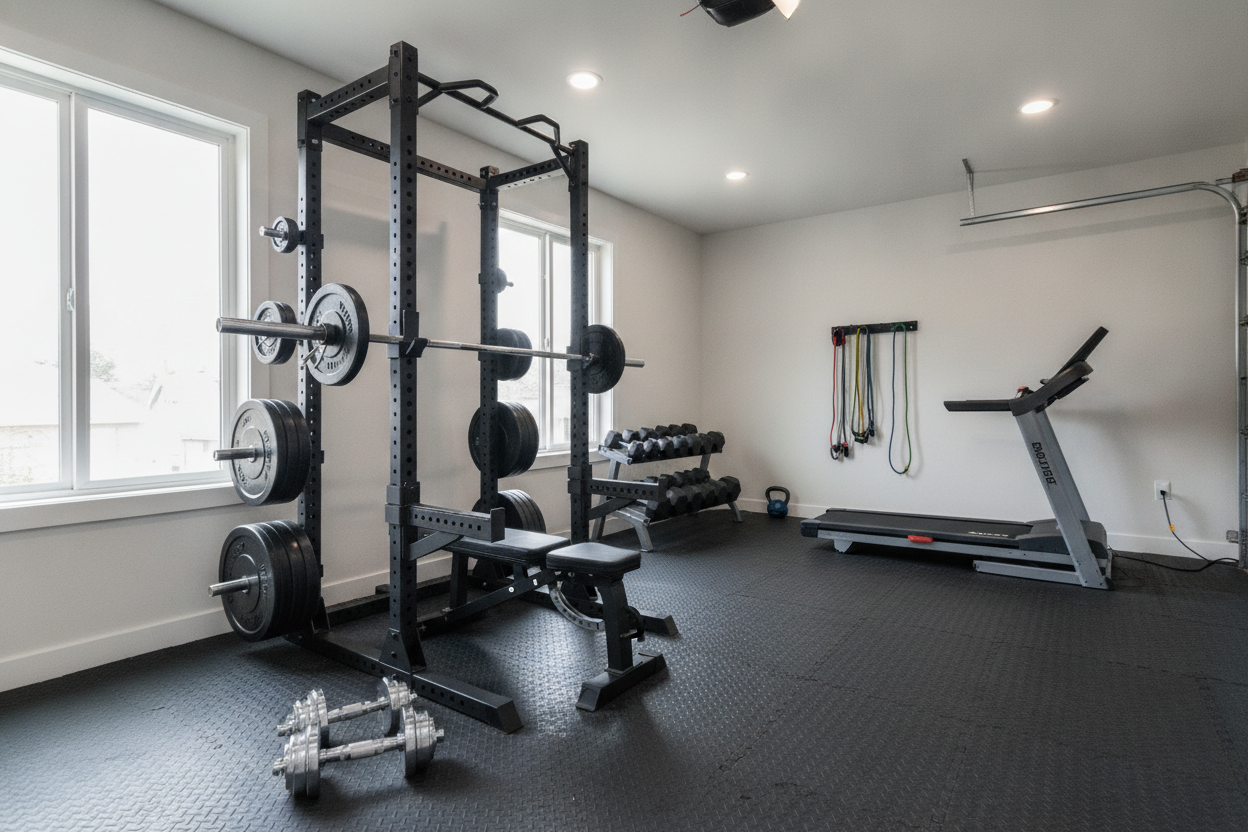
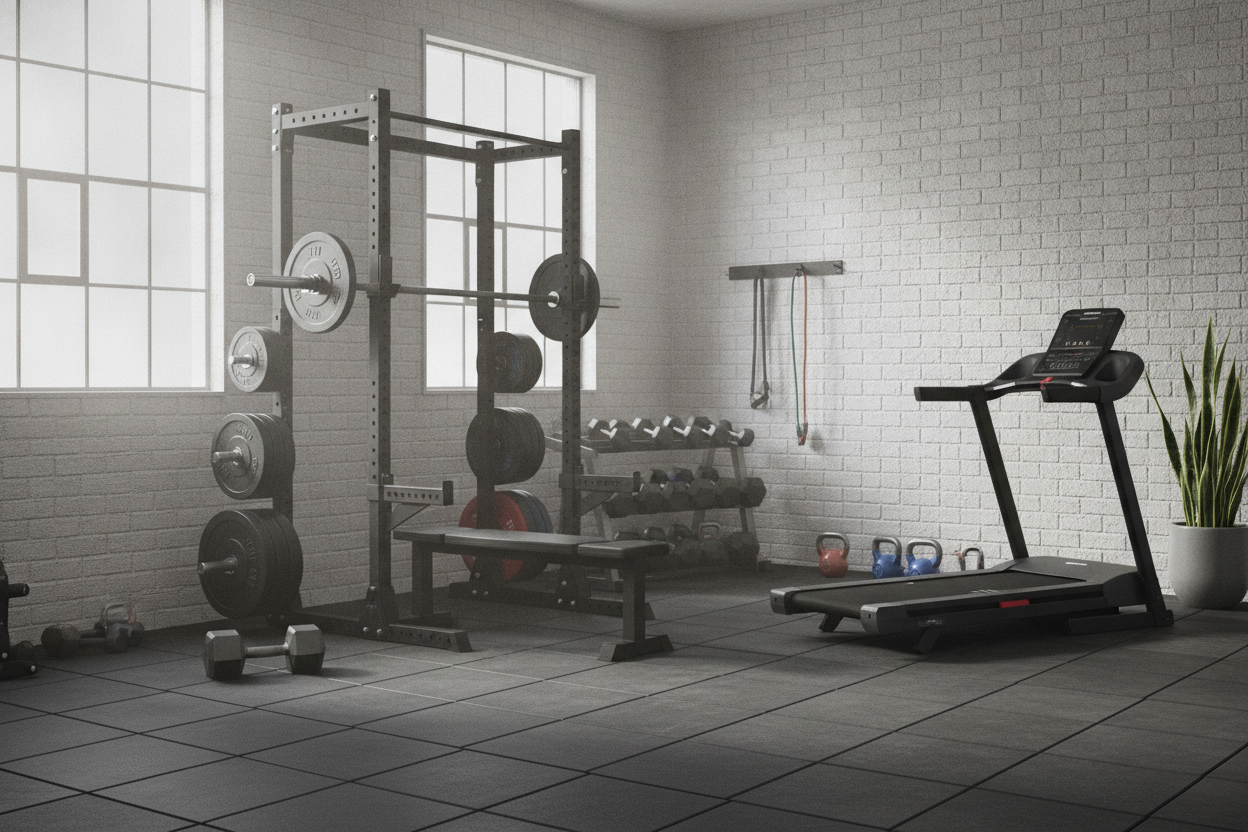
I spent a decade paying sixty bucks a month for the privilege of waiting in line for a seated chest press. One Tuesday night, while staring at a broken leg press for the third week in a row, I realized I was paying for equipment that actually made me a lazier lifter. I went home, cleared out a 6x8 foot corner of my garage, and started focusing on gym in home exercises that actually move the needle.
- Free weights force stabilizer muscles to work harder than fixed machines ever will.
- Bulgarian split squats are a superior, space-saving alternative to the leg press.
- High-density flooring is non-negotiable for safety and floor protection.
- A 4-day upper/lower split is the most efficient way to organize a home lifting routine.
The Commercial Gym Trap (And Why I Left It Behind)
Commercial gyms love machines because they are easy to teach and hard to break. But those seated rows and chest presses are often just crutches. When you switch to a home weight lifting routine, you lose the guided tracks. That is a good thing. Your core has to fire to keep you upright during a standing overhead press, and your grip strength actually gets tested when you are not using a machine handle.
A gym workout from home forces you to own the weight. Without the cable stack to assist the eccentric portion of the lift, you build better control. I found that my nagging shoulder pain actually vanished once I swapped the fixed-path chest press for dumbbells. My body finally got to move in its natural arc, not the one a machine designer in a factory decided on.
Swapping the Leg Press for Brutal Free Weight Alternatives
The leg press is the ultimate space-hog. Instead of trying to squeeze a 400-lb sled into your spare room, focus on weight lifting routines at home that utilize unilateral movements. Bulgarian split squats are my go-to. If you can do three sets of ten with a pair of 50-lb dumbbells, your quads will be screaming louder than they ever did on a hack squat machine.
For those chasing maximum mechanical tension, front squats and deficit lunges are king. These movements require a level of bracing that machines simply ignore. By building raw strength at home with a barbell or heavy kettlebells, you are hitting your posterior chain and core simultaneously. It is efficient, it is hard, and it builds functional mass that translates to the real world.
Replacing Cable Crossovers Without Losing the Chest Pump
The one thing people miss most is the constant tension of cables. You can replicate this in your home full body workout plan by using heavy-duty resistance bands or floor presses. Floor presses are underrated; they limit your range of motion just enough to keep the tension on the pecs and triceps while protecting your shoulders from over-extension.
If you want that deep stretch, go for dumbbell flyes but keep the weight manageable. Focus on the tempo—three seconds down, a pause at the bottom, and an explosive squeeze at the top. Integrating these into a home weight training routine ensures you aren't just moving weight from point A to point B, but actually taxing the muscle fibers through the entire range of motion.
Don't Let Slippery Floors Ruin Your Heavy Lifts
I learned the hard way that a thin yoga mat is not a floor. I tried doing a heavy set of walking lunges on a hardwood floor with a cheap mat, and I nearly ended up in the emergency room when the mat slid like a banana peel. If you are serious about a home lifting routine, you need a stable base that won't shift under load.
Investing in a dedicated gym flooring for home workout setup is about more than just protecting your foundation. It provides the friction needed for heavy swings and squats. A large exercise mat for home gym space also dampens noise, which is vital if you are training in a second-floor apartment or a shared garage. Don't be the person who cracks a tile because they thought a rug was 'good enough.'
Putting It Together: The Anti-Machine Training Split
A solid strength training schedule at home doesn't need to be complicated. I recommend a 4-day upper/lower split. Monday and Thursday are for the upper body (rows, presses, chin-ups), while Tuesday and Friday handle the lower body (squats, hinges, lunges). This frequency allows for plenty of recovery while still hitting each muscle group twice a week.
If you are short on time, you can condense this into a quick weight lifting routine that focuses strictly on compound movements. Skip the isolation stuff and hit the big rocks. My own weight training program at home has evolved over the years, but the core remains the same: lift heavy, stay consistent, and don't let the lack of a leg extension machine be an excuse for small legs.
My Personal Lesson in Hubris
Early on, I tried to save money by buying a cheap, bolt-together bench from a big-box store. It had a '250-lb capacity.' Between my body weight and the dumbbells I was pressing, I was right at the limit. Halfway through a set, the backrest gave way. I didn't get hurt, but it was a wake-up call. Cheap gear is a liability. Now, I only buy equipment that is rated for at least twice what I plan to lift. Buy once, cry once.
FAQ
Do I need a squat rack for a home full body workout plan?
Not necessarily, but it helps. You can do goblet squats, lunges, and Bulgarian split squats with dumbbells or kettlebells and still see massive growth. If you want to move 300+ lbs safely, then yes, get a rack.
How do I mimic lat pulldowns at home?
Pull-ups are the gold standard. If you can't do them yet, use resistance bands for assistance or perform heavy single-arm dumbbell rows to build that back thickness.
Is a home strength training routine as effective as the gym?
Absolutely. Gravity doesn't care if you are in a $10 million facility or a dusty garage. If the resistance is high and your form is dialed in, the muscle will grow.