I Decoded the Types of Workout Machines So You Can Stop Guessing
I remember walking into my first mega-gym after years of training in a dusty garage with nothing but a rusty barbell and some mismatched plates. I felt like an amateur. I was staring at a sea of chrome, pulleys, and handles, wondering which lever I was supposed to pull to actually get a pump without looking like a fool. Deciphering the types of workout machines shouldn't require a master's degree in mechanical engineering, but gym brands love to make things complicated with fancy names.
- Selectorized machines use a pin and a weight stack for speed.
- Plate-loaded machines require Olympic plates and offer a more 'raw' strength feel.
- Cable machines provide constant tension that you just can't get from dumbbells.
- Fixed-path machines are safer for training to absolute failure without a spotter.
The Two Main Types of Workout Machines: Pins vs. Plates
When you walk into the strength circuit, you'll notice two distinct vibes. The first is 'selectorized' equipment. These are the machines with the rectangular weight stacks and the magnetic pins. You sit down, pick a number, and go. They are built for efficiency and keeping your heart rate up because you aren't wrestling with heavy iron between sets. They use a system of pulleys and cams to manipulate the resistance curve, making the weight feel consistent throughout the move.
Then you have plate-loaded gear—think of the big, beefy Hammer Strength rigs. These don't have built-in weights. Instead, you're understanding the types of weight required by manually sliding 45-lb plates onto the machine's horns. In my experience, these feel much closer to free weights. They usually have a pivot point that creates a slight arc, and because there are fewer cables and pulleys, there's less friction. If you want to move heavy loads and feel that 'clank' of the iron, these are your best friend.
What Are Weight Machines Called? A Quick Translation Guide
If you're asking 'what are weight machines called?' while pointing at a weird metal chair, you aren't alone. Every brand has a different name, but the mechanics are usually the same. The 'seated push thing' is a Chest Press. If you're sitting and pulling a bar toward your stomach, that's a Seated Row. The 'leg kicker' is almost always a Leg Extension. Knowing the specific weight machine name helps you follow a program without staring at the instruction stickers for ten minutes.
You will also see 'converging' and 'diverging' machines. A converging chest press means the handles move toward each other as you push, which better mimics how your pectoral muscles actually function. A 'Linear' machine moves in a straight line. I personally prefer converging machines for upper body work; they feel more natural on my shoulders and give a much better squeeze at the top of the rep. Don't get hung up on the types of weight machines brands; just look at the movement pattern.
The Different Weight Machines You Actually Need for Leg Day
Leg day is where different weight machines really shine because they allow you to absolutely demolish your quads and hamstrings without your lower back giving out first. The Leg Press is the staple. Whether it's a 45-degree sled or a horizontal cable press, it's a mass builder. But if your gym has a Hack Squat, use it. It forces you into a deep range of motion that's hard to replicate with a barbell unless you have Olympic-level ankle mobility.
Don't sleep on the Seated Leg Curl either. I've found that the seated version usually offers better hamstring isolation than the lying version because the seat helps pin your hips in place. You'll also see weight lifting machine types like the Adductor/Abductor (the 'inner/outer thigh' machine). While people joke about them, they are actually great for hip stability. However, if you're short on time, stick to the big three: Leg Press, Hack Squat, and Leg Curl. Those are the ones that actually move the needle on your physique.
Upper Body Weight Lifting Machine Types Worth Your Time
For the upper body, the weight lifting machine types you choose should fill the gaps that dumbbells leave behind. A Chest-Supported Row is a must-have. By putting your chest against a pad, you take your lower back out of the equation, allowing you to pull heavier and focus entirely on your lats and rhomboids. I've seen guys who can't barbell row 135 lbs with good form move 200 lbs on a supported machine with perfect isolation.
Another winner is the Lateral Raise machine. Doing side raises with dumbbells is great, but the resistance is zero at the bottom and heaviest at the top. A cam-driven lateral raise machine keeps tension on your delts through the entire arc. It burns like nothing else. When looking at types of weight training machines for the chest, I always look for a Pec Deck or a fly machine. It’s the most efficient way to stretch the chest fibers under load without the risk of dropping a dumbbell on your face.
Cables and Functional Trainers: The Ultimate Types of Weight Training Machines
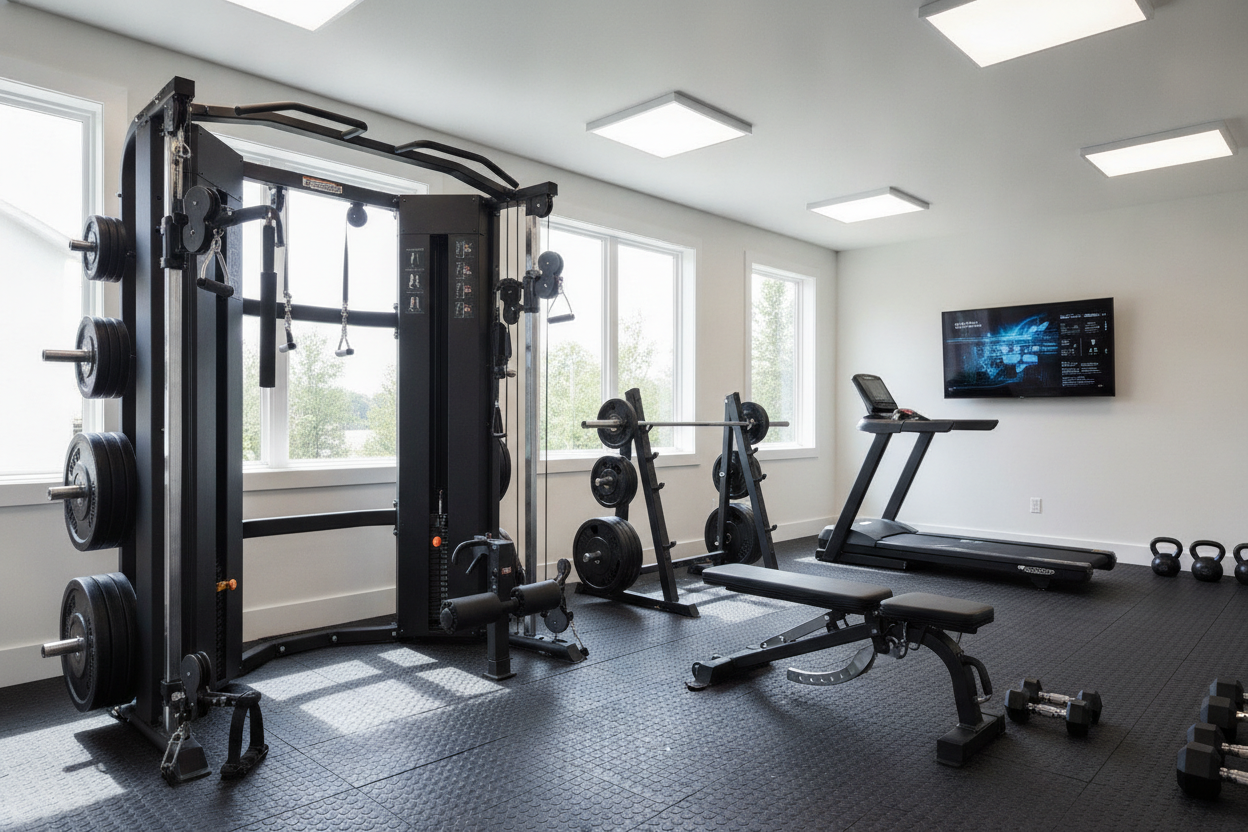
If I could only have one machine in my home gym, it would be a Functional Trainer. These are the dual-adjustable cable stacks you see in every commercial facility. Cables are unique because the resistance is 'omni-directional.' You can set the pulley low for curls, high for face pulls, or at chest height for crossovers. Because the weight stack is suspended by a cable, the tension is constant—there's no 'dead spot' in the movement.
These are the most versatile types of weight training machines because they allow for 'functional' patterns. You can mimic a golf swing, a punch, or a swimming stroke against resistance. I use them mostly for 'finishers' at the end of a workout. There is something about a high-rep cable crossover that provides a pump you just can't get from a bench press. Plus, most modern cable stacks have a 2:1 ratio, meaning 100 lbs on the stack feels like 50 lbs, giving you much finer control over your weight increments.
How to Pick Which Types of Weight Machines Fit Your Goals
Choosing between weight lifting machine types comes down to your goal. If you're a bodybuilder, you want machines that provide the best isolation and 'feel.' If you're a powerlifter, you might use machines as accessory work to build the muscles that support your big lifts. Don't listen to the 'hardcore' crowd who says machines are for lazy people. The truth is, machines aren't cheating your progress; they are just another tool in the box.
I spent years thinking I had to do everything with a barbell. My joints were constantly achy, and my progress plateaued. The moment I started incorporating more weight machine types into my routine, my hypertrophy took off. You can push yourself to the absolute limit on a machine because you don't have to worry about the weight crushing you. Use them for your high-rep work, use them to failure, and stop worrying about what the purists think.
Personal Experience: The Leg Press Lesson
I used to be a total 'free weights only' snob. I thought the leg press was a waste of time until I tore a minor muscle in my lower back doing heavy back squats. I couldn't put a bar on my spine for eight weeks. I swallowed my pride and lived on the Hack Squat and Leg Press. To my surprise, my legs actually got bigger during those two months than they had in the previous year. I realized that the machine allowed me to focus 100% on my quads rather than 50% on my quads and 50% on not falling over. I still squat, but I never skip the machines anymore.
FAQ
Are machines better than free weights?
Neither is 'better.' Free weights are superior for building stability and coordination, while machines are generally better for isolating specific muscles and training to failure safely.
Do machines count as 'real' strength?
Yes. Your muscles don't know if you're holding a dumbbell or pushing a lever; they only know tension and load. If you get stronger on a machine, you are getting stronger, period.
Why do some machines feel heavier than others with the same weight?
It's all about the pulley ratio and friction. A machine with a 2:1 ratio feels half as heavy as the number on the stack, while a 1:1 ratio feels exactly like the weight listed.