
Huge Glutes Blueprint: 5 Simple Glute Training Principles, Biomechanical Vectors, and Home Floor Staging
Developing powerful, thick glutes requires more than random high-rep burnouts or isolated machine work. Achieving structural lower-body hypertrophy demands an organized approach combining multi-planar biomechanical tension with rock-solid equipment stability. When pursuing the goal of building huge glutes, lifters frequently encounter training plateaus caused by quad dominance, poor mind-muscle connection, or unstable home gym floor setups that compromise movement execution.
The Hypertrophy Mechanics Behind Building Thick Glutes
Gluteal musculature consists of three distinct functional units: the gluteus maximus, gluteus medius, and gluteus minimus. To build balanced, thick glutes, programming must account for the unique fiber orientations and primary movement actions of each region rather than relying exclusively on traditional vertical squats.
Understanding Regional Muscle Architecture and Fiber Orientation
The gluteus maximus is the largest muscle in the body, primarily functioning as a powerful hip extensor and external rotator. Its upper and lower fibers recruit differently depending on hip angles and external resistance paths. The gluteus medius and minimus sit higher along the lateral pelvis, acting primarily as hip abductors and pelvic stabilizers during single-leg actions. lifters seeking the best adaptations described in our glutes woman guide must expose all three muscles to progressive overload.
The Three Tension Vectors: Axial, Anteroposterior, and Abduction
Complete development for anyone targeting big glutes female strength goals requires training across three primary mechanical force vectors:
- Axial Loading: Vertical forces relative to the torso, such as back squats and lunges, creating maximum tension when the hip flexes.
- Anteroposterior Loading: Horizontal forces relative to the torso, such as hip thrusts and barbell glute bridges, maximizing tension at full hip extension.
- Lateral Abduction: Horizontal-plane forces away from the midline, challenging the upper glute shelf and hip stabilizers.
5 Simple Training Principles for Maximum Posterior Development
Structured programming outperforms arbitrary exercise variation. Adhering to these five foundational principles ensures consistent progression toward the biggest glutes female athletes build through structured athletic regimens.
1. Prioritize Horizontal Loading (Hip Thrusts and Glute Bridges)
Horizontal hip extension places peak mechanical tension on the gluteus maximus precisely at the point of full hip lock. By maintaining a slight posterior pelvic tilt at the top of the movement and keeping the chin tucked, lifters achieve full contraction without hyperextending the lower back. Explore specific movement choices in our comprehensive glutes women guide.
2. Master Deep Hip Flexion Lengthened Patterns (RDLs and Deficit Lunges)
Exercises that place high mechanical tension on stretched muscle fibers stimulate substantial hypertrophy. Romanian deadlifts (RDLs), Bulgarian split squats, and deficit reverse lunges force the gluteal fibers to control heavy loads through deep hip flexion. Pushing the hips back horizontally while keeping the shins relatively vertical maximizes glute recruitment over quadriceps involvement.
3. Integrate Unilateral Stabilization to Eliminate Strength Asymmetries
Single-leg training balances lateral hip strength and activates the stabilizing gluteus medius. Step-ups, single-leg hip thrusts, and walking lunges prevent the dominant side from compensating, resulting in symmetrical development and superior overall pelvis alignment for big glutes women.
4. Isolate Lateral Abduction for Upper Glute Shelf Width
Dedicated hip abduction exercises using resistance bands or cables create lateral upper glute development. Seated band abductions, side-lying hip raises, and cable kickbacks angled slightly outward recruit the upper gluteus maximus and medius fibers that compound lifts alone do not fully exhaust.
5. Enforce Mind-Muscle Pauses and Controlled Eccentric Tempos
Momentum reduces muscular tension. Incorporating a deliberate two-second isometric hold at the peak of hip thrusts alongside a controlled three-second lowering phase during RDLs amplifies time under tension, producing powerful stimulus for big glutes woman hypertrophy without requiring excessive, joint-straining loads.
Execution Mastery: Form Cues to Prevent Lower Back and Quad Dominance
Lifting heavy weights without strict mechanical alignment often shifts tension to the lumbar extensors and quadriceps. Using detailed form corrections from our glutes female guide ensures tension stays squarely on the target muscles.
Shin Angle Calibration and Foot Stance Adjustments
During hip thrusts, feet placed too far forward shift tension onto the hamstrings, while feet placed too close to the hips force the quadriceps to dominate. Adjust foot placement so that shins form a vertical ninety-degree angle to the floor at peak extension. Slightly turning the toes outward allows comfortable external hip rotation during the press.
Ribcage-to-Pelvis Bracing to Protect the Lumbar Spine
To avoid arching the lower back under heavy barbell loads, pull the ribcage down toward the pelvis and lock the abdominal wall before initiating the hip extension. Moving the torso and pelvis as a single rigid cylinder protects the spine and ensures the glutes execute the entire movement range.
Home Gym Floor Staging and Equipment Safety for Heavy Glute Work
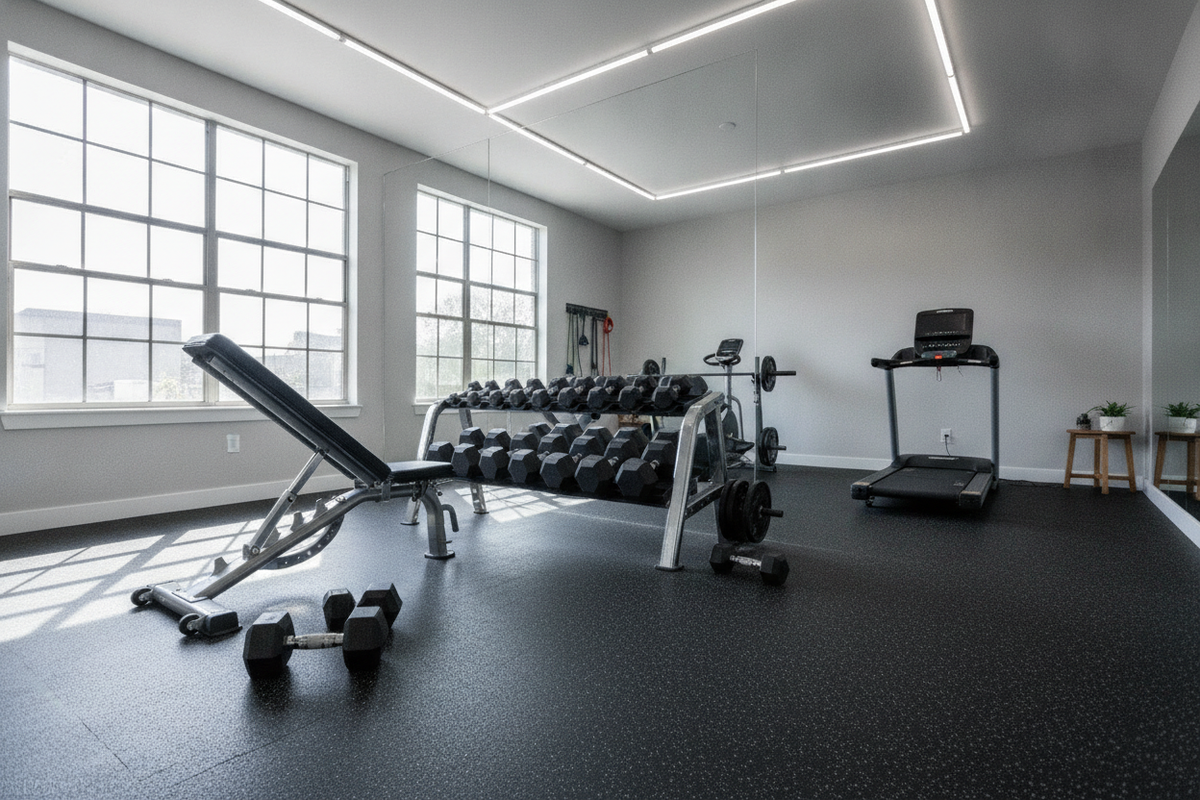
Executing heavy posterior chain work at home requires intentional floor setup. Exercises like heavy barbell hip thrusts, RDLs, and deficit lunges generate substantial localized friction and downward force. Complementing your lifting strategy with the structural setup in our woman female guide creates a safer, more stable training space.
Bench Anchoring and Anti-Slip Friction on High-Density Mats
A frequent hazard during heavy hip thrusts is the utility bench sliding backward against slick flooring when pressing upward. Placing both the bench and the lifter's feet on high-density rubber exercise mats creates reliable traction. Dense rubber grips hard subfloors, preventing bench shift and keeping your feet planted firmly throughout heavy loading sets.
Subfloor Protection for Heavy Barbell Thrusts and Deadlifts
Repeatedly lowering heavy barbells during deadlifts and glute bridges can damage underlying concrete, hardwood, or tile floors over time. High-density floor mats disperse impact shock and absorb localized vibration, keeping home surfaces intact while deadening acoustic resonance throughout the living space.
Surface Hygiene, Sweat Resistance, and Floor Mat Maintenance
Ground-based glute exercises—such as floor bridges, kneeling kickbacks, and bench thrusts—require substantial direct contact with your flooring. Mats with non-porous, sweat-resistant surfaces prevent moisture accumulation and make post-workout wipe-downs straightforward, maintaining a clean home gym environment.
Structuring Your Weekly Split for Sustainable Glute Hypertrophy
Consistency and progressive overload drive long-term muscle adaptation. Structuring a sustainable routine allows sufficient rest while regularly applying tension across all force vectors.
Balancing Intensity, Movement Rotation, and Adequate Recovery
A structured routine balances exercise types across separate lower-body sessions throughout the week:
- Day 1 (Horizontal & Unilateral Focus): Barbell hip thrusts, Bulgarian split squats, cable kickbacks, and seated band abductions.
- Day 2 (Lengthened & Axial Focus): Romanian deadlifts, deficit reverse lunges, goblet squats, and side-lying abductions.
Long-Term Progression Tracking Framework
Track your resistance loads, sets, and rep quality over time. Focus on incrementally adding weight, adding reps with pristine form, or extending eccentric tempo control to build huge glutes safely and effectively over the long term.


