How to Pick a Dumbbell for Exercise That Won't Limit Your Lifts
I remember the first time I bought a dumbbell for exercise. It was a pair of plastic-coated 20-pounders from a big-box store that I found in a clearance bin. Within three months, they were basically expensive doorstops because I had outgrown the weight, and the handles felt like they were coated in grease the second my palms started sweating.
Building a home gym is an investment, but most people treat it like a grocery run. They grab whatever is cheap and colorful, only to realize that bad iron actually holds your progress back. If you want to get strong, you need a dumbbell for workout sessions that feels secure in your hand and actually scales with your strength.
Quick Takeaways
- Skip the neoprene: You will outgrow light weights faster than you think.
- Fixed Hex is king for durability: They don't roll away and they last forever.
- Adjustables save space: Perfect for 1-bedroom apartments or tight garages.
- Grip matters: Look for knurling, not smooth plastic or chrome.
- Protect your floor: Heavy weights and concrete don't mix.
The Neoprene Trap: Why Cheap Weights Cost You More
We have all seen them: those bright pink, teal, and lime green small dumbbell weights. They look great on a shelf, but they are a trap for anyone serious about dumbbell fitness equipment. Most of these sets max out at 15 or 20 pounds. In a real training program, you will pass those numbers on your rows and presses in about three weeks.
Buying a home dumbbell set that you outgrow immediately is just throwing money away. You are better off buying a pair of 25s or 35s and learning to work up to them than buying a full kit of tiny weights. If you want a dumbbells kit that actually lasts, look for cast iron or rubber-encased heads. These are the real home gym equipment dumbbells that professional athletes use.
Adjustable vs. Fixed Hex: The Garage Gym Showdown
This is the biggest debate when finding the best dumbbell set. If you have the luxury of a 3-car garage, a full rack of fixed gym dumbbells is the dream. They are indestructible. You can drop them, throw them, and they are always ready to grab. No clicking, no pins, no dial-turning.
But for most of us, space is the enemy. A home gym dumbbell set that goes from 5 to 50 pounds in a fixed rack takes up about six feet of wall space. High-quality adjustable dumbbells for home gym use can replace 15 pairs of weights in the footprint of a shoebox. Just be warned: some adjustables feel like 'long dumbbells' and can be clunky during curls or overhead presses. If you go adjustable, don't buy the cheapest ones; the internal mechanisms can fail when you start pushing heavy weight dumbbell sets.
What Actually Matters When You Grip the Handle
The handle is your only point of contact with the weight. If it is bad, your lift is bad. Most gym dumbbell set options come with either a straight handle or a contoured (ergo) handle. I prefer a straight handle with aggressive knurling—that sandpaper-like texture that bites into your skin. It keeps the weight from spinning when you are doing heavy dumbbells for fitness movements like snatches or rows.
Avoid the smooth, chrome-plated handles found on cheap dumbbells for at home workout setups. They look shiny, but as soon as you sweat, they become slippery. A 1.25-inch diameter is the sweet spot for most people. If the handle is too thin, it hurts your palms; too thick, and your grip will fail before your muscles do.
Protecting Your Foundation (Because You Will Drop Them)
You are going to drop a weight eventually. Maybe your grip fails on the last rep of a PR, or you just have to bail on a heavy bench press. If you are using a dumbbells set for home gym training on bare concrete, you are going to crack your floor or, worse, the dumbbell head. I have seen cast iron dumbbells for home use literally snap at the handle because they hit the floor at the wrong angle.
Investing in a large exercise mat for home gym protection is non-negotiable. If you are doing serious lifting, you need a dedicated gym flooring for home workout zone. This isn't just about the floor; it is about noise. Your neighbors (and your spouse) will thank you when you aren't rattling the whole house every time you finish a set of dumbbells for home workout routines.
Stop Tripping Over Your Iron
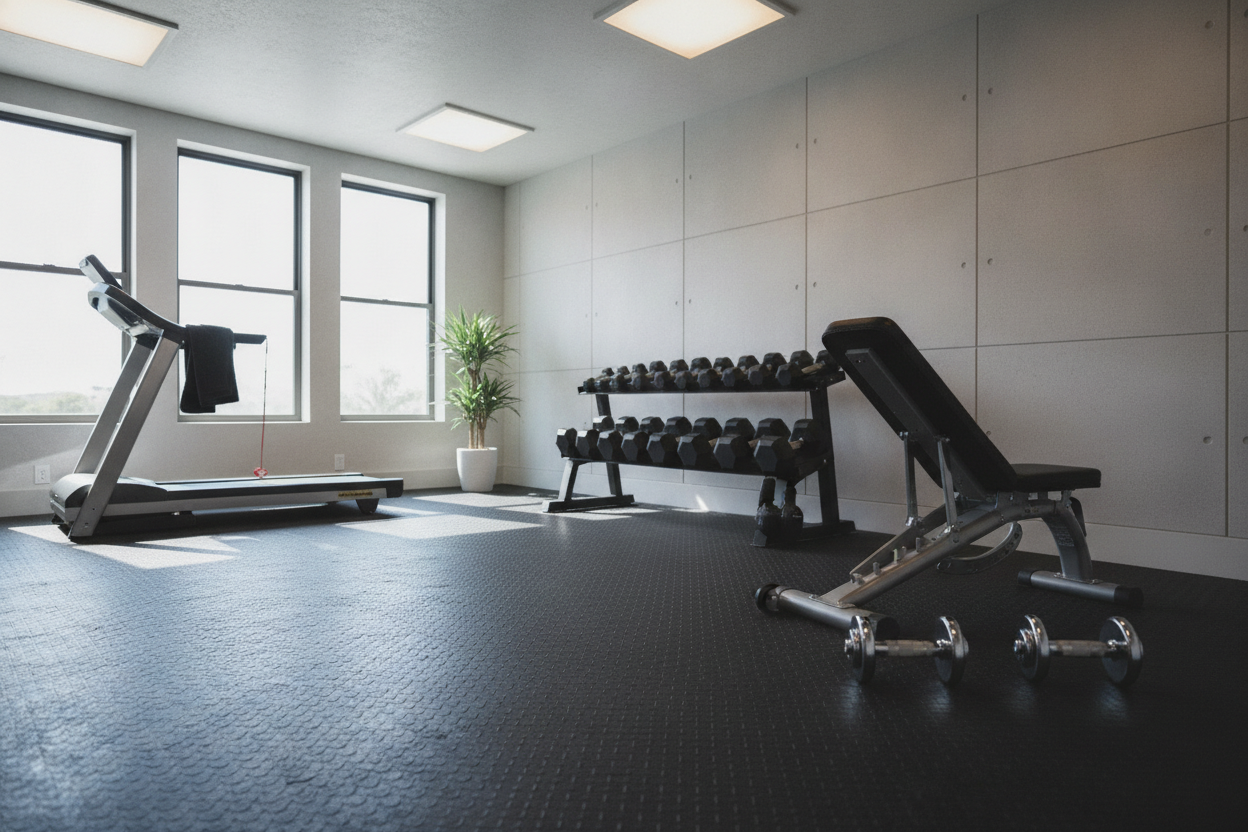
Nothing kills a workout vibe like stubbing your toe on an at home dumbbell set left in the middle of the floor. Organizing your space makes it feel like a real gym, not a storage unit. A simple A-frame rack or a three-tier horizontal rack will help you choose the right dumbbell storage for your specific layout.
If you have an at home dumbbells setup, keep the heavy ones on the bottom and the cool weights—the ones you use for high reps—at eye level. It keeps the center of gravity low so the rack won't tip, and it saves your lower back when you are reaching for the heavy hitters.
My Honest Experience
I once bought a cheap set of 'sand-filled' weights because they were half the price of iron. One day, I dropped a 30-pounder during a set of lunges. The plastic casing split right open, and I had black sand all over my garage for six months. It was a mess. Now, I only buy rubber hex dumbbells. They are quieter, they don't roll, and even if I drop them, they don't leak 'gym dust' everywhere. Buy once, cry once.
FAQ
Should I get rubber or iron dumbbells?
Rubber hex is better for home use. They are quieter, they don't rust, and they won't ding your walls as easily as raw cast iron will.
Are adjustable dumbbells safe for heavy lifting?
Yes, but stick to reputable brands. Cheap knock-offs have plastic locking tabs that can snap. If you are doing overhead work, you want a locking mechanism you can trust.
How many dumbbells do I need to start?
If you aren't getting adjustables, start with three pairs: one 'light' (for lateral raises), one 'medium' (for curls/presses), and one 'heavy' (for rows/goblet squats).