How to Master the Exercise Ball Hip Thrust Without Rolling Away
I remember the first time I tried a hip thrust in my living room. I didn't have a bench, so I grabbed the old stability ball my wife used for yoga. Thirty seconds later, I was sliding across the hardwood floor like a curling stone, nearly taking out a floor lamp. It was embarrassing, but it taught me a valuable lesson: the exercise ball hip thrust is a fantastic movement, but if your setup is garbage, your workout will be too.
Quick Takeaways
- Traction is non-negotiable; never do these on bare hardwood or tile.
- The instability forces your hamstrings and core to work harder than a standard bench.
- Proper pelvic tilt is the only way to avoid lower back strain.
- Progression is limited, so focus on time under tension rather than max weight.
Why the Bench Isn't Always Better
Most people view the swiss ball hip thrust as the 'budget' version of a barbell bench thrust. That’s a mistake. When you’re on a rigid bench, your upper body is locked in. On a ball, every micro-wobble requires a muscular correction. This dynamic instability turns a standard glute move into a full-posterior chain fight.
You’ll feel your hamstrings firing much earlier in the rep because they’re trying to keep the ball from squirting out from under you. If you’ve plateaued on the big lifts, switching to a stability ball hip thrust for a few weeks can wake up those neglected stabilizer muscles that a fixed bench ignores.
Your Setup Is Why You're Sliding Across the Room
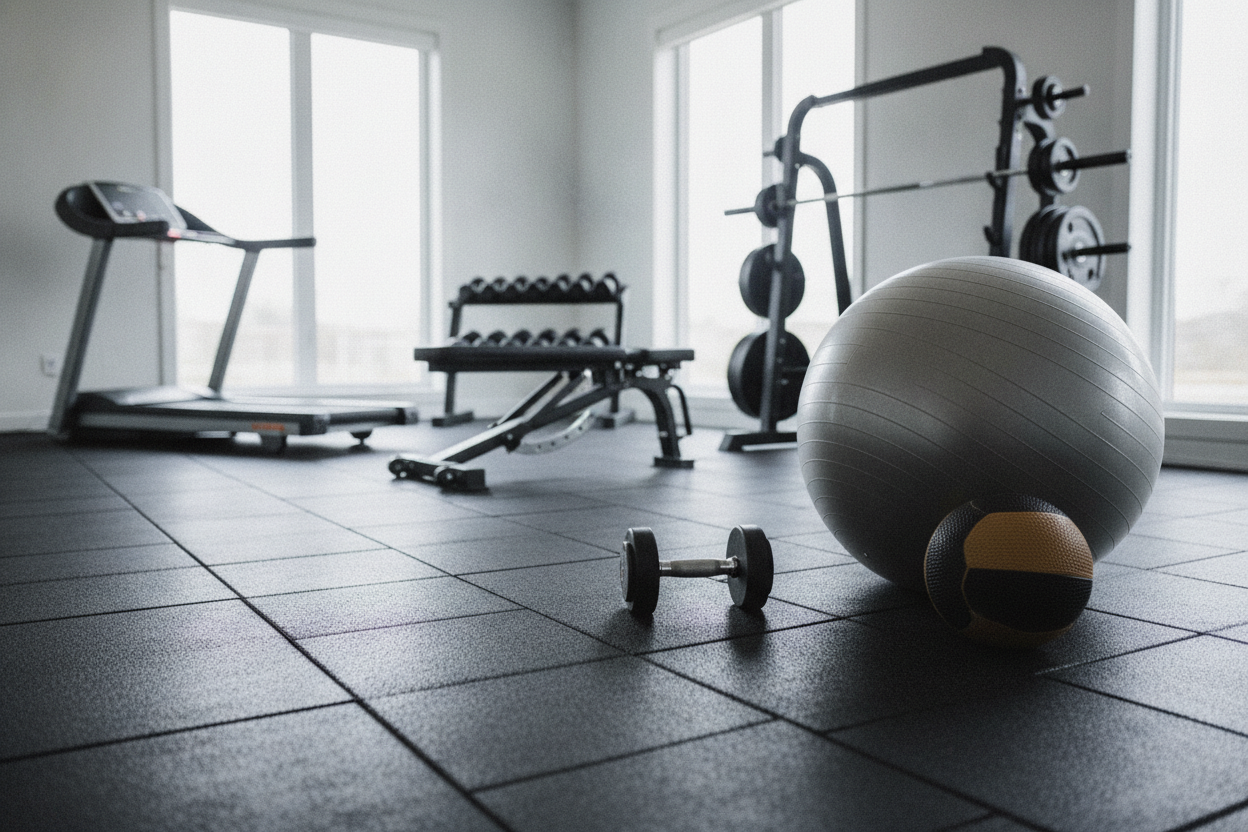
If you find yourself drifting backward during your set, it’s not a weakness issue—it’s a friction issue. You need a grippy surface for both the ball and your feet. I’ve found that high-quality gym flooring is the gold standard here. The rubber bite prevents the ball from migrating while you drive through your heels.
If you're working out in a cramped apartment, at least throw down a large yoga mat to create a 'sticky' zone. Without that friction, you’ll spend 80% of your energy fighting physics instead of building your glutes. Also, check your shoes. Barefoot or flat-soled lifting shoes work best; squishy running shoes will only add more instability to an already unstable movement.
Nailing Your Shoulder and Neck Placement
Don't just flop onto the ball. You want your shoulder blades (the scapulae) centered on the highest point of the ball. If you sit too high, the ball will roll toward your head; too low, and it’ll shoot out toward the wall. Keep your chin tucked toward your chest throughout the entire movement. This keeps your spine neutral and prevents you from arching your neck like a turtle every time you hit the top of the rep.
Stop Dropping Your Hips: Fixing the 'Fake Lockout'
The biggest trap with the fitball hip thrust is the 'squish factor.' Because the ball compresses under your weight, it’s easy to think you’ve reached full extension when your hips are actually still several inches low. I call this the fake lockout. You feel the pressure, but your glutes aren't fully contracted.
To fix this, focus on a posterior pelvic tilt at the top. Think about tucking your tailbone between your legs. If you don't feel a massive squeeze in your glutes at the top, you're likely just arching your lower back to compensate for the ball's give. Slow the tempo down. Hold the top for two seconds. If the ball starts shaking, you’re doing it right.
How to Add Weight When Bodyweight Gets Too Easy
Once you can knock out 20 clean reps, it’s time to load up. A medicine ball hip thrust is the easiest transition. Resting a 20-lb med ball on your hips adds resistance without the awkwardness of a long barbell. You can also try a hip thrust with band placed just above your knees. This forces you to push outward (abduction) while thrusting upward, which hits the glute medius and makes the stability challenge even more intense.
If you use dumbbells, be careful. A heavy dumbbell on a squishy ball can be a balancing act you don't want to lose. Start light and ensure your feet are glued to the floor before you even think about picking up the weight.
When Should You Finally Ditch the Ball?
I love the yoga ball hip thrust for accessory work and high-rep burners, but it has a ceiling. If your primary goal is to move three plates and build maximum strength, the ball is going to become a liability. There’s a point where the instability limits the amount of weight you can safely move.
When you reach that point, you need to move to a dedicated hip thrust bench. A solid platform allows you to focus 100% of your effort on the hip drive rather than worrying about the ball popping or sliding out. Use the ball for your 'burnout' sets or travel workouts, but stick to the iron for your heavy lifting.
Personal Experience: The 'Cheap Ball' Disaster
I once bought a generic 'anti-burst' ball from a big-box store that felt like a thin balloon. The first time I tried to add a 50-lb dumbbell to my hip thrust, the ball deformed so much my butt actually hit the floor before I reached the bottom of the rep. It felt like trying to lift on a marshmallow. If you're going to do this, invest in a professional-grade ball with a high weight rating. It’s the difference between a productive workout and a trip to the chiropractor.
FAQ
Is a med ball hip thrust better than using a dumbbell?
A medicine ball is often more comfortable because it’s round and fits the contour of your hips, but dumbbells allow for much heavier loading. Start with the med ball to get used to the balance.
Can I do a ball hip thrust if I have lower back pain?
Often, yes, because the ball allows for a more natural range of motion. However, if you arch your back instead of tucking your pelvis, you'll make the pain worse. Focus on the 'tuck' at the top.
What size ball should I use for hip thrusts?
Most people do well with a 55cm or 65cm ball. You want your knees to be at a 90-degree angle when your hips are fully extended at the top. If the ball is too big, you won't be able to reach the floor comfortably.