How to Build Massive Delts Using Only Machines for Shoulders
Walk into any commercial gym, and you’ll usually see the squat racks and dumbbell areas packed, while the machine sector is relatively quiet. There is a lingering myth in the fitness community that you cannot build a truly impressive physique without a barbell. That is dead wrong.
When your goal is pure hypertrophy (muscle growth) rather than just moving weight from point A to point B, machines for shoulders offer a distinct advantage: stability. By removing the need to balance a heavy bar, you can direct 100% of your output into the deltoid muscle fibers. If you have been struggling to feel your shoulders working during overhead presses, or if your joints ache from heavy dumbbell swinging, switching to a machine-based approach might be the catalyst you need for new growth.
Key Takeaways: The Machine Advantage
If you are looking for a quick summary of why and how to utilize this equipment, here is the breakdown:
- Constant Tension: Unlike dumbbells, where gravity creates dead spots, machines provide resistance throughout the entire range of motion.
- Isolation: A shoulder exercise machine eliminates momentum, forcing the target muscle to do the work.
- Safety: Mechanical stops prevent the weight from crashing down on you, allowing you to train closer to failure safely.
- The Holy Trinity: The three essential gym machines for shoulders are the Overhead Press (Front), Lateral Raise Machine (Side), and Reverse Pec Deck (Rear).
Why Stability Equals Growth
The science here is straightforward. When you use free weights, a significant portion of your energy goes toward stabilizing the load. Your rotator cuff and core work overtime to keep you upright. While this is great for functional strength, it can be a bottleneck for muscle size.
Weight machines for shoulders solve this. Because the path of motion is fixed, stabilization requirements drop to near zero. This allows for higher motor unit recruitment in the actual deltoid muscle. You can grind out those last two or three reps—the ones that actually trigger growth—without worrying about the weight falling on your head.
The Essential Shoulder Workout Machines
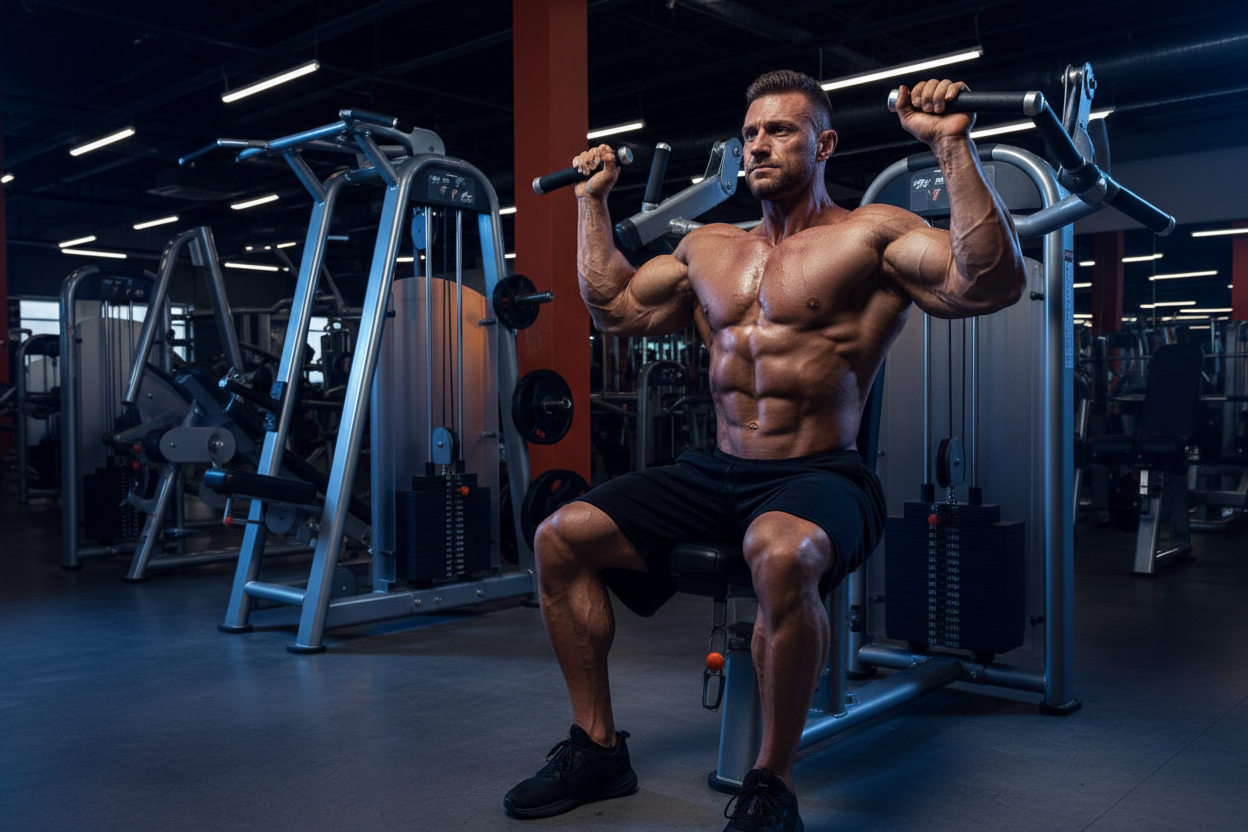
1. The Converging Overhead Press
This is your bread and butter for mass. Look for a gym shoulder machine where the handles move closer together at the top (converging). This mimics the natural arc of your shoulder movement better than a rigid vertical path.
Set the seat height so the handles align with your ears at the start. If you start too low, you place excessive torque on the rotator cuff. Drive up explosively, but control the eccentric (lowering) phase. This machine primarily targets the anterior (front) deltoid.
2. The Lateral Raise Machine
This is arguably the most valuable shoulder exercise on machine equipment in the gym. Why? Because dumbbell lateral raises have a flawed resistance profile; there is zero tension at the bottom and maximum tension at the top.
The shoulder lift machine (lateral raise) keeps tension on the side delts from the very start of the movement. It creates that "capped" look. Keep your elbows slightly bent and drive the pads out and up, leading with your elbows, not your hands.
3. The Reverse Pec Deck (Rear Delts)
Most people neglect their rear delts, leading to a hunched posture. The reverse pec deck is the superior machine for shoulder workout sessions focusing on the posterior chain. It isolates the rear delt without allowing the lats to take over, provided you use the right grip.
Pro Tip: Use a neutral grip (palms facing each other) or pronated grip (palms down). Don't pull too far back; once your arm passes your shoulder line, your traps start taking the load.
Machines for Shoulders and Back
Shoulder training rarely happens in a vacuum. Many movements overlap with back training. For a complete upper body structure, you should look at shoulder and back workout machines.
Specifically, the shoulder extension machine (often resembling a pullover machine) is fantastic. While often used for lats, if you focus on the very end of the range of motion and squeeze the back of your shoulder, it becomes a potent rear delt builder. Integrating gym machines for shoulders and back ensures you don't develop imbalances that lead to injury.
Common Mistakes on Shoulder Equipment
Even with a fixed path, you can mess this up. The biggest error is seat height. On a shoulder press machine, if the seat is too high, you shorten the range of motion. If it's too low, you risk impingement.
Another issue is slamming the weight stack. When using gym equipment for shoulders, you want to barely touch the stack at the bottom—or better yet, stop an inch before it touches. This maintains the "time under tension" that machines are famous for.
My Training Log: Real Talk
Let's be honest about what using these machines actually feels like. I’ve spent years grinding away on shoulder workout machines at the gym, and it’s not always the smooth experience manufacturers advertise.
Take the lateral raise machine, for example. On paper, it's perfect. In reality? If you are sweating even a little bit, your bare arms slide all over the vinyl pads. I learned the hard way that you have to wear sleeves or bring a towel to wedge between your arm and the pad, otherwise, you spend more energy trying to keep your arm from slipping than actually lifting the weight.
Also, there is a specific, gritty vibration you feel in the handles of an older cable-driven shoulder weight machine when the pulleys haven't been oiled in a decade. It adds a weird, stuttering resistance that actually makes the eccentric portion harder. And the shoulder press machine? If you have long arms like me, you know the struggle of the "clank" at the top. You think you have another inch of reach, but the machine bottoms out, sending a shockwave down your elbows. You learn quickly to stop just shy of lockout to save your joints.
Conclusion
Don't let the "free weights or nothing" crowd deter you. Machines for shoulders are not a downgrade; they are a specialized tool for hypertrophy. They allow you to safely push past failure, isolate the three heads of the deltoid, and maintain constant tension that gravity-based free weights simply cannot match. Next time you walk into the gym, head straight for the machine section and focus on the squeeze, not just the weight.
Frequently Asked Questions
Are machines for shoulders better than dumbbells?
For pure muscle isolation and safety, yes. Shoulder workouts on machine equipment provide constant tension and stability, allowing you to focus entirely on the muscle contraction without balancing the weight. However, dumbbells are better for stabilizer muscle strength.
What is the best gym shoulder machine for side delts?
The lateral raise machine is superior for side delts. Unlike dumbbells, where tension is lost at the bottom of the movement, the lateral raise machine provides resistance through the full range of motion, which is critical for growing the side deltoid.
Can I do a full shoulder workout using only machines?
Absolutely. A comprehensive routine would include a shoulder press machine for the front delts, a lateral raise machine for the side delts, and a reverse pec deck for the rear delts. This covers all three heads of the shoulder effectively.