The Underrated Best Quad Builders Most Lifters Ignore
You hit the rack every week, load up the bar, and grind out reps, yet your legs refuse to grow. It is one of the most frustrating plateaus in lifting. The problem usually isn't a lack of effort; it is a lack of intention. Many lifters rely on generic movements that involve the glutes and lower back too heavily, missing the target completely. To fix this, we need to zero in on the best quad builders that prioritize the anterior chain.
This isn't about reinventing the wheel. It is about selecting exercises that mechanically force the quadriceps to do the heavy lifting, rather than letting your hips take over.
Key Takeaways: Quick Summary
- High-Bar Squats: Superior to low-bar for quad isolation due to the upright torso angle.
- Hack Squats: The king of machine movements for hypertrophy, allowing safe failure without stabilization limits.
- Heel-Elevated Goblet Squats: Increases knee flexion to target the teardrop (Vastus Medialis).
- Leg Extensions: Essential for targeting the rectus femoris in the shortened position.
- Bulgarian Split Squats: Fixes imbalances and places extreme tension on the lead leg.
The Science of Leg Hypertrophy
Before grabbing weights, you need to understand the goal. The best quad exercises for hypertrophy maximize knee flexion (bending the knee) while minimizing hip extension help. If you are leaning forward excessively, your glutes are stealing the tension. To build sweeping quads, we need to keep the torso upright and drive the knees over the toes.
The Compound King: High-Bar Squat
Forget the powerlifting-style low-bar squat for a moment. If growth is the goal, the bar needs to sit high on your traps. This forces your torso to stay vertical.
Why It Works
By shifting the center of gravity, you force the knees to travel further forward. This deep knee flexion stretches the quad muscles under a massive load. It is brutally effective, but you must leave your ego at the door; you will lift less weight here than with a low-bar stance, but the tension on the quads will be significantly higher.
The Machine Advantage: Hack Squats
Free weights are great, but they require stabilization. Eventually, your lower back or core might give out before your quads do. This is where the Hack Squat shines.
The Hypertrophy Benefit
Because your back is braced against a pad, stability is no longer a limiting factor. You can push the best quad builders on a machine to absolute mechanical failure safely. Place your feet lower on the platform to emphasize the quads. If your heels lift, wear weightlifting shoes or use a wedge.
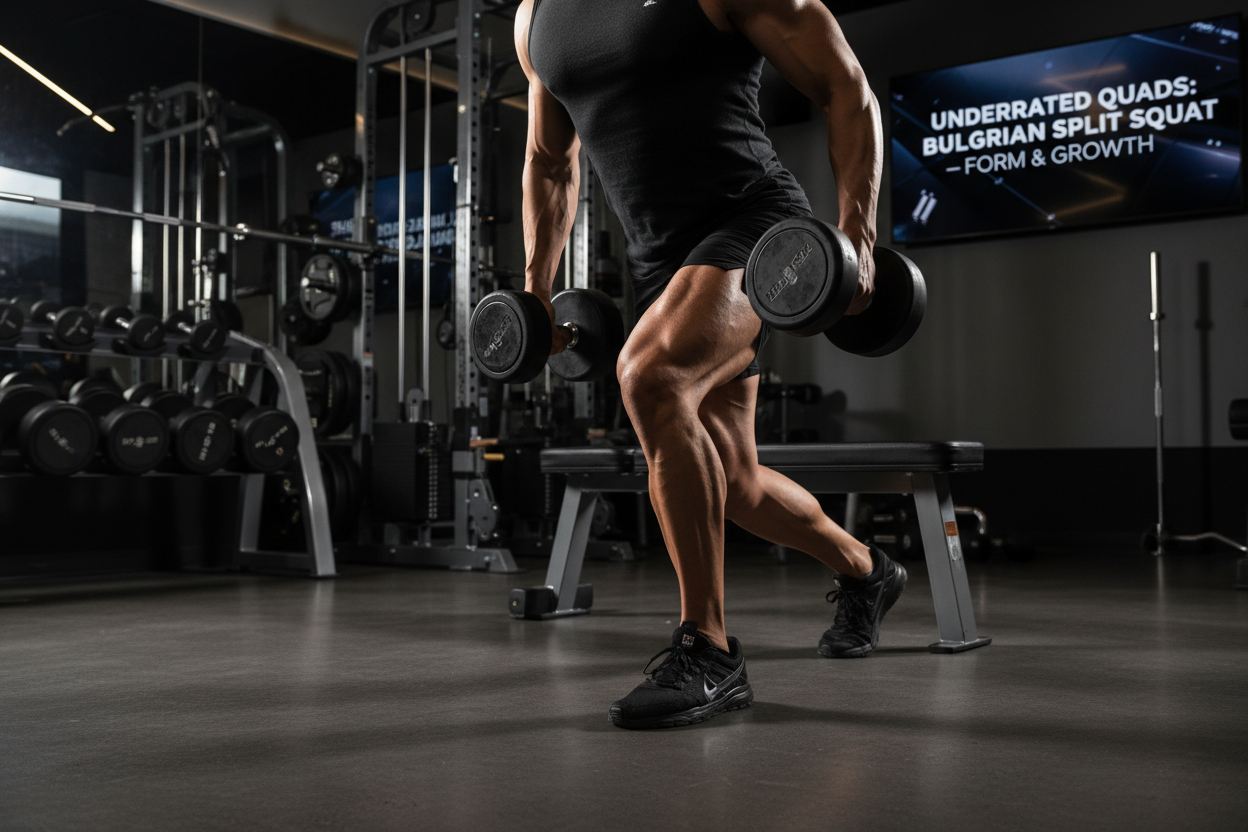
Unilateral Torture: Bulgarian Split Squats
Most people skip these because they are uncomfortable. That is exactly why you should do them. Unilateral work prevents your dominant leg from compensating for the weaker one.
Form Check
To make this a quad-dominant movement, take a slightly shorter stance. A long stance targets the glutes. Keep your torso upright and drive your knee forward over your toes. The stretch at the bottom is where the growth signal is strongest.
Isolation: Leg Extensions
Many coaches dismiss the leg extension as "non-functional." For hypertrophy, however, it is non-negotiable. It is the only movement that loads the quad in its fully shortened position.
The rectus femoris (the muscle running down the middle of your thigh) crosses the hip joint. It doesn't get fully worked during squats. Extensions fill that gap, ensuring complete development of all four quad heads.
My Training Log: Real Talk
I want to be honest about what it actually feels like to prioritize these movements. When I finally switched from ego-lifting heavy squats to strict, high-bar positioning and deep Hack Squats, the feeling wasn't just "tiredness."
I remember specifically the first time I truly committed to a 20-rep set on the Hack Squat. It wasn't just the burn; it was the specific, grinding friction sound of the sled rollers next to my ears that became psychological torture. By rep 15, my teardrops felt like they were tearing (in a good way), but the worst part was the nausea. There is a specific metallic taste you get in the back of your throat when you actually push leg hypertrophy to the limit. Walking out of the gym, my legs didn't just feel heavy; I had that distinct wobble where your knee joint feels like it has no structural integrity left. If you aren't feeling that wobble or fearing the stairs, you probably have more reps in the tank.
Conclusion
Building massive legs doesn't require a secret Russian program. It requires executing the best quad builders with perfect form and high intensity. Stop letting your glutes do the work. Elevate your heels, keep your chest up, and embrace the burn.
Frequently Asked Questions
How often should I train quads for growth?
For most natural lifters, training legs twice a week is the sweet spot. This allows you to accumulate enough volume (10-20 sets per week) while giving your central nervous system time to recover between heavy sessions.
Are squats absolutely necessary for big quads?
Technically, no. You can build massive legs using Hack Squats, Leg Press, and Smith Machine squats if you have lower back issues. However, free-weight squats provide a systemic growth signal that is hard to replicate with machines alone.
What is the best rep range for quad hypertrophy?
Quads respond exceptionally well to higher reps. While 6-10 reps are great for strength, the best quad exercises for hypertrophy often shine in the 12-20 rep range. This ensures maximum metabolic stress and blood flow to the muscle.