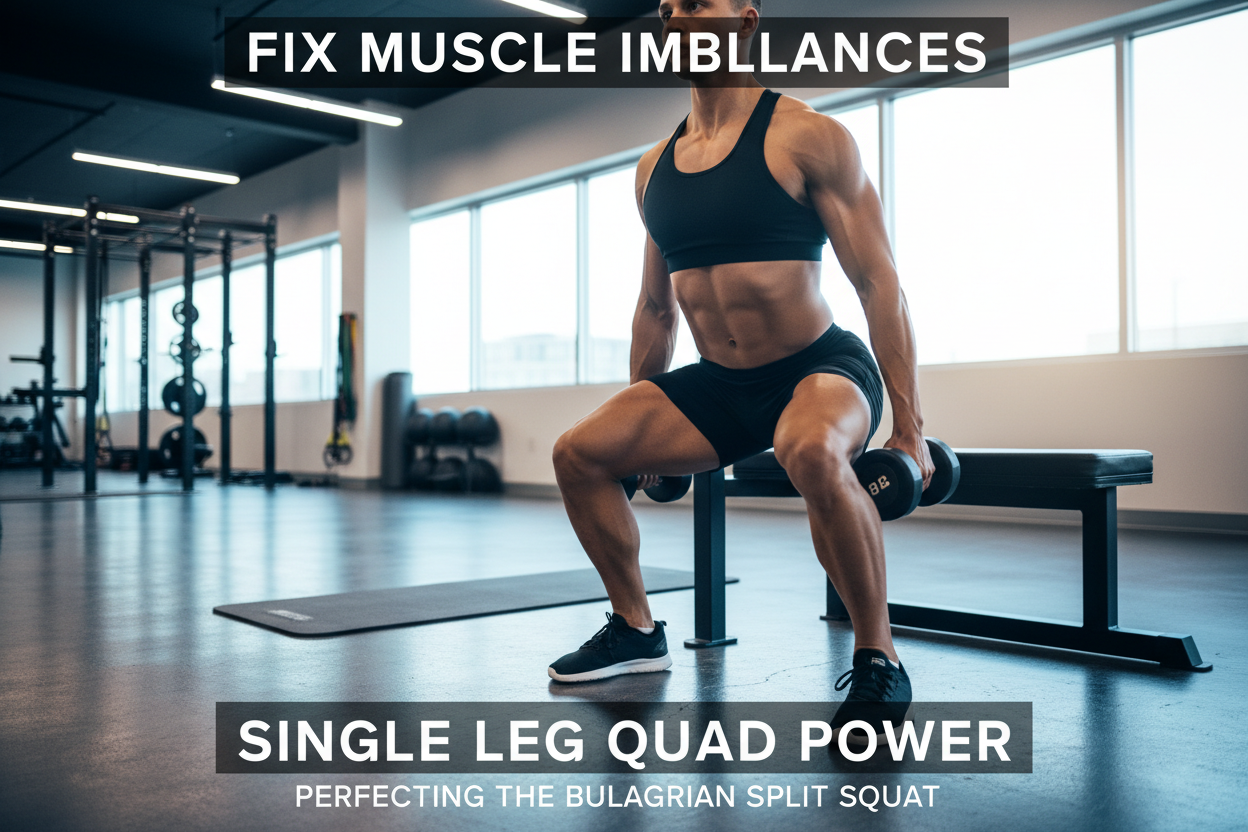
How to Fix Imbalances With The Best Single Leg Quad Exercises
You can hide a weak leg during a heavy back squat. Your dominant side will naturally take over, shifting the load and exacerbating the imbalance without you even noticing. But there is nowhere to hide when you strip away that stability.
If you want to build aesthetic symmetry and bulletproof knees, you need to incorporate the best single leg quad exercises into your routine. Unilateral training isn't just rehabilitation; it is the missing link for hypertrophy that most lifters ignore because it is uncomfortable and humbling.
This guide breaks down exactly how to isolate your quads, fix strength gaps, and force growth where bilateral movements fail.
Key Takeaways: The Unilateral Shortlist
- Bulgarian Split Squat: The gold standard for overload and range of motion.
- Poliquin Step-Up: specifically targets the VMO (teardrop muscle) for knee health.
- Deficit Reverse Lunge: Increases stretch on the quad without excessive knee stress.
- Single-Leg Leg Press: Removes stability constraints to focus purely on muscular failure.
- Pistol Squat Regression: Builds extreme mobility and body control.
Why Bilateral Squats Aren't Enough
The barbell squat is king, but it has a flaw: the bilateral deficit. Your nervous system often limits the total force production when both limbs work together. By training one leg at a time, you can often lift more total weight relative to the muscle mass involved.
Furthermore, structural balance is critical. If your left quad is 10% weaker than your right, your lower back often compensates during heavy squats to keep the bar straight. Unilateral work fixes the root cause rather than treating the symptom.
The "Big Three" Single Leg Quad Builders
1. The Bulgarian Split Squat (Rear Foot Elevated)
This is arguably the most effective movement for raw hypertrophy. By elevating the rear foot, you place the working quad in a deep stretch under load.
The Science: The stretch-mediated hypertrophy here is significant. To make this quad-dominant rather than glute-dominant, keep your torso upright and do not let your front foot travel too far forward. A shorter stance increases knee flexion, which biases the quadriceps.
2. The Poliquin Step-Up
Named after the late strength coach Charles Poliquin, this isn't your standard aerobics step-up. You use a slant board or elevate the heel on a plate.
The Execution: Stand on a low box (4-6 inches). Touch the heel of the non-working leg to the floor gently, then drive back up. The goal is to maximize knee travel over the toe. This targets the Vastus Medialis Oblique (VMO), the muscle directly responsible for knee stability.
3. Deficit Reverse Lunge
Forward lunges require deceleration, which can be tough on cranky knees. Reverse lunges are friendlier, but to make them one of the best single-leg quad exercises, we add a deficit.
The Tweak: Stand on a 2-4 inch platform. Step back off the platform. This allows your back knee to drop lower than your front foot, increasing the range of motion and the stretch on the front quad.
Common Mistakes That Kill Gains
Pushing Off The Back Leg
In split squats and lunges, the back leg is a kickstand, not a piston. If you feel a massive burn in your back leg, you are distributing the weight 50/50. Shift your weight forward. 80% of the load should be on the front leg.
Lack of Stability
If you are wobbling, you aren't building muscle; you're training proprioception. Don't be afraid to hold onto a rack or use a Smith Machine for stability. The goal is muscle exhaustion, not a circus balancing act.
My Training Log: Real Talk
I have a love-hate relationship with the best single leg quad exercises, specifically the Bulgarian Split Squat. I remember specifically when I started programming these as my primary movement rather than an accessory.
The hardest part wasn't the muscular failure; it was the setup. I distinctly recall the specific, sharp bruise I'd get on the top of my instep from resting my back foot on a standard gym bench. It felt like the vinyl was sawing into my ankle bone. I eventually learned to wrap a towel around the roller or use a dedicated single-leg stand.
Also, there is a specific type of nausea that hits you around rep 10 on the second leg. It’s not cardio fatigue; it’s a systematic panic because your blood pressure spikes differently than in a bilateral squat. My left leg would always start shaking—not the muscle, but the actual knee joint—long before my right leg did. That wobble was the physical manifestation of the imbalance I had been ignoring for years.
Conclusion
You don't need to do every exercise listed here. Pick two. Place one heavy compound movement (like the Split Squat) at the start of your leg day, and a lighter, pump-focused movement (like the Step-Up) at the end.
Embrace the instability and the discomfort. When your weak leg finally catches up to your strong leg, your bilateral squat numbers will skyrocket.
Frequently Asked Questions
Should I go heavy or high reps for single-leg work?
Generally, the sweet spot is 8–12 reps. Going too heavy (1–3 reps) makes balance the limiting factor rather than strength. Going too light (20+ reps) becomes a cardio test. Stick to moderate reps with controlled eccentrics.
Can I replace back squats with these exercises?
Yes, especially if you have back issues. Many bodybuilders build massive legs exclusively using machines and unilateral free-weight movements to avoid spinal compression. You do not need to barbell squat to build quads.
How do I stop falling over?
Strip the ego. Hold onto a power rack upright with one hand while holding a dumbbell in the other (contralateral loading). Creating artificial stability allows you to push the muscle harder because you aren't worried about falling.