How to Build a Beginner Fat Loss Workout Plan: Structured Full-Body Splits and Floor Staging
Core Principles of a Sustainable Beginner Fat Loss Workout Plan
Establishing an effective beginner fat loss workout plan centers on combining fundamental resistance exercises with manageable cardiovascular sessions and steady recovery pacing. While high-volume training schedules are often highlighted in fitness media, starting with a grounded and repeatable schedule helps trainees establish proper mechanics and maintain training continuity week after week. Structuring a fat loss gym workout for beginners around multi-joint movement patterns provides full-body engagement while keeping exercise selections focused and manageable.
Resistance movements engage major muscle groups across the upper and lower body, supporting overall energy expenditure while building foundational movement confidence. When designing a beginner workout program for weight loss, the core emphasis remains on learning controlled exercise cadence, organizing rest intervals to sustain workout quality, and establishing a structured weekly rhythm that fits personal schedules.
Foundational Movement Pillars for Full-Body Caloric Demand
A balanced beginner gym workout routine for weight loss incorporates five essential movement patterns. Structuring weekly sessions around these fundamental categories ensures that all major muscle regions receive systematic attention without requiring overly complicated exercise variations:
- Squat Patterns: Variations such as goblet squats, bodyweight box squats, or supported split squats engage the quadriceps, glutes, and stabilizing core muscles.
- Hinge Patterns: Exercises like Romanian deadlifts, floor glute bridges, or kettlebell deadlifts emphasize the posterior chain, training hip extension mechanics along with the hamstrings and lower back.
- Push Patterns: Movements including incline push-ups, dumbbell floor presses, and overhead dumbbell presses develop upper-body pushing mechanics across the chest, shoulders, and triceps.
- Pull Patterns: Options such as horizontal dumbbell rows, lat pulldowns, and resistance band rows support upper-back strength and shoulder posture.
- Carries and Core Bracing: Loaded carries, tall-kneeling holds, and forearm planks encourage trunk stiffness, midsection control, and total-body coordination during dynamic movement.
By rotating through these compound pillars, a weight loss gym workout for beginners encourages balanced physical development and simplifies exercise progression over time.
Weekly Training Split and Routine Architecture
Organizing a gym workout plan for beginners to lose weight around three non-consecutive resistance training days offers an approachable balance between active stimulus and recovery. Alternating training days with dedicated low-impact conditioning or active recovery helps maintain movement consistency throughout the week.
Full-Body Strength Circuit Template
A full-body training session can be organized as a sequential circuit of four to five exercises. Completing one exercise after another with modest rest intervals keeps the workout moving smoothly while maintaining technical focus. For individuals who prefer pacing based on continuous intervals rather than counting repetitions, using a beginner exercise workout plan the rep free timer method offers a practical time-based structure that keeps the focus centered on form execution.
- Station 1 (Lower-Body Squat): Goblet squat or box squat performed with a controlled lowering cadence.
- Station 2 (Upper-Body Push): Dumbbell bench press, floor press, or incline push-up.
- Station 3 (Posterior Chain Hinge): Dumbbell Romanian deadlift or kettlebell hinge.
- Station 4 (Upper-Body Pull): Two-arm dumbbell row or supported cable row.
- Station 5 (Core Bracing or Carry): Suitcase carry, bird-dog, or forearm plank hold.
Performing three complete rounds of this sequence, paired with comfortable rest intervals between rounds, provides a dependable structure for a simple weight loss gym routine.
Low-Impact Conditioning and Active Recovery Blocks
Non-lifting days can incorporate low-impact cardiovascular work such as brisk outdoor walking, stationary cycling, incline treadmill walking, or light rowing. Integrating complementary conditioning formats, such as a structured workout weight loss guide, allows trainees to build aerobic capacity, mobility, and core endurance while minimizing repetitive impact stress on ankles, knees, and hips.
Staging Your Workout Station: Flooring, Room Protection, and Safety
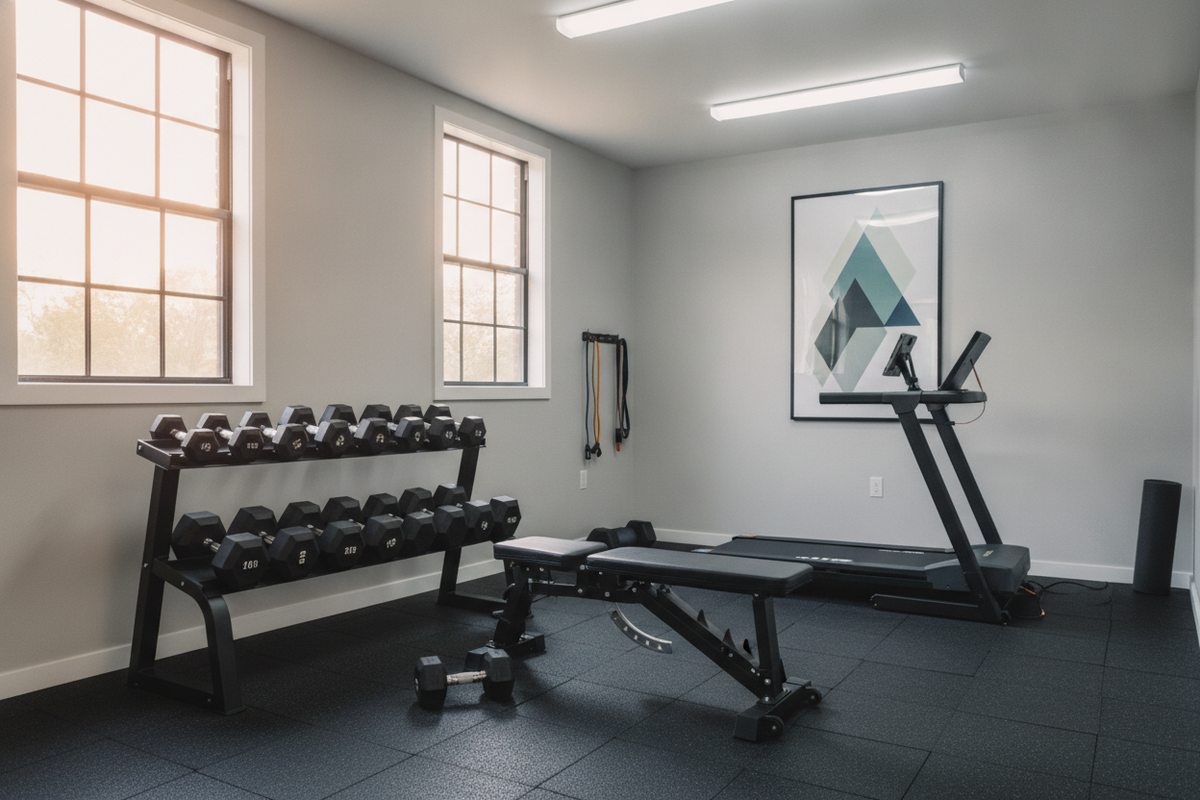
Whether training in a commercial fitness facility or outfitting a dedicated home gym area, the physical workout surface plays a significant role in movement stability and equipment protection. Multi-directional lunges, floor presses, mountain climbers, and dumbbell transitions all require a firm, level, and slip-resistant base.
Laying down a dedicated large exercise mat for home gym use creates an expansive, high-grip station that prevents sliding during dynamic floor routines. A broad, continuous surface cushions pressure points during kneeling and supine exercises while eliminating the tripping hazards associated with small, piecemeal mats.
For home settings with sensitive flooring such as hardwood, laminate, or carpet, rolling out a seamless 6x10ft exercise mat yoga mat gym flooring for home workout layout provides generous spatial coverage. This setup shields subfloors from scuffs, sweat, and dropped accessories while giving you enough floor real estate to complete full-body circuits without constantly repositioning your equipment.
Progression Strategies and Habit Maintenance for Long-Term Fat Loss
Achieving sustainable progress with a gym program for beginners to lose weight relies on steady habit formation and measured progression rather than drastic sudden changes. The following guidelines help maintain steady momentum across initial training blocks:
- Prioritize Technique Before Load: Focus on maintaining controlled joint alignment, balanced foot pressure, and steady breathing throughout each set before increasing dumbbell weights.
- Adjust Session Density Gradually: Progress by modestly reducing rest intervals between circuit stations or adding an extra round before introducing heavier external loads.
- Focus on Weekly Adherence: Consistently completing two to three structured sessions per week over multiple months builds a more dependable foundation than sporadic high-intensity training.
- Incorporate Everyday Movement: Regular daily activity, such as walking and brief mobility stretches, complements structured gym sessions and supports overall physical well-being.
By combining fundamental compound movements, manageable conditioning blocks, and a stable floor workout station, beginners can establish a practical training framework that supports long-term fitness and fat loss goals.