
Beginners Fitness Programme: Foundational Movement Blueprints, Weekly Routine Frameworks, and Home Floor Staging
Core Principles of an Effective Beginners Fitness Programme
Starting a new exercise routine can feel overwhelming when confronted with complex jargon, aggressive workout splits, and conflicting training philosophies. A sustainable beginners fitness programme strips away unnecessary complications, prioritizing basic movement competence, routine consistency, and gradual progression over extreme intensity or rapid fatigue.
Rather than jumping straight into demanding daily routines that lead to burnout, novices benefit most from establishing manageable weekly patterns. Structuring workouts around predictable schedules reinforces exercise adherence. When movement patterns are practiced with deliberate control, the neuromuscular system adapts efficiently, laying a durable groundwork for long-term physical development. For deeper insights on early-stage progression, consult a structured workout programs beginners guide to understand how gradual habit formation supports lasting results.
Foundational Movement Pillars for Fitness Beginner Workouts
Every comprehensive fitness beginner workout revolves around essential functional human movement patterns. Training these fundamental movement categories creates balanced muscular development, minimizes imbalances, and builds coordination across multiple planes of motion.
- Knee Flexion (Squat Pattern): Exercises like bodyweight box squats, goblet squats, and reverse lunges train the lower body, teaching hip and knee coordination while maintaining an upright posture.
- Hip Hinge: Movements such as Romanian deadlifts with light resistance or glute bridges teach the hips to travel backward while keeping a neutral spine, targeting the posterior chain.
- Upper Body Pushing: Horizontal push movements (such as elevated push-ups or floor presses) and vertical push variations develop pressing mechanics across the chest, shoulders, and triceps.
- Upper Body Pulling: Exercises such as inverted body rows or resistance band rows reinforce scapular retraction and posture balance.
- Trunk Bracing and Core Control: Isometric holds, planks, and dead bugs build foundational midsection stability without requiring excessive spinal flexion.
Mastering these movement categories ensures that your training remains versatile and functional. Exploring a dedicated workout resource can provide practical exercise variations and visual cues to refine your technique across each foundational pillar.
Structuring Weekly Workout Programs for Beginners
When organizing workout programs beginners can follow consistently, the distribution of training days and recovery intervals is just as crucial as exercise selection. A full-body structure performed two to three non-consecutive days per week generally offers the ideal balance between stimulus and recovery.
Sample Three-Day Full-Body Framework
- Day 1 (Full Body A): Focus on knee flexion (goblet squats), horizontal pushing (incline push-ups), and horizontal pulling (banded rows), followed by a basic trunk plank.
- Day 2 (Active Recovery or Rest): Low-intensity walking, gentle mobility routines, and light stretching.
- Day 3 (Full Body B): Emphasize the hip hinge (glute bridges or light dumbbell Romanian deadlifts), overhead pressing, and vertical or assisted pulling, paired with rotational core bracing.
- Day 4 (Rest): Complete recovery to allow joints and tissues to adapt.
- Day 5 (Full Body C): Combine unilateral leg work (split squats) with balanced pushing and pulling supersets.
- Days 6 and 7 (Weekend Recovery): Light recreational activity and preparation for the following week.
Maintaining strict tempo control and avoiding rushed repetitions during each session ensures steady motor learning. Reviewing a detailed workout programs beginners guide will help you understand the mechanics of lowering resistance under control to maximize the benefits of each repetition.
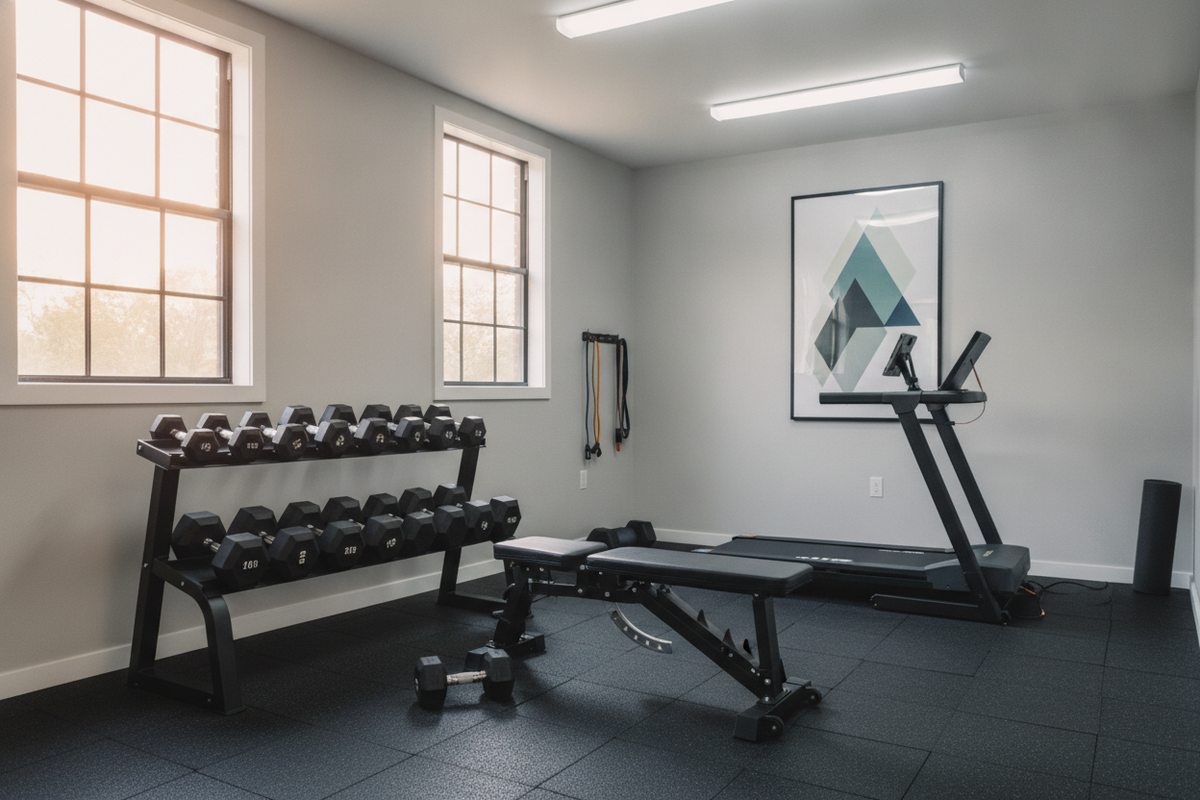
Staging Your Home Training Space: Flooring, Traction, and Room Protection
Establishing an organized training environment at home removes friction, making it easier to stick to your schedule. A critical yet frequently overlooked component of a home gym setup is the surface beneath your feet. Hardwood, laminate, and tile floors can be slippery and uncomfortable during floor-based exercises, while standard domestic carpet often bunches or lacks the firm stability needed for balance drills.
Integrating a durable workout product like a large, high-density exercise mat transforms ordinary living spaces into a functional training zone. A dedicated flooring layer provides essential benefits:
- Firm Traction: Textured, non-slip surfaces offer reliable grip for athletic shoes or bare feet during lunges, planks, and dynamic transitions.
- Subfloor Protection: High-density material acts as a barrier against scuffs, sweat, and light equipment contact, preserving residential subfloors.
- Acoustic and Impact Dampening: Dense padding helps absorb ambient noise and floor vibrations during stepping drills and bodyweight movements.
- Spatial Definition: Having a dedicated mat creates a clear visual boundary for your workout, reinforcing your mental focus during training blocks.
Progression Mechanics, Form Quality, and Recovery Fundamentals
Progressing within a beginner fitness routine does not require rapid increases in external resistance. Instead, beginners should measure progress through refined movement quality, enhanced control, and improved consistency. A structured progression hierarchy keeps training sustainable:
- Movement Familiarity: Execute repetitions smoothly with complete control throughout the entire range of motion.
- Volume Progression: Gradually add repetitions per set or an extra set across several weeks while maintaining consistent form.
- Load Addition: Introduce light external resistance (such as resistance bands, dumbbells, or kettlebells) only after bodyweight movement mechanics are stable and repeatable.
- Adequate Recovery: Balance training sessions with regular sleep, proper hydration, and nutritious meals to support ongoing tissue adaptation.
Frequently Asked Questions About Starting a Beginner Fitness Programme
How long should a beginner workout session last?
Most novice training sessions can be completed effectively in 30 to 45 minutes. This timeframe accommodates a thorough dynamic warm-up, three to four primary multi-joint exercises, and a brief cool-down without causing excessive fatigue.
What basic equipment is needed to begin training at home?
A beginner can start with minimal equipment. A large, non-slip workout mat, a set of light-to-medium resistance bands, and comfortable athletic footwear provide everything required for a comprehensive full-body routine.
How do I know when it is time to progress an exercise?
When you can complete all prescribed sets and repetitions with steady balance, smooth pacing, and zero breakdown in form across consecutive sessions, you can consider adding a modest amount of resistance or choosing a slightly more challenging exercise variation.


