How I Program Weight Lift Exercises at Home to Replace Cable Machines
I remember the exact moment I decided to ditch my $80-a-month commercial gym membership. I was standing in line for a cable crossover machine, watching someone use it for 'functional' stretching while scrolling their phone. I realized I was paying for access to 5,000 square feet of equipment I didn't actually need. I went home and started researching how to perform weight lift exercises at home without losing the constant tension that machines provide.
Quick Takeaways
- Free weights force stabilizer muscles to work harder than fixed-path machines ever will.
- Mechanical tension, not the machine itself, is what drives muscle growth.
- Floor grip is the most underrated safety factor in a home gym.
- You can replace a 400-lb leg press with strategically loaded split squats.
The Machine Illusion: Why Free Weights Expose Your Weaknesses
Commercial weight lifting machines are designed for one thing: isolation. They lock you into a fixed path, which is great for bodybuilders trying to hit a specific muscle head, but it makes your nervous system lazy. When I first switched to lifting exercises at home, I was shocked at how weak my stabilizers were. I could row the full stack on a seated cable row, but a pair of 70-lb dumbbells had me wobbling like a newborn giraffe.
Switching to weight lifting home exercises forces you to create your own stability. You aren't leaning against a padded seat or braced by a steel frame. Your core, hips, and even your feet have to engage to keep the weight moving vertically. This 'raw' strength is what actually transfers to moving furniture or carrying groceries. It’s less about the ego-lifting numbers and more about how much of that weight you can actually control.
Replicating the Leg Press (Without Wrecking Your Lower Back)
The leg press is the hardest machine to replace because it allows you to move massive weight without taxing your spine. However, most home versions are flimsy and take up half a garage. My solution for an at home weight lifting routine is the Rear-Foot Elevated Split Squat (RFESS). It’s the exercise everyone loves to hate because it’s brutal.
By putting one foot back on a bench or a sturdy chair, you put 80% of the load on your front leg. Suddenly, a pair of 50-lb dumbbells feels like a 300-lb leg press. If you want that quad pump, try front-racked goblet squats with a slow 3-second eccentric. You get the same hypertrophy benefits without needing a thousand pounds of iron or a machine that costs as much as a used car.
Replacing the Lat Pulldown With Raw Vertical Pulls
People think they need a cable tower for lats, but at home weight lifting exercises for the back are actually more effective when you use gravity correctly. The dumbbell pullover is my secret weapon here. Lying across a bench and lowering a weight behind your head creates a massive stretch in the lats that mimics the top of a lat pulldown perfectly.
Pair those pullovers with strict, braced single-arm rows. The key is the 'braced' part—put your non-lifting hand on a bench or a rack. This mimics the stability of a machine, allowing you to go much heavier than you could if you were just bent over in open space. It’s about being smart with your setup to get that machine-like isolation.
The Foundation Under Your Feet: Why Traction Dictates Tension
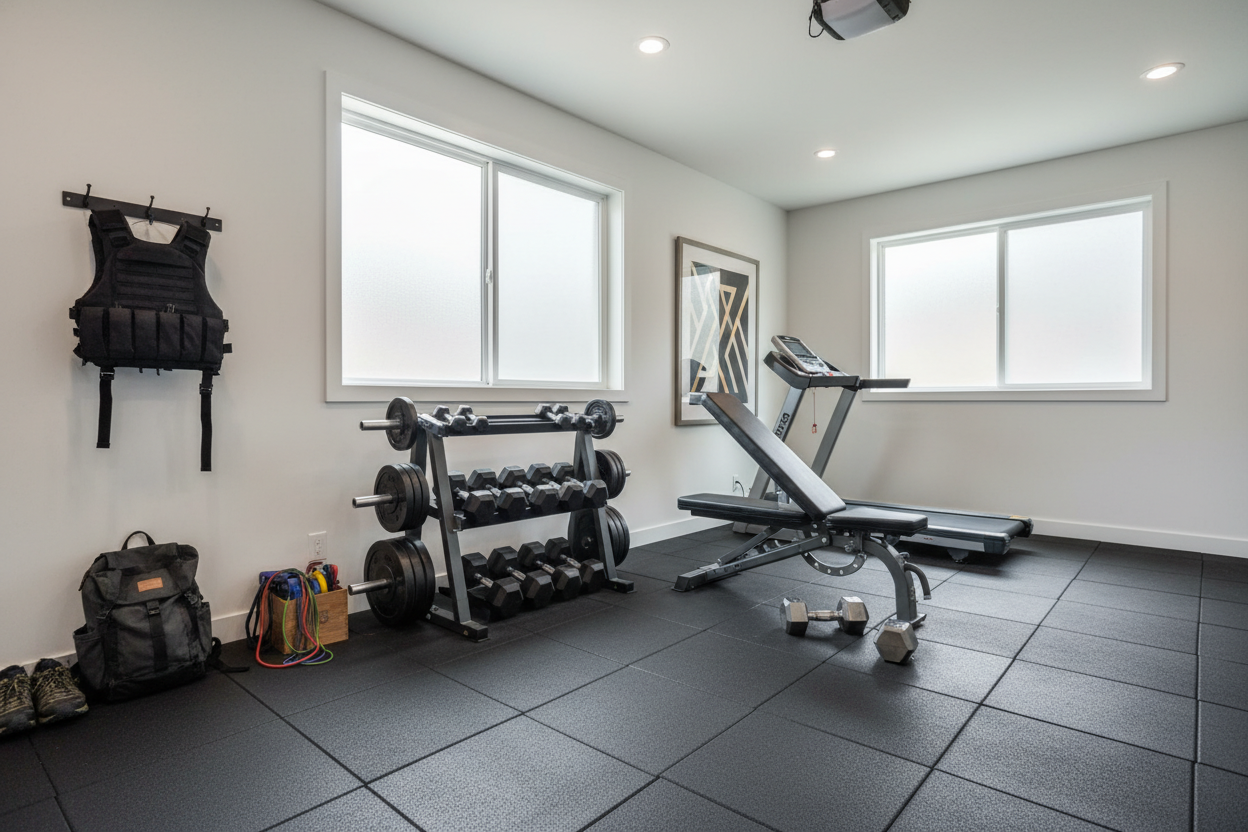
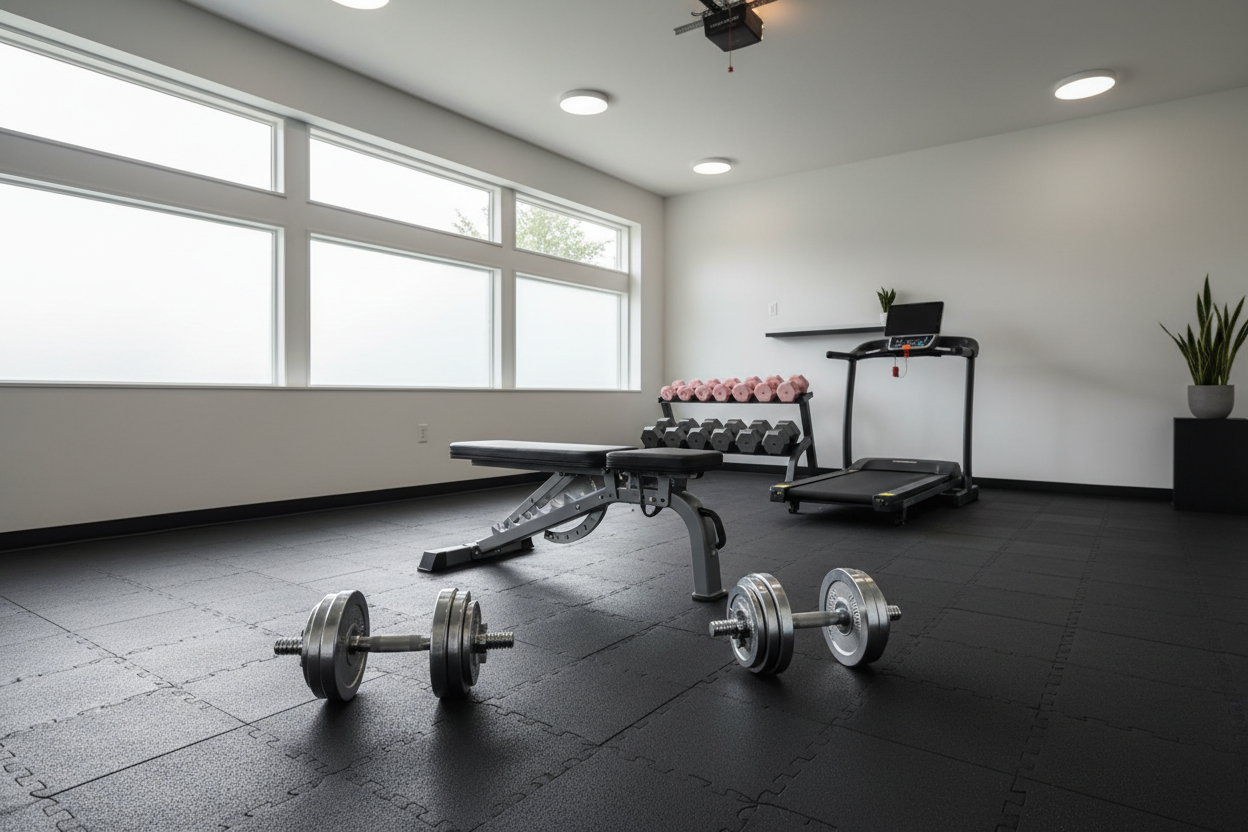
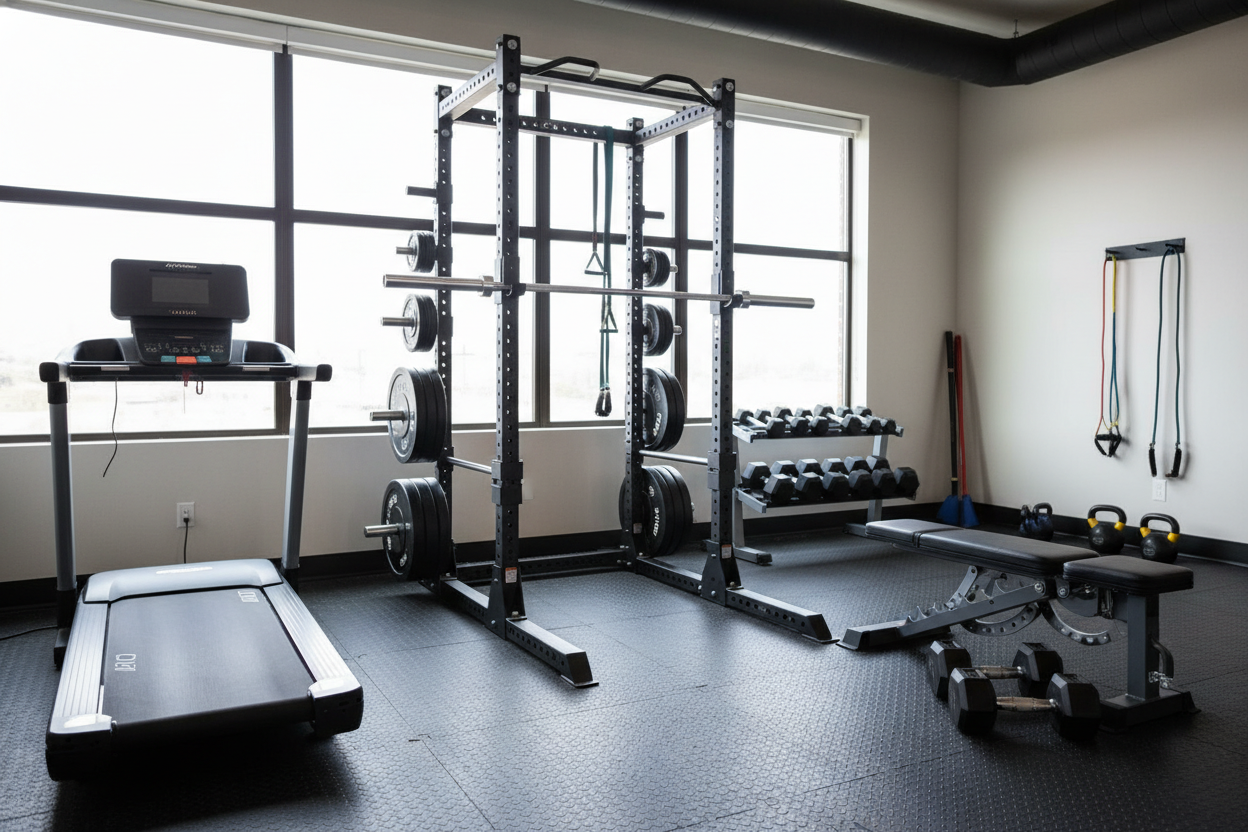
You cannot produce force if your feet are sliding. I learned this the hard way trying to do heavy lunges on a dusty garage floor; I nearly did an accidental split with 60 lbs in each hand. This is why I always tell people to invest in high-density gym flooring for home workout spaces.
If you're lifting on hardwood or squishy carpet, you're leaking energy. A proper rubber surface allows you to 'screw' your feet into the ground, creating the torque needed for heavy squats and overhead presses. It also protects your subfloor from the inevitable 'oops' when you drop a hex dumbbell after a set of rows. If your floor feels like a trampoline, your lifts will feel like garbage.
Putting It Together: The Free Weight Living Room Split
To make this work, you need a structured at home weight lifting program that prioritizes tension over just 'doing reps.' I recommend a four-day split: two upper body days and two lower body days. This allows for maximum recovery while ensuring you hit every muscle group with enough volume to see change.
On 'Upper A' days, focus on heavy presses and rows. On 'Upper B' days, use lighter weights with higher reps and shorter rest periods to create that metabolic stress you’d usually get from a cable circuit. By varying the tempo—like taking four seconds to lower the weight—you can make 30-lb dumbbells feel like 60-lb ones. This is how you bypass the limitations of a limited home rack.
My Honest Mistake
When I first started, I bought the cheapest adjustable dumbbells I could find. They had plastic internal gears that shattered the first time I set them down a little too hard after a heavy set of chest presses. I learned that in a home gym, 'cheap' usually means 'disposable.' I eventually upgraded to a set of 11-gauge steel adjustables that have survived five years of abuse. Buy once, cry once.
FAQ
Can I build a big chest without a cable fly machine?
Absolutely. Use floor presses to safely overload the triceps and chest, and finish with 'fly-press' hybrids where you use a fly motion on the way down and a press motion on the way up. It keeps the tension high without the risk of overstretching.
How do I know if my dumbbells are heavy enough?
If you can do more than 20 reps with perfect form, it's time to increase the weight or drastically slow down your tempo. Most people can get a year of progress out of a 50-lb set just by manipulating rest times.
Is it safe to lift heavy at home alone?
Yes, provided you have a plan. Use dumbbells for movements where you might get stuck (like bench press) so you can drop them to the side, and always ensure your flooring is non-slip.