Home Warm Up Exercises: The Desk-to-Workout Transition
You just closed your laptop after eight hours of staring at spreadsheets. Your lower back feels like a rusty hinge, and your shoulders are practically glued to your ears. You walk fifteen feet to your garage, load up a barbell with 135 pounds, and drop straight into a squat. That right there is the fastest route to a pulled hamstring I have ever seen. If you want to train safely and effectively, you need a system to decompress from that hunched desk posture. Implementing proper home warm up exercises is the crucial bridge between your office chair and your dumbbell rack.
As a personal trainer who has helped dozens of remote workers build out their home gyms, I see this mistake constantly. People assume that because they are already home, they can skip the physical transition of going to a gym. But your joints don't care about your commute time.
Quick Takeaways
- Transitioning straight from sitting to heavy lifting shocks the nervous system and invites injury.
- A proper warm-up requires zero cardio machines—just targeted, continuous movement.
- Prioritize un-gluing the hips and thoracic spine to reverse the 'desk hunch.'
- Central nervous system (CNS) activation ensures your muscles fire fast and efficiently.
- Dedicate at least a 6x6 foot area specifically for floor-based mobility work.
The Danger of the Zero-Transition Workout
Sitting for prolonged periods shortens your hip flexors, weakens your glutes, and rounds your upper back into a C-shape. Going from this frozen, flexed state straight into a heavy deadlift is physiological whiplash. Your joints lack synovial fluid, making them stiff, dry, and unyielding.
A structured warm-up acts as a crucial buffer. It tells your body that the static portion of the day is over and physical demands are imminent. I have seen countless clients tweak a lower back or strain a rotator cuff simply because they skipped this transition phase. When you sit at a desk for eight hours, your nervous system essentially goes to sleep to conserve energy. Your breathing becomes shallow, and blood pools in your digestive tract and lower extremities.
If you immediately load a barbell, your muscles simply aren't receiving the electrical signals required to contract efficiently to protect your spine. You need to bridge the gap systematically. A proper decompression routine shifts your body from a parasympathetic state to a sympathetic state, ensuring that when you finally grip that dumbbell, your body is actually prepared to move it safely.
Phase 1: Elevating Core Temperature Without Machines
Forget the treadmill or the stationary bike. You don't need a bulky piece of cardio equipment taking up half your garage to get your blood flowing. We want low-impact, continuous movement for three to five minutes to bring synovial fluid to the joints.
I usually have clients start with 60 seconds of light shadow boxing. Just stay light on your toes, keep your hands up, and throw easy, fluid punches to get the shoulders and torso rotating. Follow that with 60 seconds of alternating reverse lunges with a reach overhead. As you step back, reach your arms toward the ceiling to stretch the abdomen and engage the trailing leg. Finish with 60 seconds of jumping jacks or fast-paced high knees.
The goal here is a light, sustained sweat. You are physically warming up the tissue, making it more pliable for the mobility work that follows. Keep the intensity around a 4 out of 10. If you are gasping for air, you are pushing too hard. I tell my remote-worker clients to treat this phase like a physical commute. You are leaving the office behind and traveling to the gym, even if that gym is just a spare bedroom. By the end of this three-minute block, your heart rate should be elevated to around 110 to 120 beats per minute, and your joints should feel significantly less rigid.
Phase 2: Un-Gluing the Hips and Thoracic Spine
Now that you are warm, we need to attack the specific postural deficits caused by your desk chair. Your hip flexors are tight from being stuck in a 90-degree angle, and your thoracic spine is locked up from hunching over a keyboard.
I always program the 'World's Greatest Stretch' here. Step into a deep lunge, drop your inside elbow toward your front heel, and then rotate your arm up toward the ceiling. Do five slow, controlled reps per side. Next, drop to the floor for 90/90 hip switches. Sit with both knees bent at 90-degree angles on the floor, and slowly windshield-wiper your legs side to side. This internal and external rotation is vital for squatting pain-free.
If your hips feel like concrete, adding targeted hip mobility exercises to this phase will dramatically improve your squat depth and protect your lower back. Finish with 10 repetitions of cat-cow stretches to mobilize the spine. Get on all fours, arch your back like a scared cat, and then let your belly sink toward the floor while lifting your head. Move slowly and link your breathing to the movement.
The modern seated work environment forces our bodies into a constant state of anterior pelvic tilt and forward head posture. These specific drills actively reverse those mechanics. Taking five minutes to un-glue these sticky areas ensures that when you load your joints with resistance, you are moving through a full, healthy range of motion rather than compensating with your lower back.
Phase 3: Central Nervous System Activation
Stretching and sweating are not enough. You have to wake up your central nervous system so your fast-twitch muscle fibers are ready to fire on command. If you skip this, your first heavy set of 50-pound dumbbells will feel twice as heavy because your brain isn't recruiting enough motor units.
We use dynamic, explosive movements here, but keep them completely unweighted to avoid unnecessary fatigue. Pogo jumps are my absolute go-to for this phase. Keep your legs mostly straight and bounce off the balls of your feet for 20 seconds, maximizing your time in the air and minimizing your ground contact time. It should feel like jumping rope without the rope.
Next, perform three broad jumps, focusing on a soft, controlled landing. Throw your arms forward and jump as far as you can across the room, absorbing the impact with a partial squat. Finally, knock out five explosive plyo push-ups. If you can't clap, simply push the floor away hard enough that your hands briefly leave the ground.
Your heart rate should spike, and you should feel dialed in, alert, and springy. This phase is all about speed and intent. You are sending a massive electrical signal from your brain to your muscles, telling them that it is time to produce force. I have tested this protocol with dozens of home gym owners, and the feedback is always the same: their first working set feels significantly lighter and more stable.
Designing Your Floor Space for Pre-Workout Movement
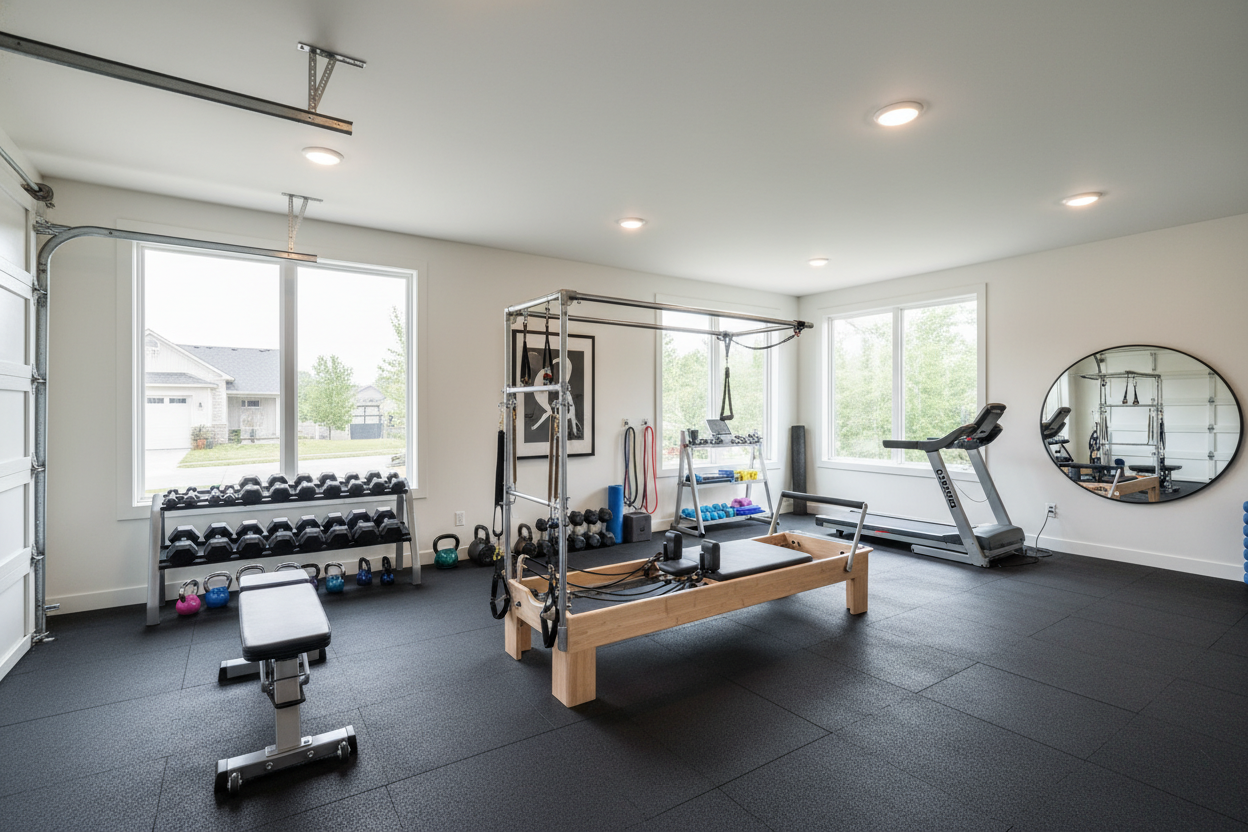
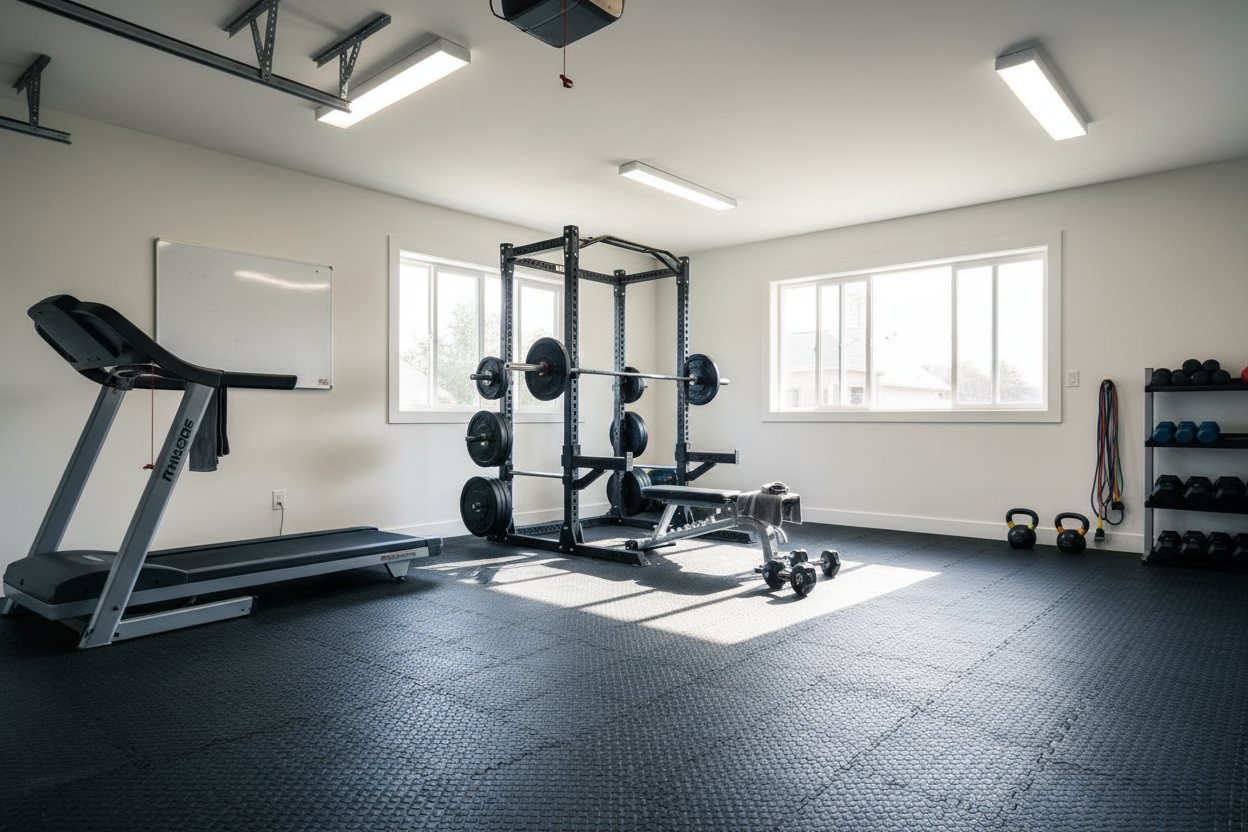
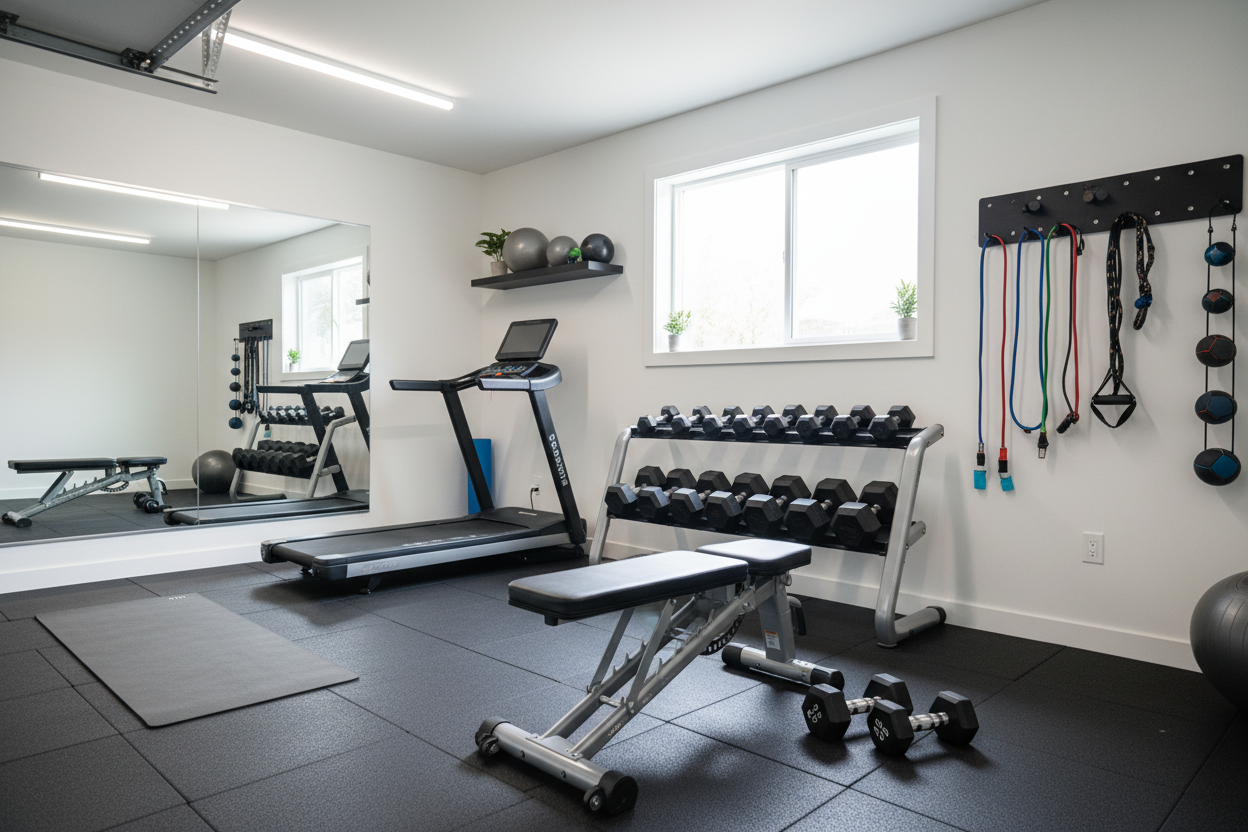
If you have to move a heavy coffee table every time you want to stretch, you will eventually skip the warm-up. Friction is the enemy of consistency. You need a dedicated, adequately sized footprint that is always ready for action. I recommend clearing at least a 6x6 foot area.
Having a dedicated large exercise mat for home gym use completely changes the experience. Nobody wants to do 90/90 stretches on cold, hard concrete or slippery hardwood. When I built out my own garage setup, I laid down a 6x8ft exercise mat. It gave me the exact dimensions needed to stretch out fully, perform sweeping mobility drills, and land plyometrics without bruising my knees or slipping.
The only honest downside I found with a mat this thick and large is that it weighs over 30 pounds, making it tough to roll up and store if you don't leave it out permanently. But for a dedicated space, it is a non-negotiable foundation. A proper floor setup removes the mental barrier to getting on the ground. When your environment supports your routine, you are far more likely to spend the necessary eight to ten minutes mobilizing.
Adapting Your Warm Up At Home Exercise to Your Layout
Not everyone has a two-car garage to convert into a fitness sanctuary. If you are training in a small apartment or a cramped bedroom alongside your desk, you have to get creative. A solid warm up at home exercise routine doesn't strictly require massive amounts of floor space.
You can easily modify sweeping dynamic movements to fit your spatial constraints. Swap traveling broad jumps for vertical squat jumps. Instead of walking lunges, do reverse lunges in place. If you literally cannot spread your arms without hitting a wall or a bedframe, you might need a specialized warm up for tight spaces that focuses heavily on isometric holds, vertical mobility, and closed-chain movements.
The key is to keep moving continuously, even if your footprint is limited to the exact size of a standard yoga mat. I once trained a client who lived in a 400-square-foot studio; we replaced all horizontal traveling drills with vertical bounds and deep static squat holds. The physiological response was identical. You just have to adapt the mechanics to the square footage you have available.
The Final Checklist Before Your First Working Set
Before you touch a piece of iron, run through a quick mental checklist. Are you breaking a light sweat? Do your hips and shoulders feel lubricated and free of pinching? Is your core engaged and your breathing slightly elevated?
If you can answer yes to all three, your body has successfully transitioned out of desk mode. You are fully primed, your central nervous system is online, and you are ready to tackle your resistance training safely. Grab your weights and get to work.
FAQ
How long should a home warm-up take?
A highly effective warm-up should take between 8 and 12 minutes. Anything shorter usually skips CNS activation, and anything longer might tap into the energy reserves you need for heavy lifting.
Should I stretch cold muscles?
Never do static stretching on cold muscles. Always elevate your core temperature first with 3-5 minutes of light, continuous movement before trying to lengthen the tissue.
Can I just use light weights to warm up?
Doing a few light sets of your first exercise (like an empty barbell squat) is great, but it shouldn't replace a general warm-up. You still need to mobilize joints and elevate your core temperature first.