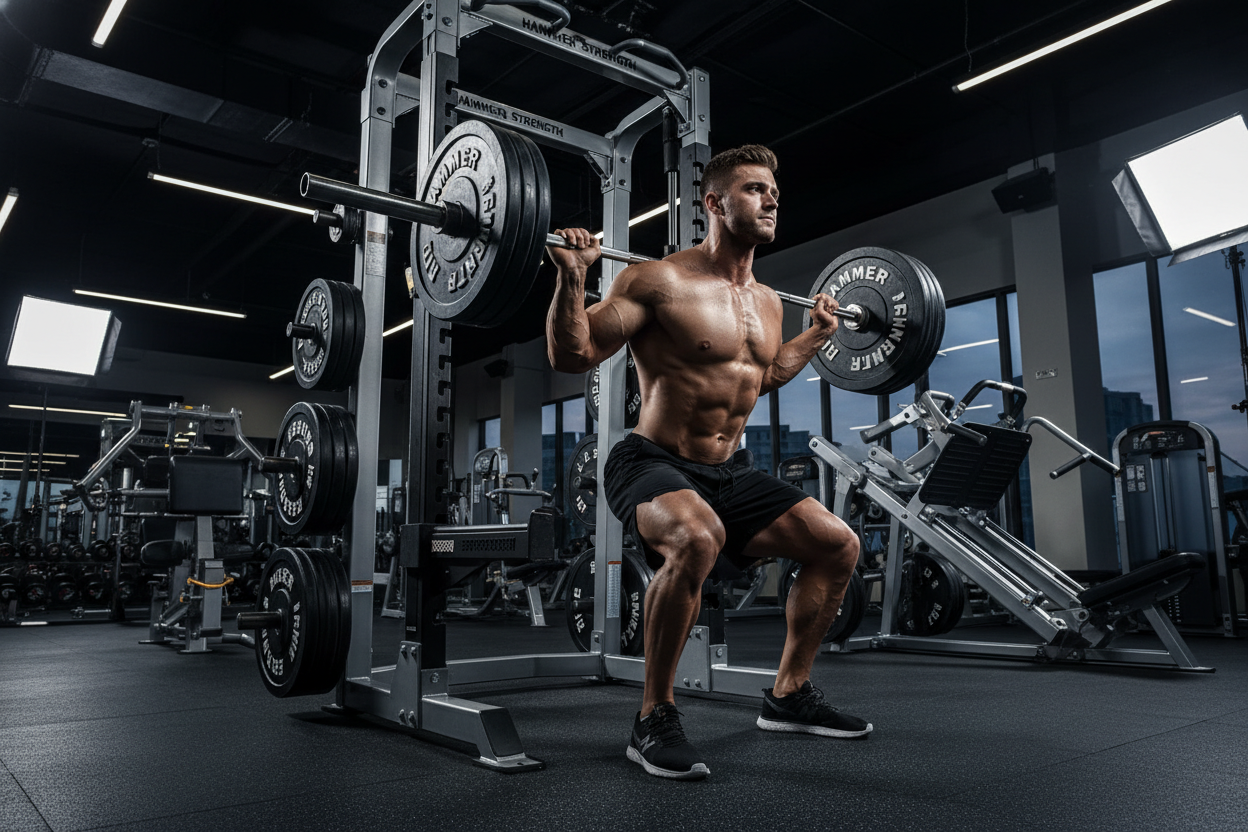
Hammer Strength Smith Machine: The Definitive Guide for 2025
Walk into any serious commercial gym, and you will likely see a line for the squat racks. But just to the side, often empty or being used as a coat rack, stands the Hammer Strength Smith Machine. Many lifters ignore it because of the 'free weights or nothing' dogma. That is a mistake.
This piece of equipment isn't just a crutch for beginners; it is a precision tool for hypertrophy. When you remove the need to stabilize a load in three-dimensional space, you can direct 100% of your output into the target muscle tissue. However, the mechanics of a Hammer Strength machine differ significantly from a standard generic Smith machine, particularly regarding the bar path and starting weight. Understanding these nuances is the difference between an injury and a new level of growth.
Key Takeaways
- Counterbalanced System: Unlike standard bars, the Hammer Strength carriage is counterbalanced, reducing the starting weight significantly.
- The 7-Degree Angle: Most Hammer Strength units feature a 7-degree angled path to mimic natural body mechanics during pressing and squatting movements.
- Starting Resistance: The average starting resistance is usually 20 lbs (approx. 9 kg), not the standard 45 lbs of an Olympic bar.
- Safety Stops: Adjustable bottom stops allow for safe failure without a spotter, making it ideal for high-intensity training.
Understanding the Hammer Strength Difference
Not all Smith machines are created equal. Hammer Strength, a brand under Life Fitness, builds equipment based on biomechanics. While a cheap gym Smith machine might have a vertical rail that forces your joints into unnatural positions, the Hammer Strength version is engineered to follow the natural arc of movement.
The 7-Degree Bar Path
The defining feature of this machine is the 7-degree angle of the guide rods. This isn't an aesthetic choice; it's physics. When you squat or bench press, the bar doesn't naturally travel in a perfectly straight vertical line. It moves in a slight arc.
The angled path accommodates this natural movement pattern. However, this creates a variable you must account for: orientation. If you face the wrong way during a squat or overhead press, you will fight against your body's natural mechanics, placing shear stress on the knees or shoulders. Always position yourself so the bar path aligns with your joint movement.
The Weight Confusion: How Heavy is the Bar?
This is the most common question I get from clients. You load up what looks like your normal working weight, but it feels lighter. Why?
The hammer strength smith machine bar weight is deceptive. While the bar itself looks thick and heavy, the machine utilizes a counter-balance system hidden inside the frame. This system consists of weights, pulleys, and cables that offset the weight of the bar.
On a standard Olympic barbell, you are lifting 45 lbs (20 kg) before adding plates. On the Hammer Strength Smith Machine, the starting resistance is typically 20 lbs (9 kg). Some older models or specific commercial variations might range up to 30 lbs, but you should never calculate your total volume assuming the bar is 45 lbs. Adjust your math, or your progressive overload tracking will be inaccurate.
Hypertrophy Benefits Over Free Weights
We aren't saying free weights are obsolete. But for pure muscle growth (hypertrophy), stability is king. The more stable the environment, the more tension you can apply to the muscle.
When you use this machine, you eliminate the need for stabilizer muscles to balance the load. This allows you to push closer to true muscular failure safely. For exercises like the split squat or the seated overhead press, the Hammer Strength machine allows you to grind out those last two reps without worrying about the bar toppling over.
My Training Log: Real Talk
Let's drop the technical manual for a second. I’ve spent hundreds of hours under a Hammer Strength bar, and here is the gritty reality the spec sheet won't tell you.
The first thing you'll notice is the friction—or lack thereof. When these machines are well-maintained, they glide. But in a gritty warehouse gym, I've had reps where the bar 'stutters' on the way down because the rails weren't lubricated. It throws off your concentric timing completely.
Also, let's talk about the wrist turnover. Because the bar doesn't rotate as freely as a high-end Eleiko Olympic bar, I’ve found that doing heavy bench presses on the Hammer Strength machine can sometimes crank my wrists into an uncomfortable extension if I don't use wrist wraps. And that 7-degree angle? I learned the hard way on a behind-the-neck press. I faced the 'wrong' way (against the angle), and the bar path basically tried to shave the back of my head off. You have to respect the geometry of the machine, or it will humble you quickly.
Conclusion
The Hammer Strength Smith Machine is not a replacement for the barbell squat or deadlift, but it is a superior tool for isolation and safe volume training. By understanding the lighter starting weight and utilizing the angled bar path correctly, you can add significant mass to your frame without the injury risk associated with fatigued free-weight movements.
Frequently Asked Questions
What is the starting weight of a Hammer Strength Smith Machine bar?
The starting resistance is typically 20 lbs (approx. 9 kg) due to the counterbalance system, significantly lighter than a standard 45 lb Olympic bar.
Which way should I face when squatting on an angled Smith Machine?
You should generally face outward (away from the machine) or in the direction that allows the bar to travel slightly backward as you descend, mimicking the natural hip hinge movement.
Is the Hammer Strength Smith Machine good for bench press?
Yes, it is excellent for hypertrophy as it provides stability, allowing you to focus entirely on chest contraction. However, ensure you align your chest properly with the bar path to avoid shoulder strain.