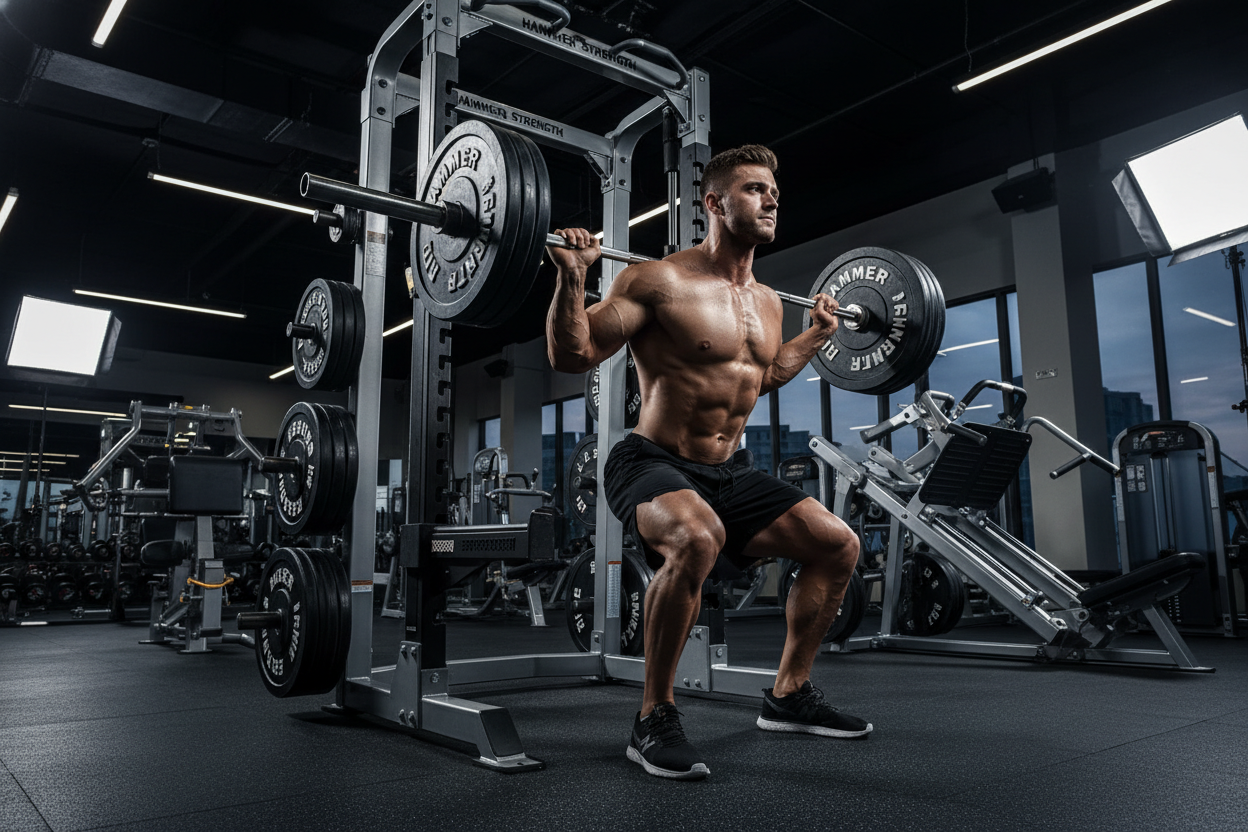
Stop Doing Squats With Weights in Front Like This (Read First)
Most lifters live and die by the back squat. It’s the ego lift, the one that lets you load up the most plates. But if your quads are lagging or your lower back feels like it’s about to snap, you are focusing on the wrong movement pattern. You need to incorporate squats with weights in front.
This isn't just about moving the bar; it's about changing the physics of your leverage. When you shift the load anteriorly, you force your body to stay upright, demanding honest mobility and exposing weak links in your kinetic chain instantly.
Key Takeaways: The Essentials
- Vertical Torso is Non-Negotiable: Unlike back squats, leaning forward causes the weight to fall. You must maintain thoracic extension.
- Quad Isolation: Front-loading shifts mechanical tension significantly toward the quadriceps and away from the glutes.
- Core Demands: Your anterior core (abs) must work double-time to prevent the spine from collapsing under the load.
- Wrist Mobility Matters: For barbell variations, wrist and lat flexibility are often the limiting factors, not leg strength.
Why You Should Shift the Load Forward
The mechanics of a squat with weight in front differ drastically from its back-loaded cousin. When the weight sits on your clavicles (barbell) or in your hands (goblet), your center of gravity shifts forward.
To keep from falling on your face, your hips must sit down rather than back. This forces a deeper knee flexion angle. The result? Your quads take a beating, and your lower back gets a break from the sheer shear force often associated with heavy back squats.
The "Weighted Front Squat" Effect on Posture
Many athletes use weighted front squats as a self-correcting exercise. You physically cannot perform this lift with poor posture. If you round your upper back, you drop the weight. It forces you to maintain a rigid, upright column, which carries over to better posture outside the gym.
Choosing Your Weapon: Barbell vs. Goblet
Not all front-loaded squats are created equal. Depending on your experience level, you should choose the variation that allows for pain-free depth.
The Goblet Squat
This is the entry point. You hold a kettlebell or dumbbell against your chest. It’s fantastic for learning to sit between your legs rather than folding over them. However, your arms will eventually become the limiting factor before your legs do.
The Barbell Front Squat
This is the king of weighted front squats. It allows for maximum loading. The bar rests on the "shelf" created by your front deltoids. The challenge here is usually the rack position—getting your elbows high enough to create that shelf requires serious lat and tricep flexibility.
Execution: The Rack and The Descent
The setup dictates the success of the lift. If you are using a barbell, drive your elbows up. Think about pointing your elbows at the wall in front of you, not the floor. If your elbows drop, the bar rolls forward, your upper back rounds, and the lift is over.
On the descent, fight for depth. Because your torso is upright, you should be able to hit "ass-to-grass" depth more easily than with a back squat. Do not cut it short. The bottom portion of the movement is where the quads are under the most stretch and tension.
My Training Log: Real Talk
Let’s be honest about the discomfort here. The first time I seriously committed to a training block of squats with weights in front, I thought I was injuring my throat. I wasn't, but the pressure on the windpipe is real and panic-inducing until you get used to it.
I specifically remember the bruising. For the first three weeks, I had these red, raw marks on my collarbone and front delts that looked suspiciously like hickeys. It wasn't the weight that bothered me; it was the skin sensitivity. I also learned the hard way that wearing a cotton t-shirt is a mistake. The bar grips the cotton and drags your shirt down your neck, choking you further. A synthetic shirt or even a little chalk on the clavicle area helps the bar stick to the skin without dragging the fabric. It’s gritty, uncomfortable work, but my quad sweep grew more in those 12 weeks than in two years of low-bar back squatting.
Frequently Asked Questions
Are squats with weights in front better for bad backs?
Generally, yes. Because the torso remains vertical, there is significantly less shear force on the lumbar spine compared to a back squat. However, you need strong abdominals to stabilize the load.
How do I hold the bar if my wrists hurt?
If you lack the mobility for a clean grip (fingertips under the bar), try the "cross-arm" or "bodybuilder" grip. Place the bar on your delts and cross your arms over it to secure it. Alternatively, use lifting straps looped around the bar as handles.
Can I lift as much weight as my back squat?
No. Most lifters can only handle about 70-80% of their back squat weight when doing a weighted front squat. The upper back strength required to hold the bar is usually the limiting factor, not leg strength.