Gym Machines for Home: Footprint Planning, All-in-One Selection, and Resilient Floor Protection
Designing a dedicated fitness area inside a residential dwelling introduces structural and mechanical challenges absent in commercial facilities. Selecting the right gym machines for home training requires assessing far more than aesthetic preferences or general conditioning targets. Homeowners must systematically evaluate mechanical station mechanics, footprint boundaries, overhead room volume, and the structural resilience of residential flooring under concentrated point loading.
Core Evaluation Framework: Selecting Gym Machines for Home Spaces
A successful home fitness machine setup bridges mechanical versatility with spatial practicality. Commercial fitness facilities feature broad expanses of reinforced concrete, generous ceiling clearances, and specialized zones that isolate heavy resistance machinery from walkways. In contrast, residential environments require a strategic balance among living functionality, structural safety, and efficient training flow.
Analyzing Footprints and Available Space
Before reviewing hardware, mapping available square footage is essential. An all in one home gym machine consolidates multiple exercise movements into a single perimeter, making it an efficient option when floor area is limited. However, a machine's static footprint—the dimensional area where the steel feet touch the ground—represents only a fraction of its operational requirement. Adequate room must accommodate lateral arm extension, seat travel, weight horn clearance, and safe ingress and egress around moving assemblies.
Comparing Home Gym Equipment Styles
Selecting home gym equipment requires categorizing how resistance is applied and whether an apparatus supports compound movement tracks. Multi-station systems, free-standing functional trainers, dedicated smith machine assemblies, and hybrid configurations each provide distinct advantages:
- Multi-station units: Feature integrated seats, press arms, and fixed pivot points to deliver guided movement pathways targeting specific muscle groups.
- Dual-pulley cable machines: Provide free-form resistance vectors, allowing users to modify angles of pull for rotational, bilateral, and unilateral strength training.
- Power rack and leverage hybrids: Combine open barbell racking with plate-loaded mechanical attachments for versatile lifting routines.
Machine Architecture Comparison: Selectorized Home Gym System, Plate-Loaded Rigs, and Cable Machines
The mechanical core of any home gym weight machine defines daily usability, overall footprint bulk, and ongoing maintenance demands. Choosing between selectorized stacks, plate-loaded trolleys, and multi-angle pulley systems depends on training methodology and the practical constraints of a residential setting.
Selectorized Weight Stack Configurations
A selectorized home gym system utilizes an enclosed cast-iron or steel weight stack governed by a magnetic guide pin. This architecture eliminates the need for separate weight plate storage trees, keeping the floor orderly. Selectorized systems allow rapid resistance changes between sets, supporting drop sets and circuit conditioning. For lifters comparing guided multi-station units, reviewing a dedicated weight machines collection highlights how selectorized frameworks optimize compact room layouts.
Plate-Loaded Leverages and Free-Moving Cable Machines
Plate-loaded machines use standard or Olympic plates placed on moving swingarms or carriage sleeves. While plate-loaded designs often require lower upfront capital, they increase overall space demands because users must store plates and reserve lateral clearance for manual loading. By contrast, dual-column cable machines rely on dynamic pulleys rather than fixed levers. Pulleys enable varied movement angles, mimicking real-world functional tasks. Lifters interested in traditional multi-station engineering can consult a detailed gym weight machine guide to examine how multi-tier pulleys manage resistance distribution across varied exercises.
Spatial Clearance, Height Thresholds, and Finding the Best Home Gym Machine for Smaller Spaces
Vertical and dynamic clearance thresholds frequently dictate which equipment fits comfortably in home settings. Many basements, converted garages, and spare bedrooms feature low ceilings, ductwork, or joist obstructions that restrict tall training equipment.
Dynamic Working Envelopes and Cable Sweeps
When engineering a residential lifting zone, distinguishing between the static footprint and the dynamic operational envelope is vital. A compact workout machine measuring four feet wide may demand eight feet of lateral clearance when dual cables are extended for chest flyes or lateral lunges. When selecting compact home workout machines, calculate the full arc of moving components to ensure structural walls, windows, and surrounding furnishings remain safely clear of moving weights.
Height Clearance for Overhead Presses and Pull Ups
Vertical dimension planning requires measuring both equipment frame heights and the user's overhead reach. Stations incorporating multi-grip pull ups bars or overhead lat pulldown towers require clear airspace above the top frame crossmember. Users must maintain sufficient head clearance beneath the ceiling during upward movements, as well as adequate vertical travel for overhead pressing without contacting light fixtures or joists.
Subfloor Dynamics: Load Distribution and Gym Machine Floor Protection
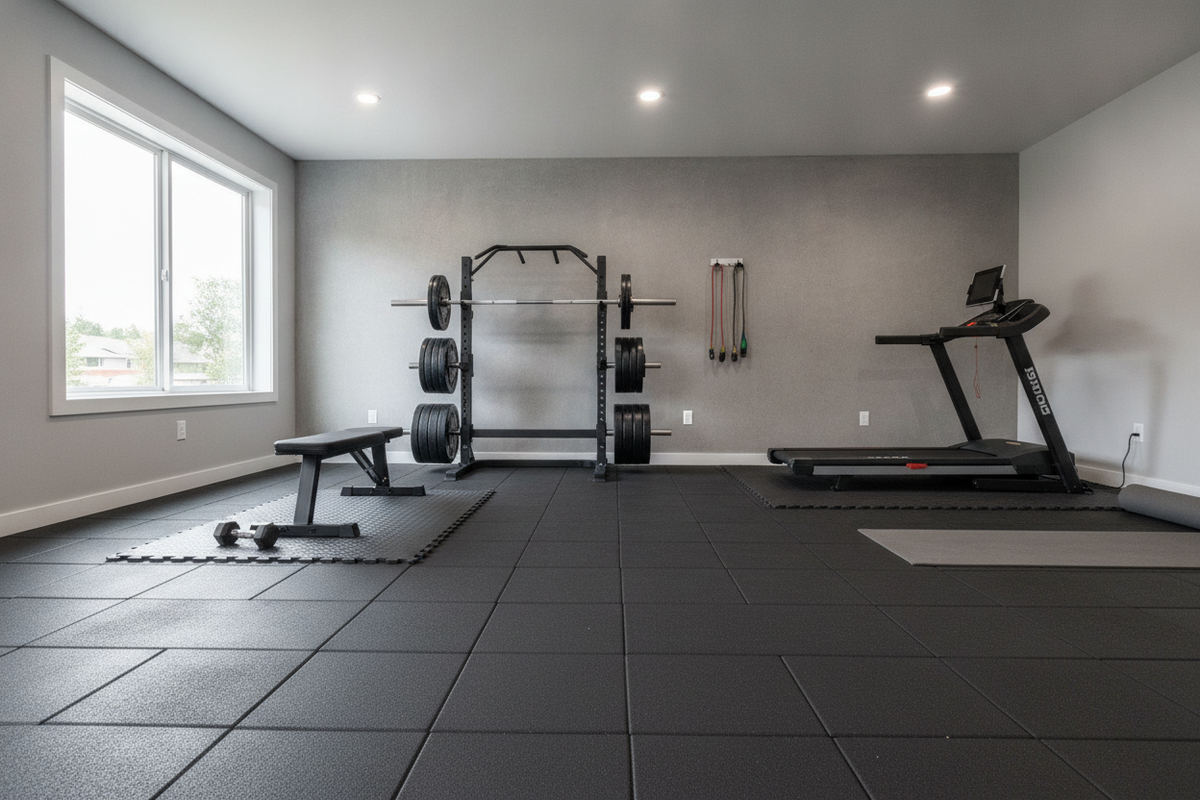
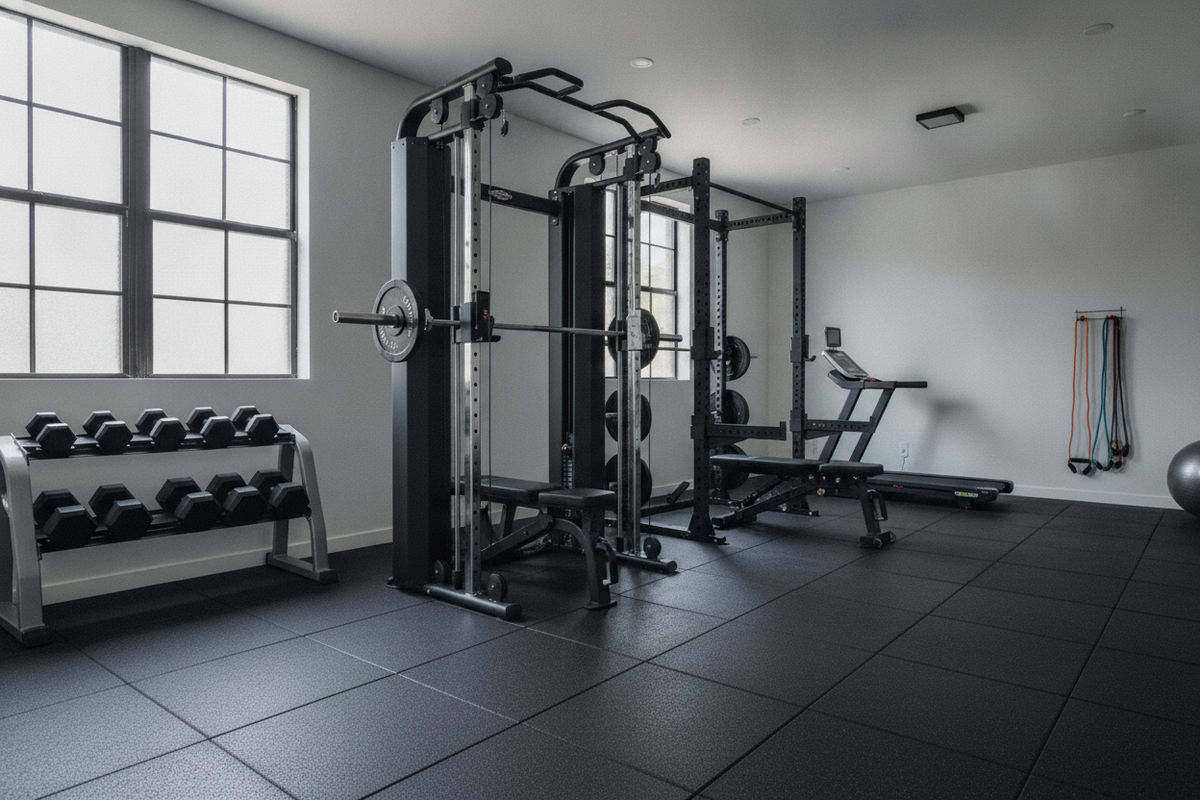
A fully assembled multi-station gym—incorporating steel uprights, dual weight stacks, plate storage, and the exerciser's body weight—generates substantial downward pressure. Without proper gym machine floor protection, concentrated mechanical weight can cause lasting structural and cosmetic damage to residential subfloors.
Why Do People Put Mats Under Gym Equipment?
Homeowners often ask why dedicated matting is necessary beneath stationary exercise equipment. Gym machinery distributes mass across small leveling feet or narrow tubular steel base rails. This creates high point-load concentrations that can crush hardwood, crack subfloor tiles, or compress joist decking over time. Installing an engineered, high-density mat provides multiple structural benefits:
- Load dispersion: Spreads concentrated frame pressure across a broader surface area, reducing the risk of subfloor indentation.
- Vibration and sound attenuation: Dampens mechanical harmonics generated by moving weight stacks, pulleys, and structural adjustments before vibrations transfer through framing.
- Micro-shift stabilization: Prevents steel frames from creeping or shifting across slick finished surfaces during high-cadence or asymmetrical exercises.
- Subfloor moisture defense: Shields subsurfaces from sweat, condensation, and machine lubricants that can degrade flooring materials.
High-Density Matting and Floor Integrity
Standard soft foam tiles easily compress flat beneath heavy machinery, losing protective value and creating unstable footings. Durable floor defense requires dense, non-porous matting designed to resist ongoing point loading without bottoming out. Anchoring heavy equipment over a large, protective gym workout product establishes a stable, resilient platform that shields foundational surfaces from ongoing wear.
Designing Balanced Training Zones: Full Body Workouts and Adjustable Dumbbells
While an all-in-one apparatus serves as a reliable anchor, a versatile training space integrates complementary free-weight and floor-based conditioning tools to provide comprehensive programming variety.
Combining a Multi-Station Home Gym Machine with Free Weights
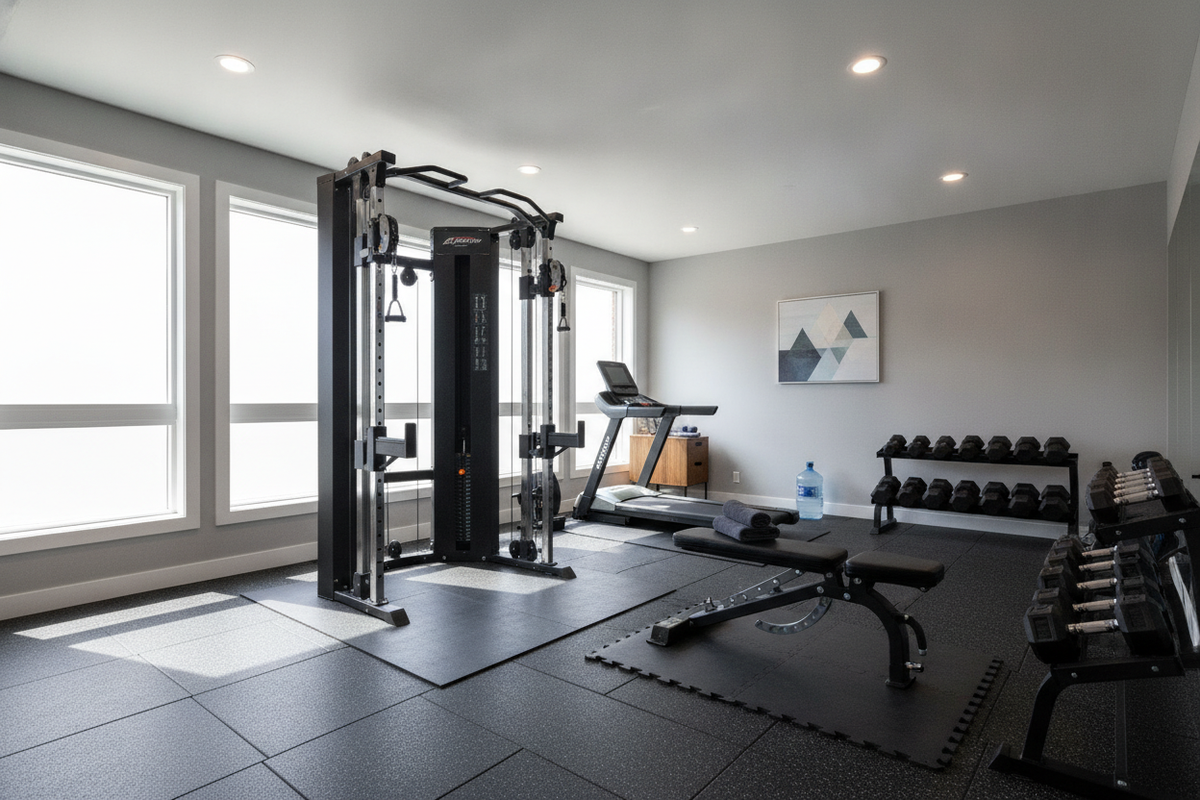
Guided machines excel at isolating muscle groups and maintaining steady mechanical tension through designated ranges of motion. Pairing a multi-function station with a set of adjustable dumbbells and an adjustable weight bench creates a versatile training center within a compact footprint. This balance allows exercisers to transition smoothly between stable compound machine movements and unilateral, stabilizer-focused free weight patterns. To explore structured machine progressions and movement tracks, reviewing an educational gym workout fitness guide provides valuable context on programming guided equipment alongside dynamic accessories.
Machine Ownership Versus an Ongoing Gym Membership
Investing in residential fitness equipment eliminates commuting overhead, facility crowds, and recurring monthly dues associated with a standard commercial gym membership. In my view, the real value of an organized home setup lies in having immediate, friction-free access to consistent strength workouts tailored entirely to personal schedules and training preferences.
Frequently Asked Questions About Home Gym Machines and Floor Staging
What equipment do I need to set up a basic home gym?
A functional starter space requires three core elements: an adaptable resistance source (such as an all-in-one cable trainer, a compact selectorized station, or adjustable dumbbells), an adjustable multi-position utility bench, and dense protective floor matting to stabilize equipment and preserve subflooring.
What is the 3-3-3 rule gym framework?
The 3-3-3 framework is a straightforward programming strategy designed to balance full-body training. It generally involves selecting three primary movement patterns (such as an upper push, an upper pull, and a lower-body compound lift), executing three distinct exercises across three working sets. This structure pairs effectively with multi-station cable machines that support rapid adjustment between varied movement angles.
What kind of mat protects residential floors best from heavy gym machines?
High-density, low-compression vulcanized rubber or dense polymer mats provide optimal floor defense under heavy frames. Avoid low-density lightweight foam tiles, which compress permanently beneath steel base plates. Premium dense matting maintains structural cushioning, disperses heavy point loads across the subfloor, and resists persistent moisture and friction.