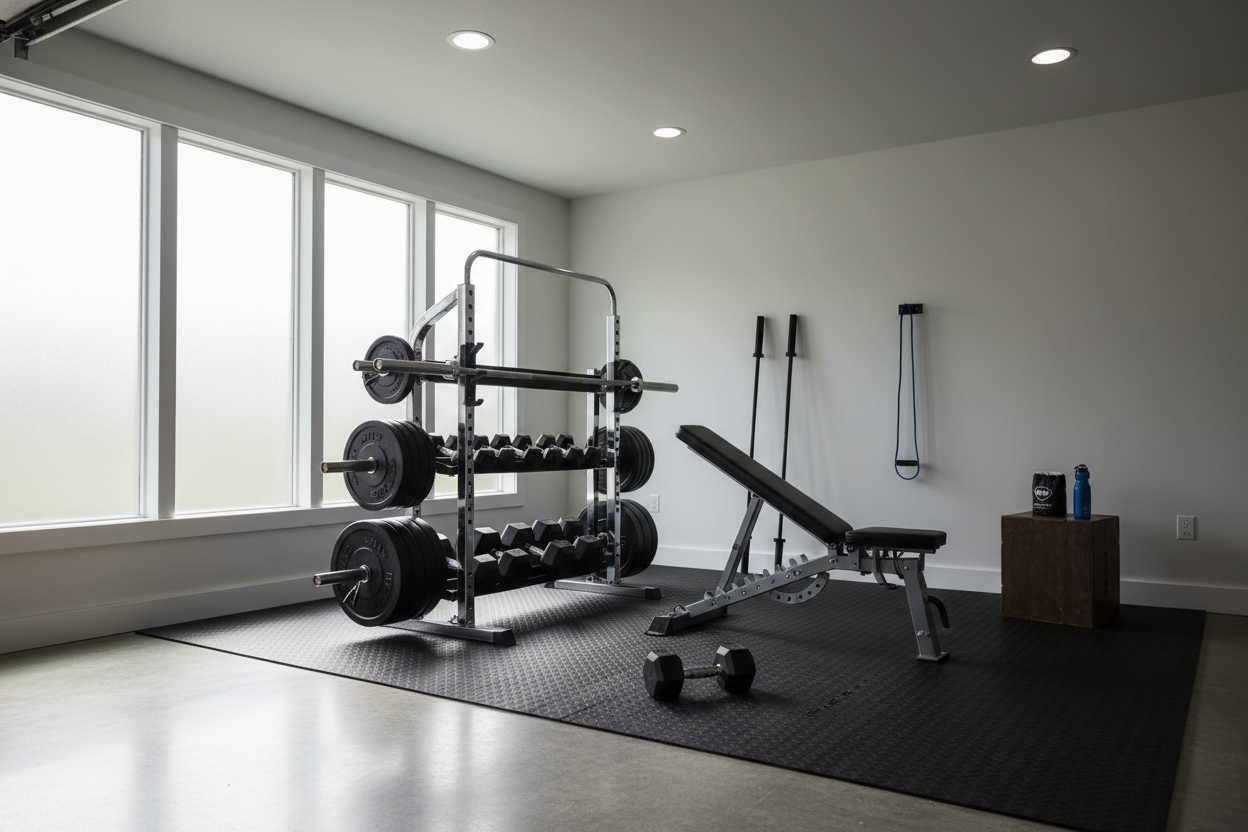
Fitness Training Workouts: Progressing Without New Gear
I remember staring at my 5-52.5 lb adjustable dumbbells in my cramped 10x10 spare bedroom, realizing I could easily row the maximum weight for 15 reps. Buying heavier plates wasn't an option. I didn't have the floor space for a massive rack, nor the budget to drop another five hundred dollars on heavier iron. That is the exact moment I had to rethink how I programmed fitness training workouts for myself and my remote clients. You don't always need more weight to build more muscle.
When you train at home, hitting a plateau is almost inevitable if you rely solely on adding weight to the bar. Eventually, you run out of metal. But muscle growth doesn't know how many pounds you are lifting. It only understands tension, fatigue, and adaptation. By changing how you lift the weight you already own, you can force your body to keep growing.
Quick Takeaways:
- Tempo manipulation increases time under tension, making lighter weights feel significantly heavier.
- Mechanical drop sets allow you to push past muscular failure without changing your dumbbells.
- Resistance bands can be paired with free weights to alter the resistance curve.
- Strategic programming ensures long-term progression without requiring a massive equipment budget.
The Home Gym Progression Problem
Most home gym owners follow a predictable path. You buy a set of adjustable dumbbells, maybe a flat bench, and start lifting. For the first few months, the progress is rapid. You bump the weight up from 20 pounds to 30, then 40. Eventually, you hit the maximum capacity of your equipment.
I see this constantly with clients who own standard 50-pound adjustable blocks. That weight is plenty for lateral raises and bicep curls. But for compound movements like goblet squats, Romanian deadlifts, or chest presses, 50 pounds quickly becomes a warm-up weight. Your legs and back are massive muscle groups that adapt incredibly fast to heavy loads.
The traditional solution is to buy more gear. But upgrading to 80-pound or 100-pound dumbbells is expensive. Adding a barbell and a power rack requires at least a 6x6 foot footprint, which just isn't feasible for an apartment dweller or someone training in a corner of their home office. You are left trying to do sets of 30 or 40 reps just to feel a burn, which shifts your training from muscle building into pure endurance work.
This plateau kills motivation. When you can't add weight, workouts feel stagnant. The solution isn't to do endless, boring high-rep sets. Instead, we need to manipulate the mechanics of the exercises and the speed at which you perform them. By changing the stimulus, we can create a high level of muscle fiber recruitment using the exact same equipment you have been using for months.
Structuring Your Fitness Training Workout
To break through an equipment-limited plateau, you have to restructure your sessions. You can no longer rely on straight sets of 8 to 10 reps resting two minutes in between. That format works beautifully when you have a 300-pound barbell at your disposal, but it falls flat when your heaviest weight is 50 pounds.
Instead, we use techniques like antagonistic supersets and pre-exhaustion. An antagonistic superset pairs two opposing muscle groups back-to-back with zero rest. Think dumbbell bench presses immediately followed by bent-over rows. Because you are working continuously, your cardiovascular system works harder, and cumulative fatigue sets in faster. By the time you hit your second or third set, those 40-pound dumbbells will feel like 60-pounders.
Pre-exhaustion is another highly effective tactic for an at-home fitness training workout. You perform an isolation movement immediately before a compound movement. For example, you might do a set of heavy dumbbell flyes to failure, then immediately move into a dumbbell chest press. Your triceps and shoulders are fresh, but your chest is already fatigued. This forces the chest to reach failure much faster during the press, requiring less total weight to achieve the desired stimulus.
It is crucial to match your specific workout style with the gear you actually have on hand. If you only own a few kettlebells, structuring your routine around heavy, low-rep sets won't work. You need to embrace density training—doing more work in less time. Shorten your rest periods from 90 seconds down to 45 seconds. The incomplete recovery forces your muscles to adapt to the metabolic stress, driving hypertrophy without requiring a single extra pound of cast iron.
Mechanical Drop Sets Explained
A traditional drop set involves doing an exercise to failure, dropping the weight, and continuing. But what if you don't have lighter weights handy, or adjusting your dumbbells takes too long? Enter the mechanical drop set. Instead of changing the weight, you change your body's leverage to make the movement easier.
This allows you to take a single fitness training exercise past failure. Let's use the overhead shoulder press as an example. You start with strict seated dumbbell presses. You hit failure at 10 reps. Instead of stopping, you immediately stand up and use a slight knee bend to perform push presses. The momentum from your legs helps drive the weight up, allowing you to squeeze out 4 or 5 more reps with the exact same dumbbells.
You can apply this to almost anything. Start with a deficit Bulgarian split squat. When your quads give out, immediately drop the deficit (remove the block under your front foot) and continue doing standard split squats. When you fail there, switch to alternating reverse lunges. You are systematically improving your mechanical advantage as your muscles fatigue.
I use this constantly for back training. Start with a strict, wide-grip bent-over row. Once you hit failure, stand slightly more upright and switch to a neutral, tucked-elbow grip. The stronger lat position allows you to keep pulling. This technique completely exhausts the muscle fibers while keeping your equipment needs incredibly low.
Tempo Manipulation for Overload
If there is one secret weapon in a home trainer's arsenal, it is tempo manipulation. Most lifters simply move the weight from point A to point B as efficiently as possible. They let gravity do half the work on the way down. When you are trying to maximize light weights, gravity is your enemy. You need to control every single inch of the repetition.
We dictate this using a four-digit tempo code, such as 4-1-1-0. The first number is the eccentric (lowering) phase. The second is the pause at the stretched position. The third is the concentric (lifting) phase. The fourth is the pause at the contracted position. A 4-1-1-0 dumbbell squat means you take 4 agonizing seconds to lower yourself, pause for 1 second at the absolute bottom, stand up in 1 second, and immediately begin the next rep without resting at the top.
When I first tested this protocol in my own living room using just a flat bench and 40-pound hex dumbbells, it was a brutal wake-up call. I thought I was strong until I tried 4-1-1-0 Bulgarian split squats. The time under tension skyrocketed. A normal set of 10 reps takes about 30 seconds. With this tempo, a set of 10 takes over a minute. The sheer lactic acid buildup is intense.
There is one honest downside to aggressive tempo work: it is mentally exhausting. Your cardiovascular system and your grip might fail before the target muscle does, especially on back and leg days. You have to fight the urge to speed up the reps as the burn sets in.
To implement this, pick an exercise you normally max out at 15 reps. Apply a 4-second negative and a 2-second pause at the bottom. I guarantee you will struggle to hit 8 reps. You have effectively doubled the intensity of the weight without spending a dime. Tempo forces you to use strict form, eliminates momentum, and creates massive metabolic stress—all primary drivers for muscle growth.
Integrating Variable Resistance
Free weights have a fixed resistance curve. A 50-pound dumbbell always weighs 50 pounds. However, your muscles do not have a fixed strength curve. In a bicep curl, the movement is hardest when your forearm is parallel to the floor, but it becomes very easy at the top of the movement. This means your muscle is only being maximally challenged for a tiny fraction of the rep.
You can fix this by combining inexpensive loop resistance bands with your existing free weights. A heavy-duty set of bands costs about 30 dollars, takes up zero floor space, and can completely transform your home gym. By anchoring a band to your foot and looping it over a dumbbell, you create variable resistance.
As you lift the weight, the band stretches, increasing the tension precisely as your mechanical advantage improves. Let's look at a goblet squat. Normally, the top quarter of a squat is virtually effortless. But if you stand on a heavy resistance band and loop the other end over your dumbbell, the tension ramps up as you stand. At the bottom, you are lifting 50 pounds. At the top, the stretched band might add another 40 pounds of resistance.
This technique is phenomenal for Romanian deadlifts, chest presses, and rows. If you have a bench, you can wrap a band underneath the back pad and loop the ends around your dumbbells. As you press the weights up, the band pulls outward and downward, forcing you to fight the resistance at the peak contraction. It makes a light set of dumbbells feel incredibly heavy at the top, stimulating new muscle growth and forcing you to stabilize the weight through the entire range of motion.
Programming for the Long Haul
Techniques like tempo and variable resistance are useless if you just throw them randomly into your workouts. You need a structured progression model to ensure you are actually making gains week over week. Here is a sample 4-week progression block designed to milk every ounce of tension out of limited equipment.
In Week 1, establish your baseline using tempo. Pick your exercises and apply a strict 3-1-1-0 tempo. Track your reps. Your goal is simply to get used to the time under tension without breaking form. You will likely do fewer reps than normal, and that is exactly the point.
In Week 2, introduce mechanical drop sets on your final set of each exercise. For example, do three sets of strict tempo dumbbell presses. On the third set, when you hit failure, immediately drop the tempo, stand up, and perform push presses to squeeze out those extra reps. This pushes the muscle past its normal failure point.
In Week 3, add variable resistance. Keep the tempo strict, but attach a band to your primary compound movements like squats and deadlifts. The added tension at the top of the movement will challenge your nervous system in a completely new way. You will feel sore in places you haven't felt in months.
Finally, in Week 4, combine the methods for an overreaching phase. Use banded resistance, strict tempo, and finish with a mechanical drop set. This proves that minimalist exercise setups work incredibly well when programmed intelligently. After Week 4, take a deload week—doing straight, unbanded sets with normal tempo—before starting the cycle over with slightly more reps or a thicker band.
Maximizing What You Have
Building an impressive physique at home doesn't require a commercial facility. It requires ingenuity and a willingness to embrace discomfort. When you run out of weight, you have to increase the difficulty of the execution.
Mastering strict execution, controlling your eccentric speeds, and pushing past failure with mechanical advantages will always trump having a massive, expensive rack of dumbbells that you lift with sloppy form. Your muscles respond to the tension you create, not the price tag of your gear.
Stop stressing over the heavy plates you don't have. Start manipulating the weight you do have. Squeeze the handles harder, lower the weight slower, and force your body to adapt to the new stimulus. The gains are waiting right there in your living room.
Frequently Asked Questions
How slow should my tempo be for muscle growth?
A 3 to 4-second eccentric (lowering) phase is the sweet spot for maximizing time under tension without forcing you to use weights so light that they fail to trigger mechanical tension. Always control the descent.
Can I use mechanical drop sets every day?
No. Taking muscles past failure is highly taxing on your central nervous system. Limit mechanical drop sets to the final set of an exercise, and use them on no more than two or three exercises per workout.
Do resistance bands snap easily when paired with dumbbells?
High-quality, layered latex loop bands are incredibly durable. However, you should regularly inspect them for micro-tears, especially if you are anchoring them under rough shoe tread or knurled dumbbell handles.