How to Build Total Body Strength With Just Beginner Gym Machines
Walking onto the fitness floor for the first time can feel like entering a foreign country where everyone speaks a language you don't know. You see rows of iron, cables, and people moving with purpose. It is easy to feel out of place. But here is the truth: you do not need to start with complex barbell movements to make progress.
Beginner gym machines are often dismissed by purists as "too easy," but that is a mistake. When used correctly, these tools provide the stability and safety required to build a foundational layer of muscle. They allow you to focus entirely on the contraction of the muscle without worrying about balancing a heavy bar. Let's strip away the confusion and look at how to use these tools effectively.
Key Takeaways: The Best Machines to Start With
If you are looking for a quick answer on where to begin, here is the hierarchy of equipment that offers the highest return on investment for new lifters:
- Leg Press: The safest way to load the legs heavily without spinal compression.
- Lat Pulldown: The best exercise machine for beginners to build back width before attempting pull-ups.
- Seated Chest Press: Teaches proper pressing mechanics while protecting the shoulder joints.
- Cable Seated Row: Essential for posture correction and upper back thickness.
- Elliptical Trainer: One of the most effective easy workout machines for low-impact conditioning.
Why Machines Beat Free Weights (At First)
There is a misconception that you must squat and deadlift immediately to see results. While those movements are valuable, they require a level of neuromuscular coordination that most beginners haven't developed yet.
Gym machines operate on a fixed path of motion. This removes the variable of stabilization. When you remove the need to balance the weight, you can direct 100% of your effort into pushing or pulling. This creates a stronger mind-muscle connection, which is vital for hypertrophy (muscle growth).
The "Big Three" Gym Machines for Beginners
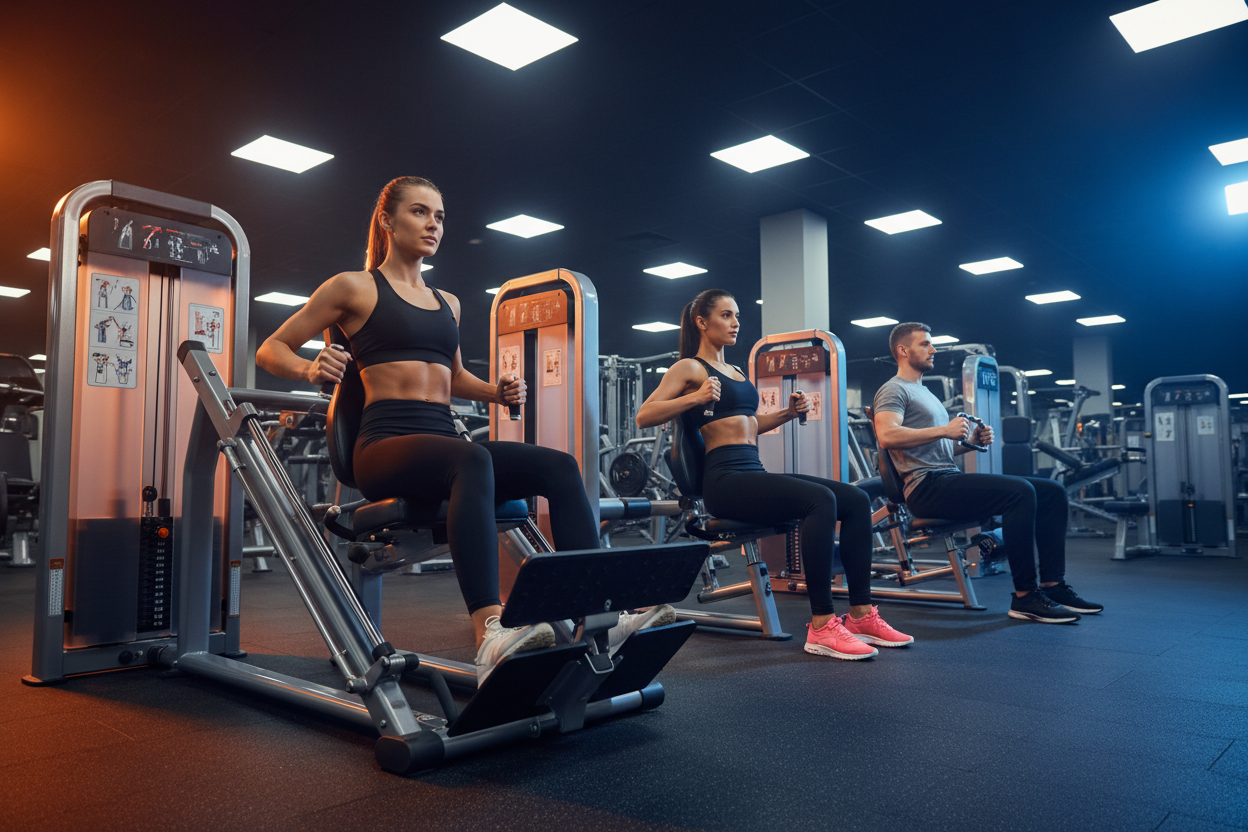
1. The Leg Press (Lower Body)
The squat is often called the king of exercises, but the leg press is the king of isolation. It is arguably the best gym machine for beginners looking to build quad and glute strength.
The Science: By stabilizing your back against the pad, you remove the axial load (downward pressure) on your spine. This allows you to lift significantly more weight than you could squat, placing immense tension directly on the thigh muscles.
Coach's Tip: Don't lock your knees at the top of the movement. Keep a slight bend to keep the tension on your muscles and off your knee joints.
2. The Lat Pulldown (Pulling Strength)
Most people cannot do a pull-up on day one. The Lat Pulldown mimics the vertical pulling motion, targeting the Latissimus Dorsi (the muscles that give you a V-shape).
The Nuance: Many beginners pull the bar down to their belly button using their arms. This is incorrect. You want to pull the bar to your upper chest, leading the movement by driving your elbows down toward the floor. Think of your hands as hooks; your back should do the work, not your biceps.
3. The Seated Chest Press (Pushing Strength)
This is your introduction to horizontal pushing. Unlike a bench press, where a lapse in focus can result in the bar dropping on you, the chest press machine has safety stops.
Setup Matters: The handles should be aligned with the middle of your chest (nipple line). If the seat is too low, you will push with your shoulders, which can lead to impingement. If it's too high, you lose leverage.
Conditioning: Easy Workout Machines That Work
Cardio doesn't have to mean running until you gasp for air. If you are looking for easy workout machines that burn calories without destroying your joints, look at the Elliptical or the Recumbent Bike.
However, "easy" refers to the impact on your joints, not the effort. To get the most out of these, you need to use enough resistance that your legs feel a slight burn. Spinning the pedals with zero resistance does very little for your conditioning.
My Training Log: Real Talk
I want to be honest about my own history with beginner gym machines. When I first started lifting, I had an ego. I skipped the machines and went straight to the squat rack. I spent three months with a sore lower back and very little leg growth to show for it.
I eventually humbled myself and moved to the Leg Press. I vividly remember the specific, gritty sound of the bearings sliding on the guide rods—that friction you can feel vibrating through the footplate. There’s a distinct "clank" when the weight stack hits the bottom if you aren't controlling the eccentric (lowering) phase.
The biggest realization for me wasn't about the weight; it was the safety stops. I remember pushing a set to absolute failure, my legs shaking uncontrollably. On a squat, I would have crumpled. On the machine, I simply engaged the safety handles and stepped out. That safety allowed me to push harder than I ever could with free weights. The vinyl seat was slippery with sweat, and the back pad dug into my spine a bit, but that machine is the reason my quads finally started to grow.
Conclusion
Don't let anyone tell you that you aren't "really training" if you aren't using a barbell. The best exercise machine for beginners is the one you feel comfortable using consistently. Master the fixed path of motion, build your base strength, and establish a routine. Once you have maxed out the weight stack, then we can talk about the free weights.
Frequently Asked Questions
How often should I use gym machines as a beginner?
For most beginners, a full-body routine performed 3 times per week is ideal. This frequency allows you to hit every muscle group often enough to stimulate growth while giving your body 48 hours of rest between sessions to recover.
Can I build muscle with just machines?
Absolutely. Your muscles do not know if you are holding a barbell or pushing a machine handle; they only understand tension. As long as you are progressively increasing the weight or repetitions over time (progressive overload), you will build muscle.
When should I switch from machines to free weights?
There is no strict timeline. You can transition once you feel confident in your strength and understand how your muscles move. Many advanced bodybuilders continue to use machines for the majority of their workouts because of the superior isolation they provide.