Bodybuilding Home Gym: The Ultimate Setup Guide for Hypertrophy
We have all been there. It is chest day, you are primed to lift, and the only decent bench in the commercial gym is occupied by someone scrolling through Instagram. The frustration is real, and it kills your pump. This is usually the moment serious lifters decide to build a bodybuilding home gym.
Creating a space dedicated to hypertrophy at home isn't just about buying a barbell. Unlike powerlifters who need to move weight from A to B, you need angles, isolation, and tension to sculpt a physique. This guide cuts through the marketing noise to help you build a setup that rivals any commercial facility.
Key Takeaways: The Essentials
- Hypertrophy Requires Variety: Unlike strength setups, a bodybuilding focus needs equipment that allows for different angles (incline, decline) and isolation movements.
- The "Big Four" Investments: Your budget should prioritize a power rack, a high-quality adjustable bench, a barbell with medium knurling, and heavy adjustable dumbbells.
- Don't Ignore Cables: Constant tension is vital for muscle growth; a pulley system is the biggest differentiator between a garage gym and a bodybuilding haven.
- Space Efficiency: You can build a complete physique in a single car garage if you utilize vertical storage and multi-functional footprints.
Designing a Home Gym for Bodybuilding
There is a distinct difference between a general garage gym and a home gym for bodybuilding. A general lifter just wants to sweat. A powerlifter wants to hit a 1RM. As a bodybuilder, your goal is stimulating muscle fibers through a full range of motion.
This means your equipment selection must prioritize versatility. You aren't just buying heavy iron; you are buying tools that allow you to isolate the lateral head of the tricep or target the upper shelf of the pecs without a spotter.
The Core: Rack and Bench
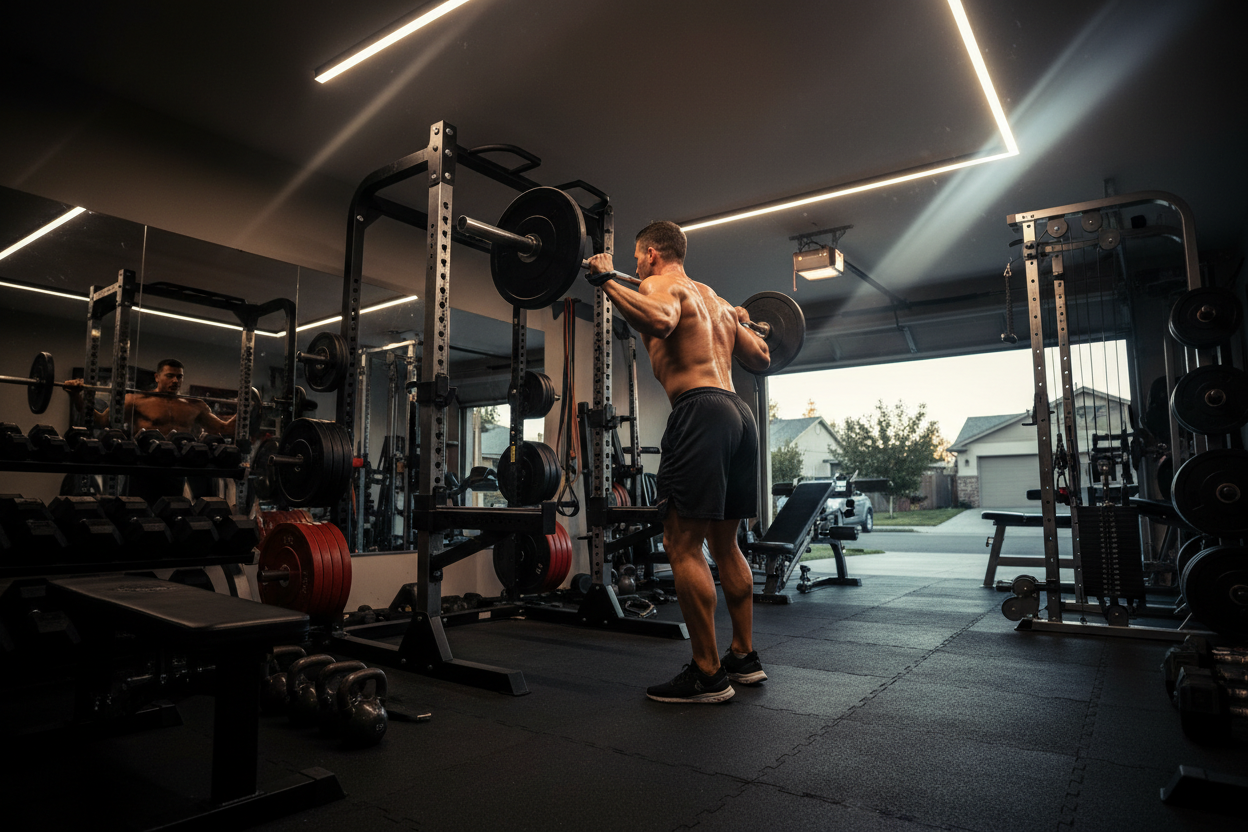
Your centerpiece is the power rack. For hypertrophy, look for a rack with close hole spacing (Westside spacing). This allows you to set safety pins at the exact height for rack pulls or pin presses without compromising your range of motion.
Paired with this, you need a gap-free adjustable bench. This is critical bodybuilding home equipment. Many budget benches have a massive gap between the seat and back pad. When you are doing an incline press, that gap often sits right where you need stability, killing your drive. Get a bench that goes from a slight decline (for triceps) up to 85 degrees (for shoulders).
The Iron: Plates and Dumbbells
When selecting home gym equipment bodybuilding enthusiasts often overspend on bumper plates. Unless you are doing Olympic lifts, you don't need expensive, bouncy rubber plates. Cast iron plates are thinner, allowing you to load more weight on the bar/machines, and they have that classic "clank" that drives intensity.
The Dumbbell Dilemma
Dumbbells are non-negotiable for symmetry and isolation. However, a full rack takes up massive amounts of space. Heavy adjustable dumbbells (going up to 80 or 90 lbs) are the standard solution. Look for models with flat ends. Why? Because as a bodybuilder, you will rest heavy dumbbells on your quads before kicking them back for a press. Rounded or protruding selector pins make this painful and awkward.
The "Secret Weapon" for Hypertrophy
Most garage gyms lack one thing: cables. Free weights rely on gravity, meaning the tension curve drops off at certain points in the rep. Cables provide constant tension, which is essential for metabolic stress and muscle growth.
You do not need a massive functional trainer. A simple high/low pulley attachment for your rack works wonders. This piece of bodybuilding at home equipment unlocks face pulls, tricep pushdowns, and cable curls—movements that are difficult to replicate with a barbell alone.
My Training Log: Real Talk
Let me tell you about a mistake I made so you don't have to. When I first set up my space, I bought a cheap, "all-in-one" adjustable bench because it claimed to have a leg extension attachment included. It seemed like a steal.
The reality? The moment I loaded up for a heavy seated shoulder press, the back pad wobbled about two inches to the left. It was terrifying. But the worst part was the vinyl. It was so slick that without a shirt (or even with a Dri-Fit shirt), I kept sliding down during incline movements. I couldn't lock my scapula in place.
I ended up wrapping the bench in yoga mat tape just to get grip. It looked terrible, but it worked until I could afford a proper competition-style pad. The lesson: Don't skimp on the bench. It supports 90% of your lifts. If you slide, you lose force transfer, and you lose gains.
Conclusion
Building a bodybuilders home gym is an investment in your consistency. By focusing on versatile equipment like an adjustable bench, a pulley system, and heavy dumbbells, you remove the barriers between you and your dream physique. Stop waiting for equipment and start controlling your environment.
Frequently Asked Questions
Can you really build a pro physique with a home gym?
Absolutely. Muscle fibers do not know if you are in a commercial gym or a garage; they only respond to tension and progressive overload. As long as your bodybuilding home gym allows for heavy compound movements and sufficient isolation work, you can achieve professional-level results.
How much space do I need for a bodybuilding setup?
You can fit a highly effective setup in a 10x10 foot space. The key is vertical storage for weight plates and utilizing a wall-mounted or folding rack if space is extremely tight. Dumbbells take up the most room, which is why adjustable versions are preferred for small spaces.
Is a Smith Machine necessary for home bodybuilding?
While popular in commercial gyms for isolation, a Smith Machine is not essential for a home setup unless you have unlimited budget and space. A power rack with safety straps allows you to push to failure safely on squats and bench presses, mimicking the safety benefit of a Smith Machine.