Exercises for Home Gym Machine: The Pin-Drop Protocol
I remember stepping into a client's spare bedroom last year. They had a massive multi-station machine crammed into a 10x10 space, but they were only using it for light triceps pushdowns. They thought real muscle could only be built with heavy barbells. I had to show them how wrong they were. If you know how to manipulate the weight stack, finding the right exercises for home gym machine setups can actually trigger more hypertrophy than a standard dumbbell rack.
As a personal trainer, I have assembled and tested dozens of these setups. When you stop treating your multi-station rig like a poor substitute for free weights and start exploiting its unique features, your results will skyrocket.
Quick Takeaways
- Selectorized weight stacks allow for instant mechanical drop sets, keeping muscles under tension.
- Fixed-track movements provide superior stability for isolating exhausted muscles safely.
- Continuous cable tension keeps your muscles engaged through the entire range of motion.
- Proper flooring is mandatory to keep a 300+ lb machine from shifting during heavy sets.
The Hidden Advantage of Your Multi-Station Setup
Free weights are great for stabilizing muscles, but they have a major flaw when it comes to chasing ultimate muscle fatigue: balance. When your chest is fried after eight heavy reps of a dumbbell press, your stabilizing muscles usually give out before your pecs do. This is where a multi-station machine shines. The fixed track removes the balance equation entirely. You can push your target muscles to absolute failure without worrying about dropping a 60-pound weight on your face.
Furthermore, the selectorized weight stack is a speed demon. Moving a pin takes about one second. Stripping plates off a barbell takes a solid minute. If you read up on the definitive home gym guide for 2024, you will see how multi-station and fixed-track systems have evolved to capitalize on this exact advantage. You get to keep the muscle under tension longer, with much shorter rest periods.
Foundational Exercises for Home Gym Machine Growth
Before we get into advanced intensity techniques, we need to establish the baseline movements. The beauty of a cable-driven weight stack is continuous tension. A dumbbell loses resistance at the top of a chest fly due to gravity. A cable keeps pulling back. By focusing on compound movements that recruit multiple muscle groups, you can build a highly effective baseline.
Upper Body: Chest Press and Lat Pulldowns
The seated chest press on a machine allows you to stretch the pectorals deeply at the bottom of the movement. I always cue my clients to take three full seconds on the eccentric (lowering) phase. Let the handles pull your hands back until you feel a deep stretch across your chest, pause for a split second, and explode forward. Lat pulldowns are equally effective. Lock your knees under the pads and focus on driving your elbows down to the floor, rather than just pulling with your biceps. The machine provides a strict vertical path, making it much easier to isolate the latissimus dorsi.
Lower Body: Leg Extensions and Hamstring Curls
Heavy barbell squats are fantastic, but they heavily load the spine. If you have lower back issues, isolating the legs on a machine is a much safer alternative. Leg extensions will set your quadriceps on fire when done correctly. Keep your toes pointed up and squeeze hard at the top of the movement for a full second. Hamstring curls require you to keep your hips pressed firmly against the pad to prevent cheating. These specific workouts for home gym machine setups allow you to train legs to absolute failure without a spotter. You can safely bail out of a rep halfway through without getting pinned under a heavy bar.
Core and Isolation: Cable Crunches and Pushdowns
The high pulley is your best tool for isolation work. For cable crunches, attach a triceps rope, kneel down, and lock your hips in place. Crunch your elbows down to your knees, focusing entirely on flexing the spine rather than pulling with your arms. For triceps pushdowns, lock your elbows strictly to your ribs. The cable provides constant tension at the bottom lockout, an area where dumbbells completely lose resistance.
The Pin-Drop Protocol: Maximizing Muscle Fatigue
Now we get to the core of my training philosophy for these machines: The Pin-Drop Protocol. This is a mechanical drop set technique that is almost impossible to replicate with free weights. Here is exactly how it works.
You load the pin with a weight you can lift for about 8 to 10 reps. You perform the exercise until you hit absolute mechanical failure—meaning you physically cannot move the handle another inch. Immediately, you reach down, move the pin up two slots (dropping the weight by roughly 20 to 30 pounds), and instantly resume the exercise to failure again. You repeat this drop one more time. The entire process takes maybe three seconds of rest between drops.
When clients ask me is a Smith machine worth it or if a selectorized stack is better, I point to this exact protocol. Stripping plates off a bar takes too long; the muscle recovers. The pin-drop keeps the muscle in a state of extreme metabolic stress, triggering massive hypertrophy.
A Complete Workout Routine for Home Gym Machine
To put this into practice, I have designed a 3-day full-body split. This workout routine for home gym machine setups relies heavily on the Pin-Drop Protocol for the final set of every exercise.
Day 1 focuses on the anterior chain. You will do 3 sets of 10 reps on the chest press, but on the third set, execute a double pin-drop. Follow this with leg extensions using the exact same rep scheme and drop-set finisher. Finish with cable crunches for 3 sets of 15.
Day 2 targets the posterior chain. Start with lat pulldowns for 3 sets of 10, utilizing the pin-drop on the final set. Move to seated or standing hamstring curls, again pushing that third set through two weight drops. Finish with straight-arm cable pulldowns to isolate the lats further.
Day 3 is arms and shoulders. Cable lateral raises, triceps pushdowns, and standing cable curls. Keep the reps slightly higher here, around 12 to 15 per set, and use a single pin-drop on the last set of each movement.
I have tested this exact routine on a standard 150-lb stack machine in my own garage. The muscle pump is unreal. However, I will be completely honest about one downside I consistently see: cable friction. Cheaper machines often have sticky pulleys that jerk during the eccentric phase. If your machine does this, spray a little silicone lubricant on the guide rods. It makes a massive difference in how smooth the reps feel.
Protecting Your Floor and Equipment Stability
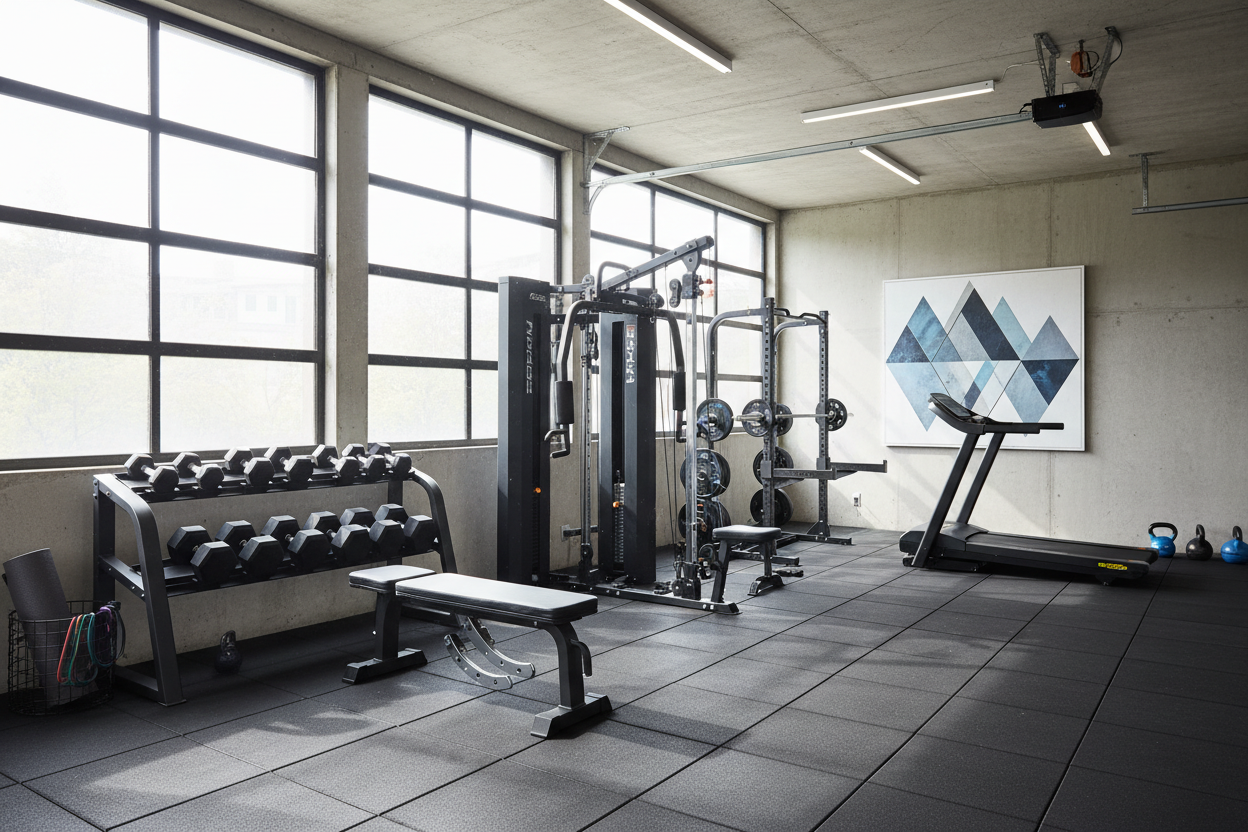
A multi-station machine usually weighs between 200 and 400 pounds, and that is before you start violently yanking on the cables during a heavy drop set. If you set this equipment directly on hardwood or thin carpet, you are going to cause permanent damage to your subfloor. More importantly, the machine will walk or shift during use.
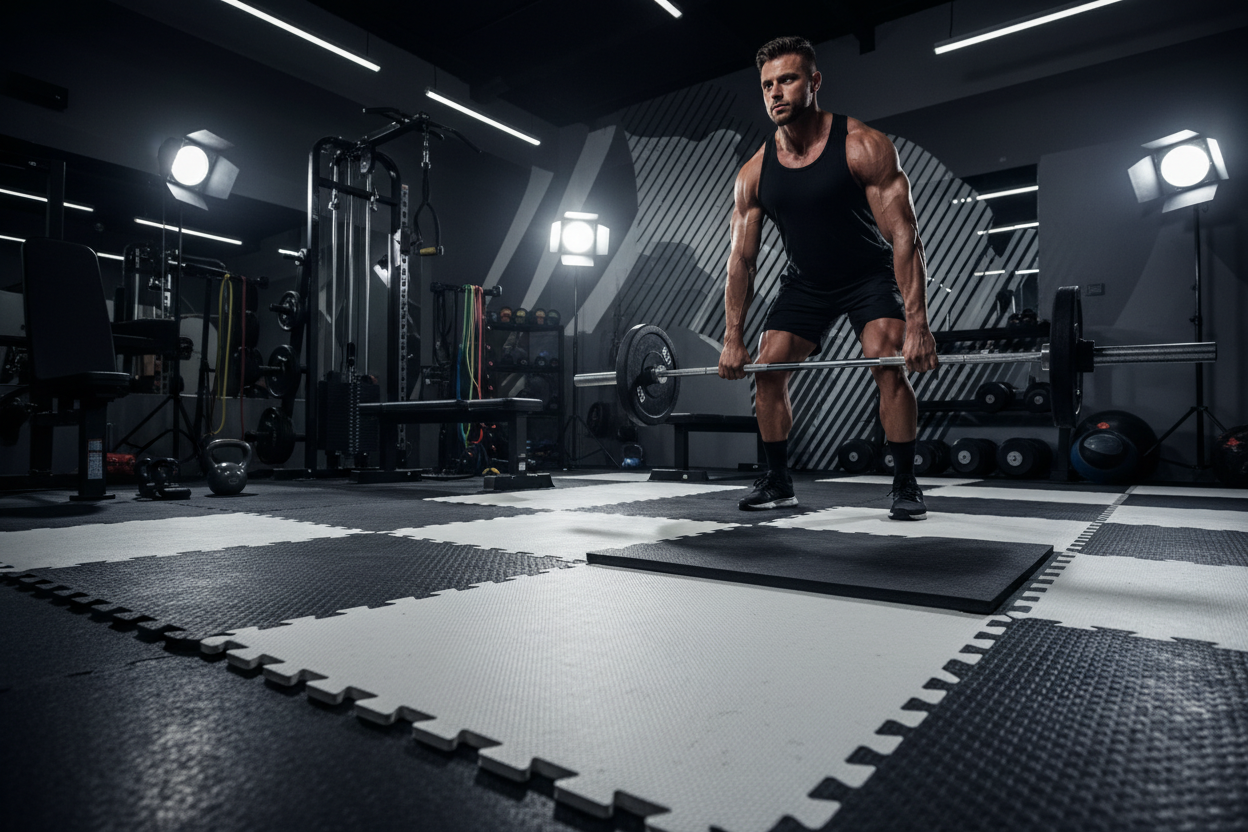
I always require my clients to put down a large exercise mat for home gym use before we even assemble the equipment. You need high-density material that absorbs vibration and prevents the steel frame from gouging the floorboards. A thick layer of rubber or high-grade PVC creates a non-slip grip. I specifically recommend getting dedicated gym flooring for home workout setups that measures at least 6x8 feet. This gives you enough footprint to cover the machine's base and provides a safe, grippy area for you to stand on while performing standing cable exercises.
FAQ
Can you build real muscle with just a home gym machine?
Yes. Muscle growth requires progressive overload and mechanical tension. A selectorized machine provides constant cable tension and allows you to safely push to failure, which is highly effective for hypertrophy.
How often should I do the Pin-Drop Protocol?
I recommend using the pin-drop technique only on the final set of a given exercise. Doing it on every single set will fry your central nervous system and lead to overtraining.
What if the weight stack isn't heavy enough?
If you max out the stack (usually 150 to 200 lbs on home models), slow down your tempo. A 4-second negative phase will make 100 pounds feel like 200 pounds.