Exercise for Glutes Only: The 5 Essential Movements, Form Mechanics, and Floor Mat Staging
When organizing lower-body training, many lifters find that broad, multi-joint leg routines distribute tension heavily into the quadriceps, lower back, or hamstrings rather than the hips. Isolating gluteal development requires selecting specific exercise variations that target the gluteus maximus, medius, and minimus across distinct force vectors.
By prioritizing movements that challenge the hip musculature in both shortened and lengthened positions while controlling external leverage, you can create a targeted training session. Pairing thoughtful movement selection with an anchored, slip-resistant floor setup ensures training consistency and equipment stability in a home gym environment.
The Minimalist Framework: Why Select an Exercise for Glutes Only Routine?
A streamlined routine eliminates redundant lower-body volume, allowing lifters to focus energy on progressive loading and clean biomechanics. Standard squats and conventional deadlifts recruit significant quad and spinal erector drive. In contrast, selecting an exercise for glutes only approach allows you to direct mechanical tension straight to the hip extensors and abductors.
Reviewing an only glute exercise guide helps clarify how matching hip angles to movement vectors reduces unwanted fatigue in adjacent muscle groups. Balancing horizontal thrusts, vertical hinges, unilateral patterns, and lateral abduction produces comprehensive muscular stimulation without overloading the lower back.
The 5 Core Glutes Only Exercises
These five foundational exercises target the glutes across distinct planes of motion and varied muscle lengths.
1. Barbell or Dumbbell Hip Thrust (Horizontal Vector)
The hip thrust is a primary horizontal movement pattern that applies peak tension when the glutes are in a fully shortened position. Proper execution relies on placing a stable weight bench across the mid-to-lower scapulae. As you drive your hips upward, keep your chin tucked and your ribcage stacked over your pelvis.
At the apex of the movement, the shins should be vertical and the pelvis tucked into a slight posterior pelvic tilt. This pelvic position prevents lumbar hyperextension and keeps tension focused on the gluteus maximus.
2. Glute-Biased Romanian Deadlift (Lengthened Range)
To bias the Romanian deadlift toward the glutes rather than the hamstrings, introduce a softer knee bend and push your hips backward as if reaching for a wall behind you. Maintain vertical shins throughout the descent.
Stop lowering the weight once your hips stop traveling backward. Lowering past this point transfers load from the hip joint to the lumbar spine.
3. Deficit Reverse Lunge (Unilateral Vector)
Unilateral training addresses side-to-side strength imbalances while engaging the gluteus medius for pelvic stabilization. Performing reverse lunges from a slight elevation allows greater hip flexion at the bottom of the movement.
Leaning the torso forward at a forward angle aligns the resistance vector through the lead hip, maximizing mechanical tension on the working glute.
4. Standing Hip Abduction (Lateral Vector)
The gluteus medius and minimus function primarily to abduct and stabilize the hip. Using a cable machine or resistance band, hinge slightly at the hips and guide the leg outward along a diagonal path.
Keeping the foot neutral or slightly turned inward prevents the hip flexors from taking over the lateral movement.
5. 45-Degree Hyperextension with Rounded Thoracic Spine (Shortened Range)
When performed on a 45-degree back extension bench, rounding the upper and mid-back takes the spinal erectors out of the movement. Turning the toes outward slightly further promotes external rotation.
Hinge purely at the hip joint, contracting the glutes firmly at the top without extending through the lower back.
Structuring a Balanced Glute Only Workout
A well-sequenced routine starts with heavy compound movements before progressing to unilateral stabilization and targeted abduction finishers. Organizing exercises by neurological demand ensures safe mechanics under load.
- Primary Compound: Barbell or Dumbbell Hip Thrust (focused on progressive overload and shortened-range contraction).
- Lengthened Builder: Glute-Biased Romanian Deadlift (controlled eccentric tempo focusing on deep hip hinge depth).
- Unilateral Builder: Deficit Reverse Lunge or Bulgarian Split Squat (addressing asymmetry and hip stabilization).
- Isolation Finishers: 45-Degree Rounded Hyperextension paired with Standing Hip Abduction (high-density metabolic work).
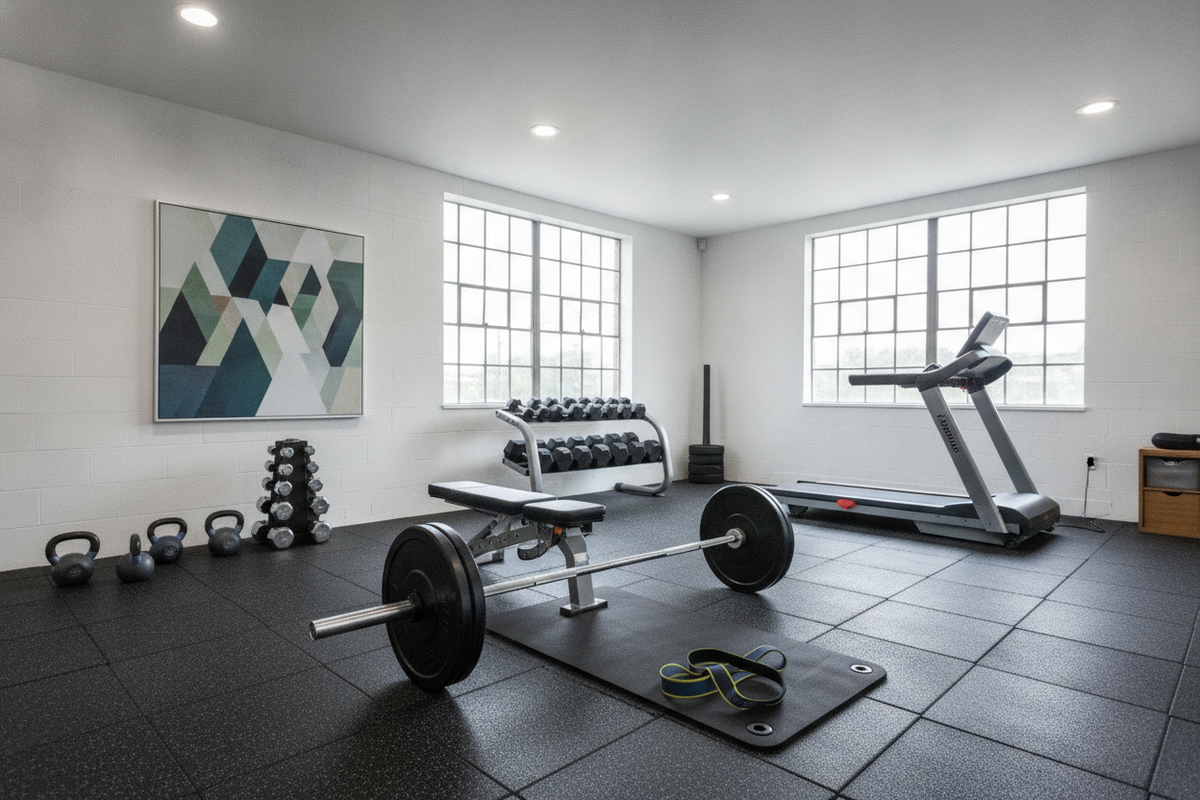
Before loading heavy weights, performing dynamic floor mobility work on a dedicated mat from an exercise collection helps prime hip internal and external rotation.
Biomechanical Form Cues for Maximum Glute Isolation
Mindful execution separates productive glute training from general lower-body fatigue. Implement these form cues during each repetition:
- Maintain Ribcage-Pelvis Alignment: Avoid arching the lower back during lockout; keep the core braced so the pelvis moves as an integrated unit.
- Drive Through the Mid-Foot and Heel: Pushing through the mid-foot anchors the base and engages the posterior chain effectively.
- Control the Eccentric Phase: Take several seconds to lower weights under control, maximizing time under tension in the lengthened position.
- Check Shin Angles: Keeping shins vertical during hinges and thrusts minimizes forward knee travel, reducing quadricep dominance.
Home Gym Staging: Flooring Stability, Room Protection, and Maintenance
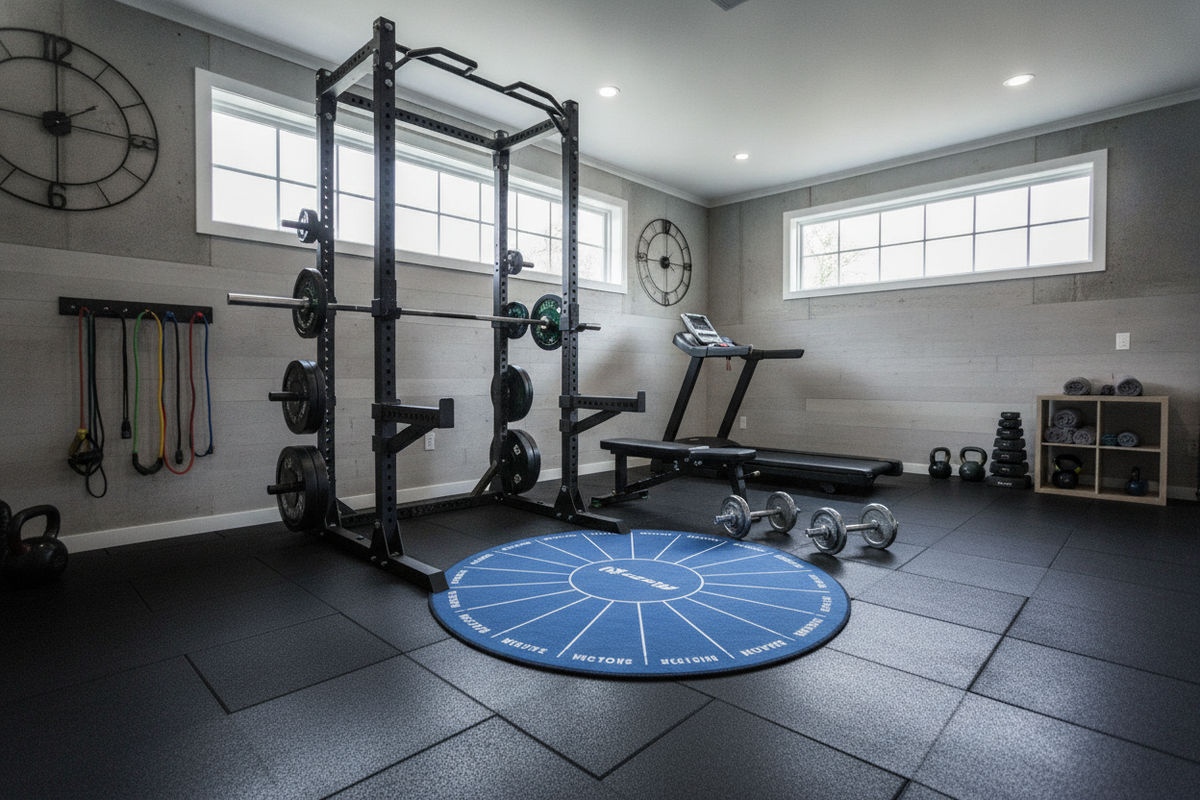
Executing heavy hip thrusts, lunges, and deadlifts requires a stable training foundation. Placing benches and weights directly onto slick hardwood or thin carpeting can cause equipment shifting during peak exertion, compromising joint alignment.
Using a large, high-density surface such as a dedicated exercise workout product provides firm traction underfoot while preventing bench creep during thrust setups. Dense matting also helps cushion floor surfaces against dumbbell and barbell contact during Romanian deadlifts.
To maintain your flooring setup, wipe down surfaces with mild soap and water after sweaty sessions, and keep the perimeter clear of stray weights. A clean, dedicated workout zone allows you to focus fully on proper form and consistent glute development.