Dumbbell Workout Lower Body Guide: Movement Frameworks, Execution Mechanics, and Floor Protection
Designing an effective training session in a home environment requires more than simply grabbing heavy weights and performing arbitrary repetitions. A comprehensive dumbbell workout lower body program relies on a clear understanding of human biomechanics, movement vectors, and floor environment management. When properly structured, free weights offer exceptional versatility for strengthening the quads, hamstrings, glutes, and stabilizing musculature without demanding bulky commercial equipment.
Architectural Foundations of a Dumbbell Workout Lower Body Routine
A balanced lower-body regimen requires intentional organization rather than random exercise selection. Structuring sessions around primary kinetic movement patterns ensures balanced joint stress and proportional muscular stimulation across both anterior and posterior chains.
Balancing Knee-Dominant and Hip-Dominant Vectors
Lower-body movements generally divide into knee-dominant patterns (such as squats and lunges) and hip-dominant patterns (such as hinges and bridges). Knee-dominant exercises place primary mechanical demands on the quadriceps and patellar complex, whereas hip-dominant exercises shift the tension toward the gluteal complex and hamstrings. Before rushing into random sets, consulting a structured dumbbell workout lower guide helps prevent common sequencing errors that overburden the knees or lower back.
The Strategic Role of Unilateral Loading
Bilateral movements distribute loads across both limbs, but unilateral training offers distinct advantages for home-based training. Single-leg patterns demand greater pelvic stabilization, challenge the foot and ankle stabilizers, and prevent the dominant limb from compensating for side-to-side strength deficits. Furthermore, single-leg exercises allow trainees to produce substantial mechanical tension with moderate dumbbell weights, reducing axial spinal loading.
Essential Lower Body Dumbbell Exercise Blueprints
Selecting the right exercises depends on mechanical efficiency and ease of execution in limited spaces. While fixed resistance systems in a specialized lower body collection guide movement along rigid tracks, dumbbells require the trainee to actively stabilize the load through every degree of joint travel.
Goblet and Front-Loaded Squat Variations
The goblet squat serves as a cornerstone for knee flexion. By holding a single dumbbell vertically against the sternum, the lifter creates an anterior counterbalance that promotes an upright torso and deep hip flexion. Key technical cues include:
- Establishing a stable three-point foot contact across the heel, first metatarsal head, and fifth metatarsal head.
- Bracing the core and actively pulling the hips down between the heels.
- Tracking the knees in alignment with the second and third toes during descent and ascent.
Romanian Deadlifts and Posterior Hinge Mechanics
The dumbbell Romanian deadlift (RDL) develops posterior chain control by loading the hamstrings through a deep eccentric stretch. Unlike a conventional floor deadlift, the movement initiates with horizontal hip displacement rather than vertical knee bend. Maintaining a neutral spinal alignment, soft knee angle, and keeping the dumbbells tight against the shins ensures direct tension on the hamstrings and glutes while mitigating lumbar strain.
Bulgarian Split Squats and Step Lunges
Rear-foot-elevated split squats and forward or reverse lunges target the quadriceps, gluteus medius, and adductors. Elevating the rear foot increases the working range of motion on the lead leg. Trainees can bias the quadriceps by maintaining a vertical torso and driving the front knee forward, or bias the glutes by adopting a slight forward torso lean and driving the hips backward into a deep hinge.
Programming Blueprints and Routine Architecture
How you organize sets, repetitions, and rest intervals directly determines the training stimulus. Structuring your lower body dumbbell exercise plan with clear progressive overload markers ensures sustainable development over time.
Time-Efficient Circuit and Superset Structures
Pairing antagonistic or non-competing movement patterns—such as a knee-dominant goblet squat with a hip-dominant dumbbell bridge—maximizes workout density. Reviewing a dedicated dumbbell lower body guide can provide additional ideas for structuring high-density training blocks when time is limited. Supersets maintain an elevated heart rate while allowing individual muscle groups to recover between working efforts.
Tempo Control and Mechanical Tension Principles
When training at home with fixed dumbbell weights, manipulating movement tempo is a reliable way to increase training difficulty. Implementing a controlled three- to four-second eccentric lowering phase followed by a deliberate pause at the bottom position enhances muscular tension, improves tendon conditioning, and reduces reliance on momentum.
Home Gym Floor Dynamics and Equipment Staging
Lower body training often involves higher total weight loads than upper body training. Creating a safe, stable surface is essential for both performance and structural preservation of your living space.
Subfloor Protection and Point-Load Shock Dissipation
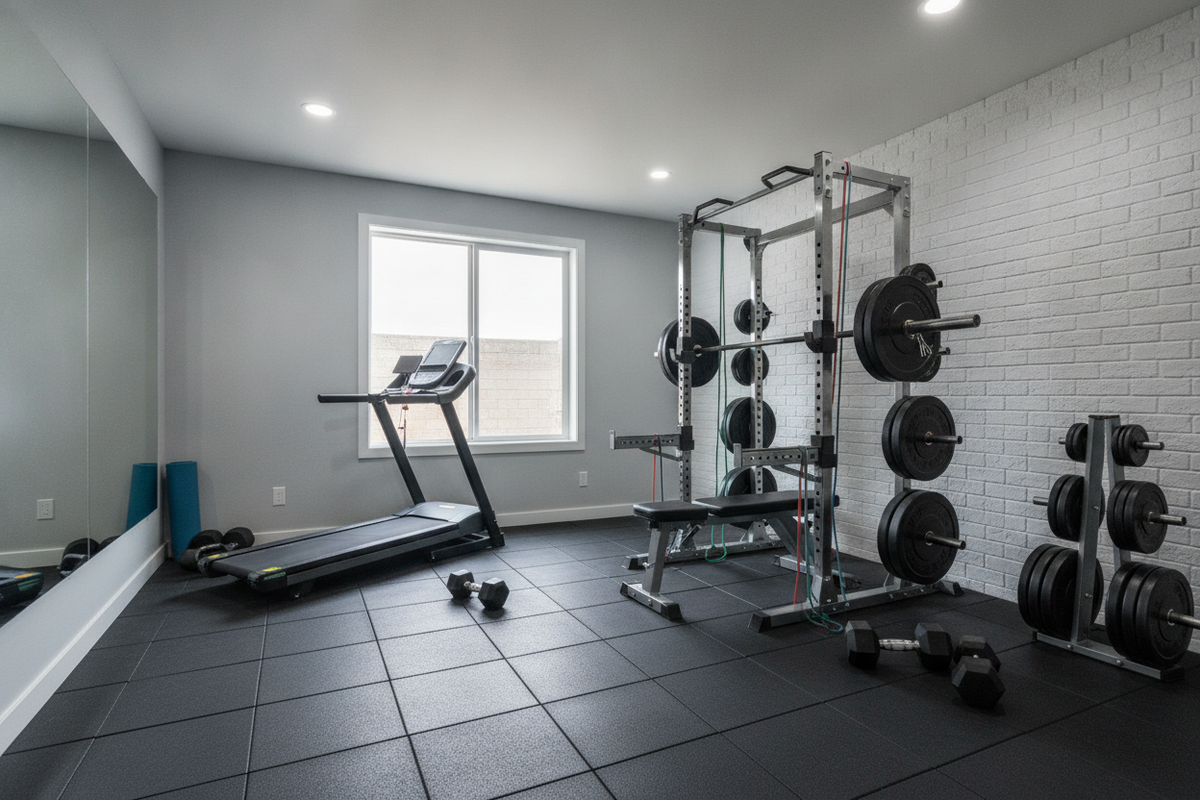
Dumbbells place concentrated, high-density point loads on domestic flooring during setup, execution, and rest transitions. Using a heavy-duty, high-density exercise workout product buffers impact forces, protects underlying tile or hardwood, and dampens vibration transfer throughout the room.
Stance Traction, Stability, and Space Safety
Dynamic lower-body movements such as walking lunges and wide-stance sumo squats require reliable surface grip. A textured, non-slip matting surface prevents foot slippage under heavy loads, providing the firm foundation necessary for confident, heavy lifts. In my own layout adjustments, maintaining a clear perimeter around the matting has always proved essential for seamless transitions between dumbbell pairs.
Common Technical Pitfalls and Practical Corrections
Even experienced lifters can fall into technical habits that compromise movement efficiency during home leg workouts:
- Collapsing Knees (Valgus): When knees cave inward during squats or lunges, glute activation diminishes. Cue pushing the floor apart and tracking knees over the outer toes.
- Rounding the Lower Back in Hinges: Loss of spinal neutrality often occurs when descending past personal hamstring mobility limits. Stop the descent once the hips stop moving backward.
- Rushing Through the Turnaround: Bouncing out of the bottom position relies on elastic rebound rather than muscular force. Pause briefly in the hole to build true strength.
By pairing strict exercise mechanics with a well-prepared training space and appropriate floor protection, a lower body dumbbell regimen delivers comprehensive strength, muscular balance, and long-term joint health.