How to Build Massive Legs With Just a Dumbbell Lower Body Workout
Let’s address the elephant in the gym: the squat rack. There is a pervasive myth in the fitness industry that if you aren't loading a barbell across your back until it bends, you aren't actually training legs. That is nonsense.
While barbells are excellent for absolute strength, they aren't the only tool for hypertrophy. In fact, a properly programmed dumbbell lower body workout can fix muscular imbalances, improve joint stability, and torch your quads and hamstrings just as effectively—without the spinal compression of heavy back squats.
If you are training at home or stuck in a crowded gym with limited equipment, this guide is your roadmap to leg growth.
Key Takeaways for Effective Leg Training
- Unilateral Focus is King: Dumbbells force each leg to work independently, fixing the strength imbalances concealed by barbells.
- Time Under Tension (TUT): Since you can't load as heavy as a barbell, you must slow down the eccentric (lowering) phase to stimulate growth.
- Grip Strength Matters: Your hands might fail before your legs do; use straps if necessary to ensure your lower body gets the full stimulus.
- Compound Over Isolation: Focus on multi-joint movements like lunges and hinges rather than small isolation lifts.
Why Train the Lower Body with Dumbbells?
It isn't just about convenience. When you train the lower body with dumbbells, you change the mechanics of the load. With a barbell, the center of gravity is often fixed. With dumbbells, the weight moves more freely, requiring your stabilizer muscles to work overtime.
The Range of Motion Advantage
Consider the split squat. With a barbell, your range of motion is often dictated by your lower back mobility and balance. With dumbbells hanging at your sides, you lower the center of gravity. This allows many lifters to sink deeper into the squat, placing a greater stretch on the glutes and quads. More stretch under load equals more muscle damage, which signals repair and growth.
The Essential Movement Patterns
Don't overcomplicate this. To hit every muscle fiber in your legs, you need to cover three main movement patterns: the Squat, the Hinge, and the Lunge.
1. The Anterior Load: Goblet Squats
This is your bread and butter. By holding a single dumbbell at chest height, you force your core to engage to keep you upright. This front-loaded position acts as a counterbalance, allowing you to squat deeper with a more vertical torso than you likely could with a bar on your back. It targets the quads mercilessly.
2. The Posterior Chain: Romanian Deadlifts (RDLs)
You cannot build legs without hamstrings. The Dumbbell RDL is superior for learning the "hinge" pattern. Keep the dumbbells close to your shins, push your hips back until you feel a deep stretch in the hamstrings, and then drive forward. Keep your back flat; if it rounds, you've gone too low.
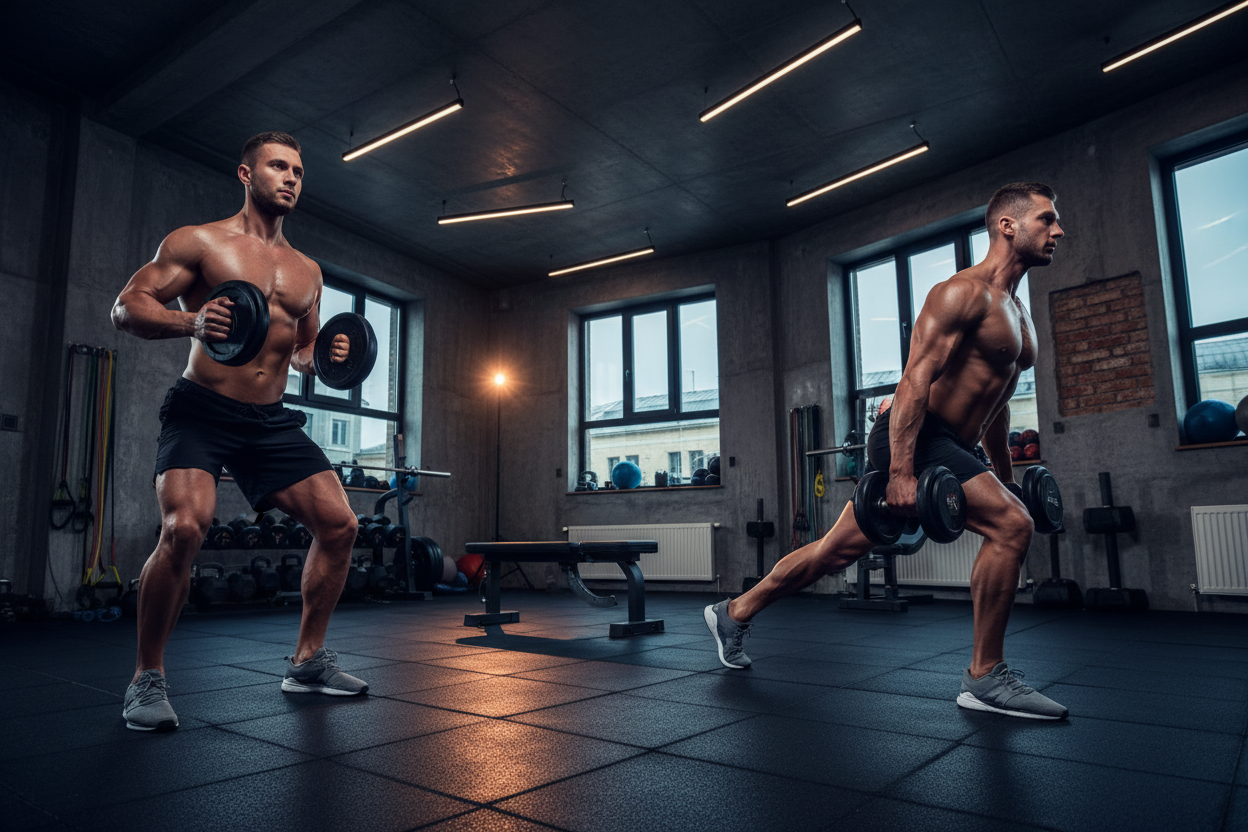
3. The Unilateral Stabilizer: Bulgarian Split Squats
This is the movement everyone loves to hate. By elevating your rear foot and holding dumbbells, you place nearly 100% of the load on the front leg. It is humbling. You will not need heavy weight here to feel a burn that lasts for days.
Crushing a Lower Body Workout at Home with Dumbbells
The biggest challenge with a lower body workout at home with dumbbells is usually a lack of weight. If you only have a pair of 30lb weights, how do you keep progressing once that becomes easy?
Manipulate the Tempo
Stop counting reps and start counting seconds. Instead of bouncing out of the bottom of a squat, take 4 full seconds to lower yourself. Pause for 2 seconds at the bottom. Explode up. This increases the "time under tension," making light weights feel incredibly heavy.
Pre-Exhaustion Techniques
If your heavy compounds are too easy, tire the muscles out first. Perform a set of isolation exercises (like dumbbell leg extensions or lying hamstring curls) immediately before your main squats. Your quads will be screaming with half the usual weight.
My Training Log: Real Talk
I want to be honest about the reality of high-volume dumbbell leg days. A few years ago, I didn't have access to a gym for three months, so I relied entirely on a pair of adjustable dumbbells in my garage.
The first thing I noticed wasn't leg fatigue—it was my grip. During high-rep RDLs (sets of 15+), the knurling on the metal handles started to feel like it was shredding my palms long before my hamstrings gave out. I remember having to buy a cheap pair of lifting straps just to finish the workout. Without them, I was leaving gains on the table because my forearms were the weak link.
Also, there is a specific, awkward "waddle" you have to do when setting up for heavy lunges. getting 80lbs into position without banging your knees is an art form in itself. But I will say this: after 12 weeks of that program, my knee pain from heavy back squatting had completely vanished, and my quad separation was better than ever.
Conclusion
You do not need a gym membership to build impressive legs. You need intensity, focus, and a pair of iron weights. By focusing on unilateral movements and controlling the tempo, a dumbbell lower body workout can rival any machine-based routine. Grab the weights, check your ego, and get to work.
Frequently Asked Questions
Can you really build mass with just dumbbells?
Absolutely. Muscle hypertrophy occurs through mechanical tension and metabolic stress. As long as you are nearing failure in your sets and progressively overloading (adding reps, weight, or slowing tempo), your muscles will grow regardless of the tool used.
How heavy should my dumbbells be for legs?
Legs are strong muscle groups. Ideally, you want weights that allow you to reach muscle failure between 8 and 15 reps. If you can easily do more than 20 reps, the weight is likely too light for optimal strength gains, and you should adjust your tempo or rest periods to increase intensity.
Is this workout safe for bad backs?
Generally, yes. Dumbbell leg workouts are often safer for the lower back than barbell squats because the weight is not compressing the spine directly. Exercises like Goblet Squats actually encourage better posture and core stability, which can help protect the back.